


Five Novembers ago I posted a short announcement: “A Mostly Weekly Review of Remarkable Reading.” It was my very first post on Miller’s Book Review, though not much of one, just an announcement of what was to come. Since then, I’ve published 465 articles—more than three-quarters of a million words.
Thanks to your ongoing interest, the newsletter boasts 12,594 subscribers, which honestly flabbergasts me. I can’t begin to express my gratitude that you’re here and reading. By way of comparison, my first regular review, “We Know Far Less than We Think—And That’s OK,” on Michael Blastland’s The Hidden Half, went out on January 1, 2022, to 66 subscribers—most of whom knew less about how this thing would grow than I did, and I knew almost nothing.
After spending a couple of days with the data, I now know something. I thought I’d share that with you.
Growth Spurts
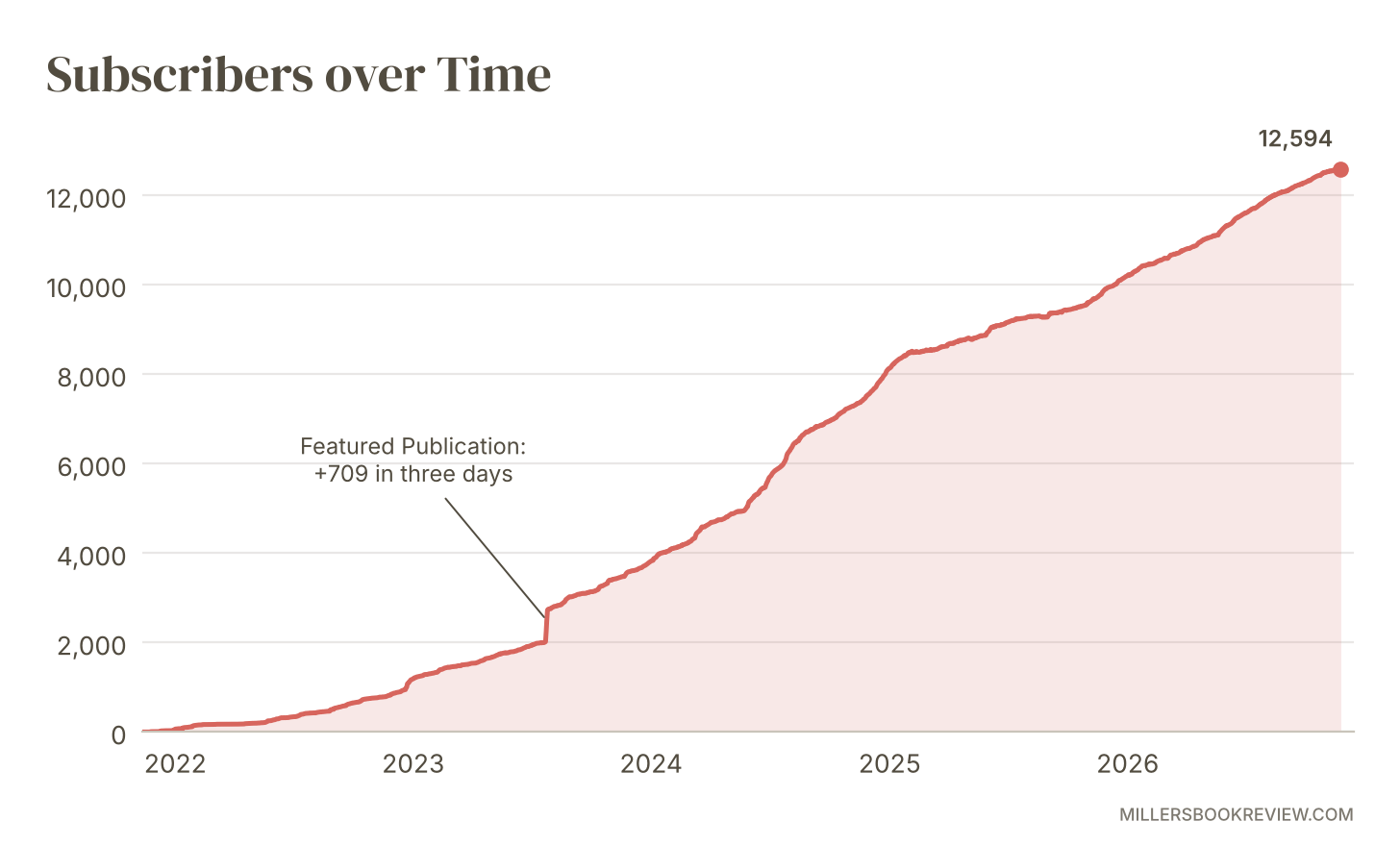
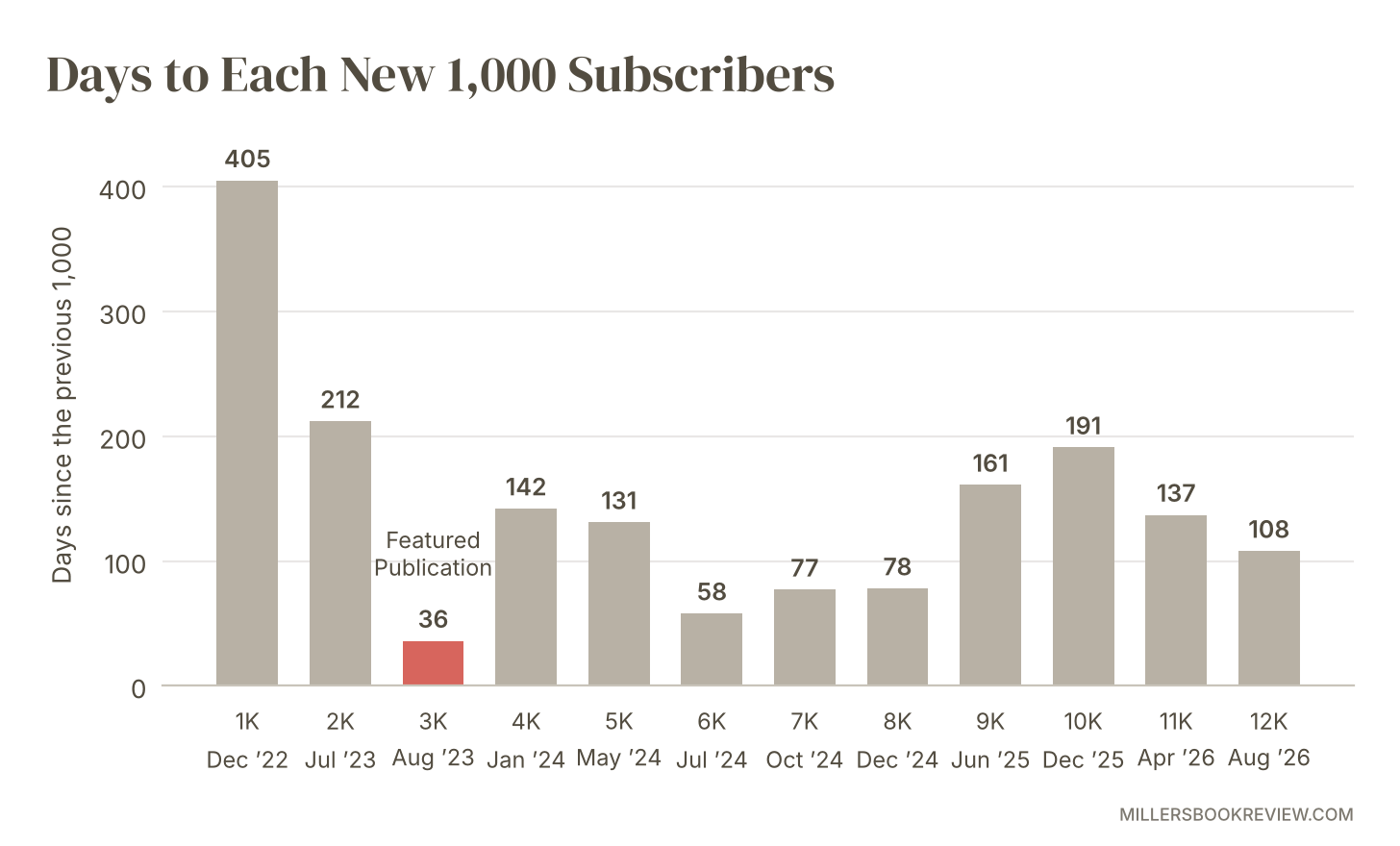
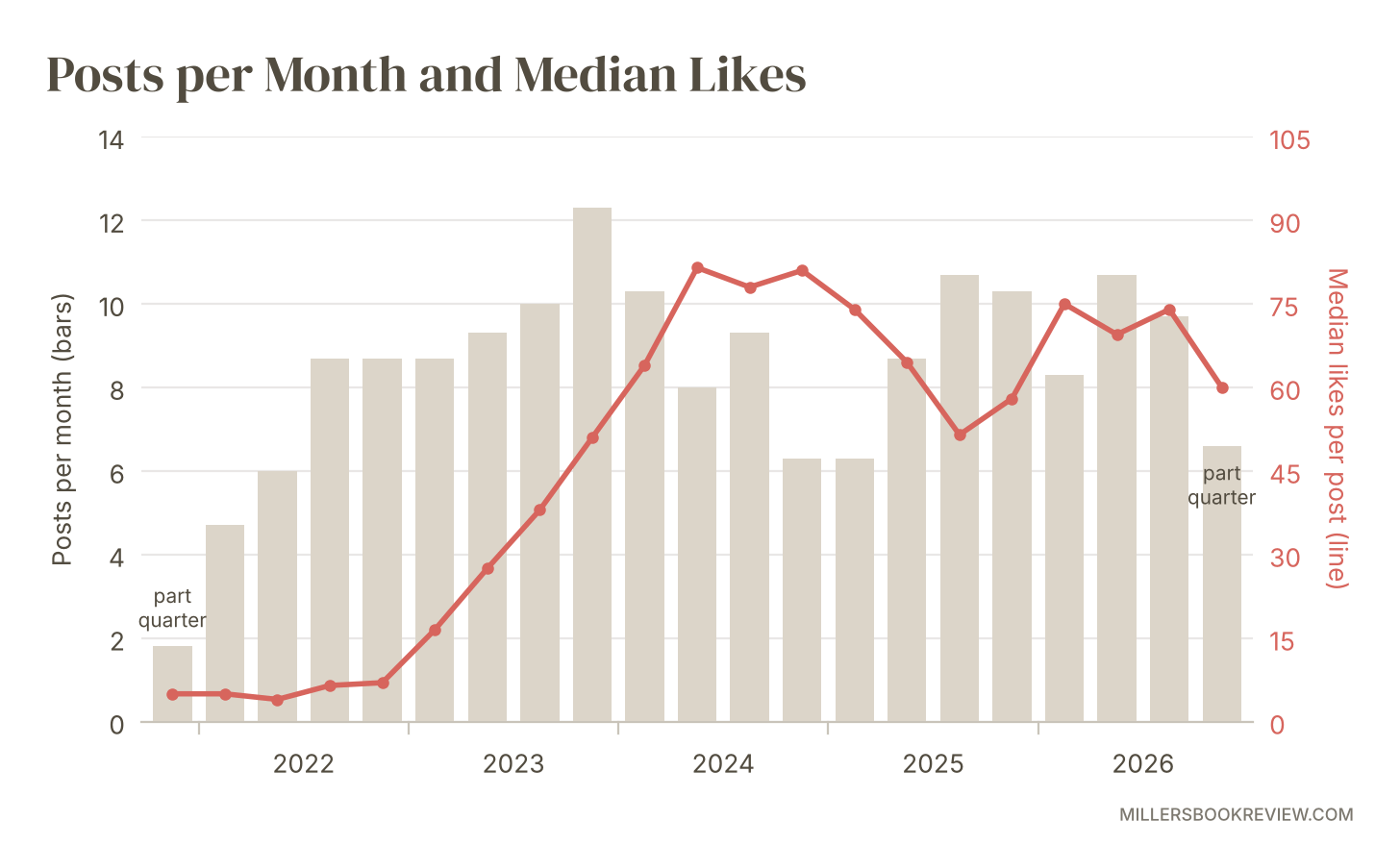
At first, I had no expectations, which was good because almost nothing happened the first half of 2022. Then by summer the subscriber count started edging upward. I added just over a thousand subscribers in 2022 and started 2023 with 1,190 and a median of six likes per post (measured over the previous twelve months). Then things accelerated. Subscriber count crossed 5,000 on May 26, 2024, with a median of 52 likes per post, and 10,000 on December 12, 2025, with a median of 61.1
The three biggest single-day subscriber gains came July 24–26, 2023, right after I published “Actually, Try Reading Several Books at Once.” That’s when Substack named MBR a Featured Publication—to my continuing surprise and appreciation. I have no idea what triggered that recognition, but I remain profoundly grateful. That led to my single best year for growth, 2024, when the list grew by 4,319. In 2025, it grew by half that; you can see the slope gentle out. No more Dramamine required, but thankfully still headed up.
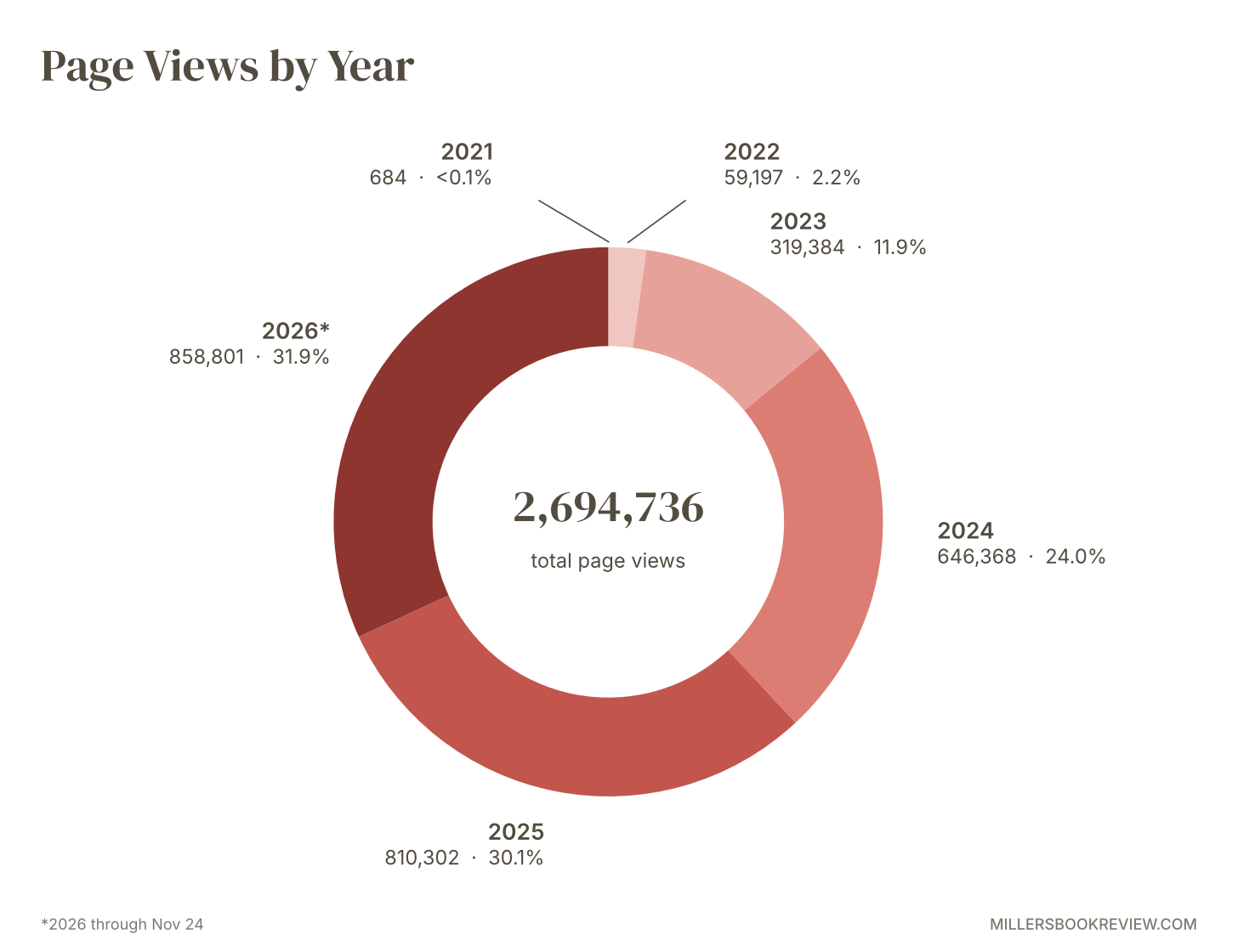
Page views tell a similar story at a bigger scale: 59,197 total in 2022 and 858,801 so far in 2026, for 2.7 million since the start—which is bonkers. The best month was April 2026, with 114,523 views, owing mostly to one single post that brought in 27,704 views all by its lonesome: “No, Books Are Not Remotely Too Expensive.”
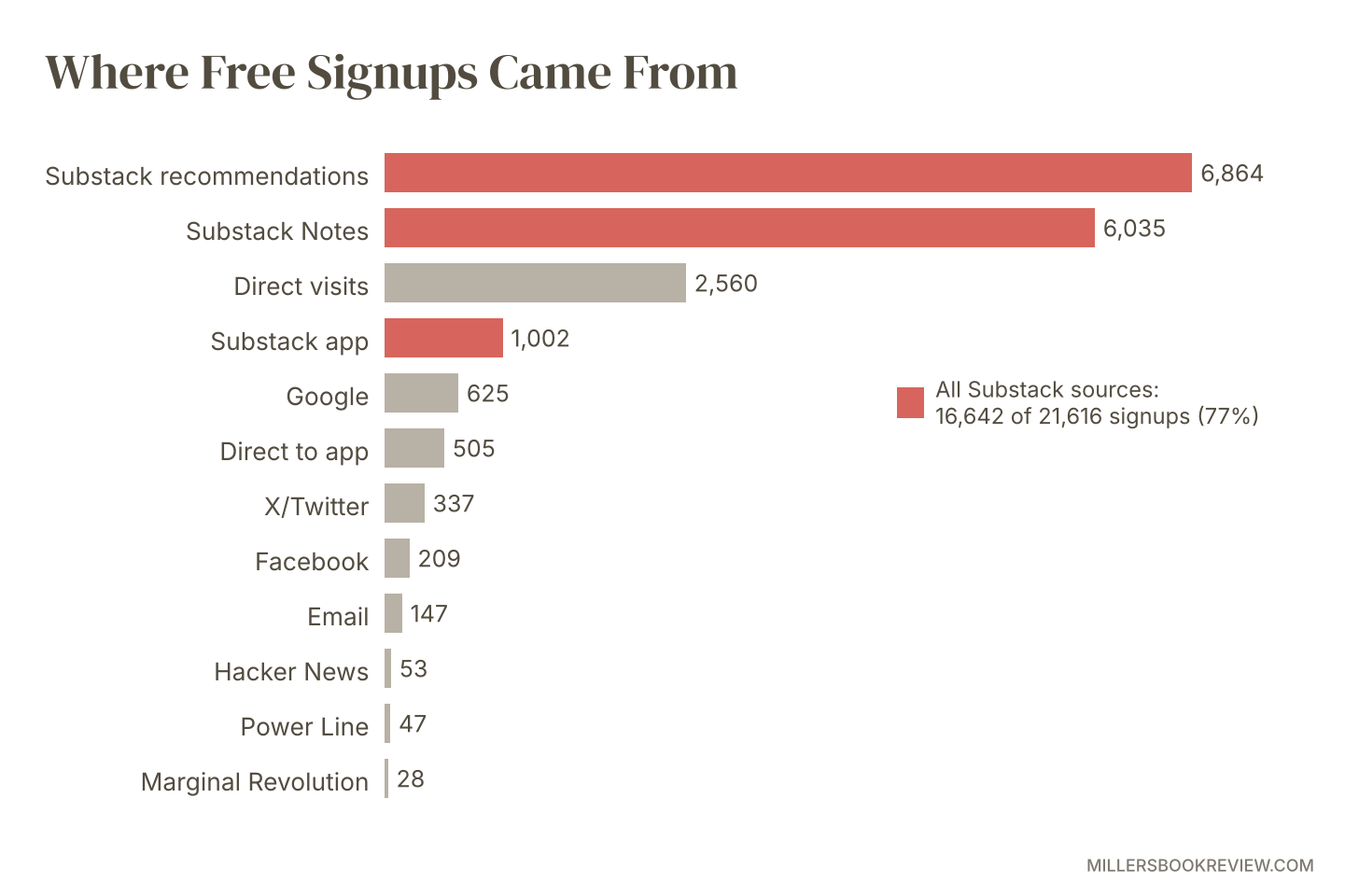
What accounts for the growth? Not surprisingly, most of it has come from inside Substack, so kudos to Chris Best and Hamish McKenzie for keeping things bitchin. The Substack network accounts for 16,642 of the 21,616 signups I’ve ever had—a whopping 77 percent of the total, led by recommendations (6,864) and Notes (6,035).
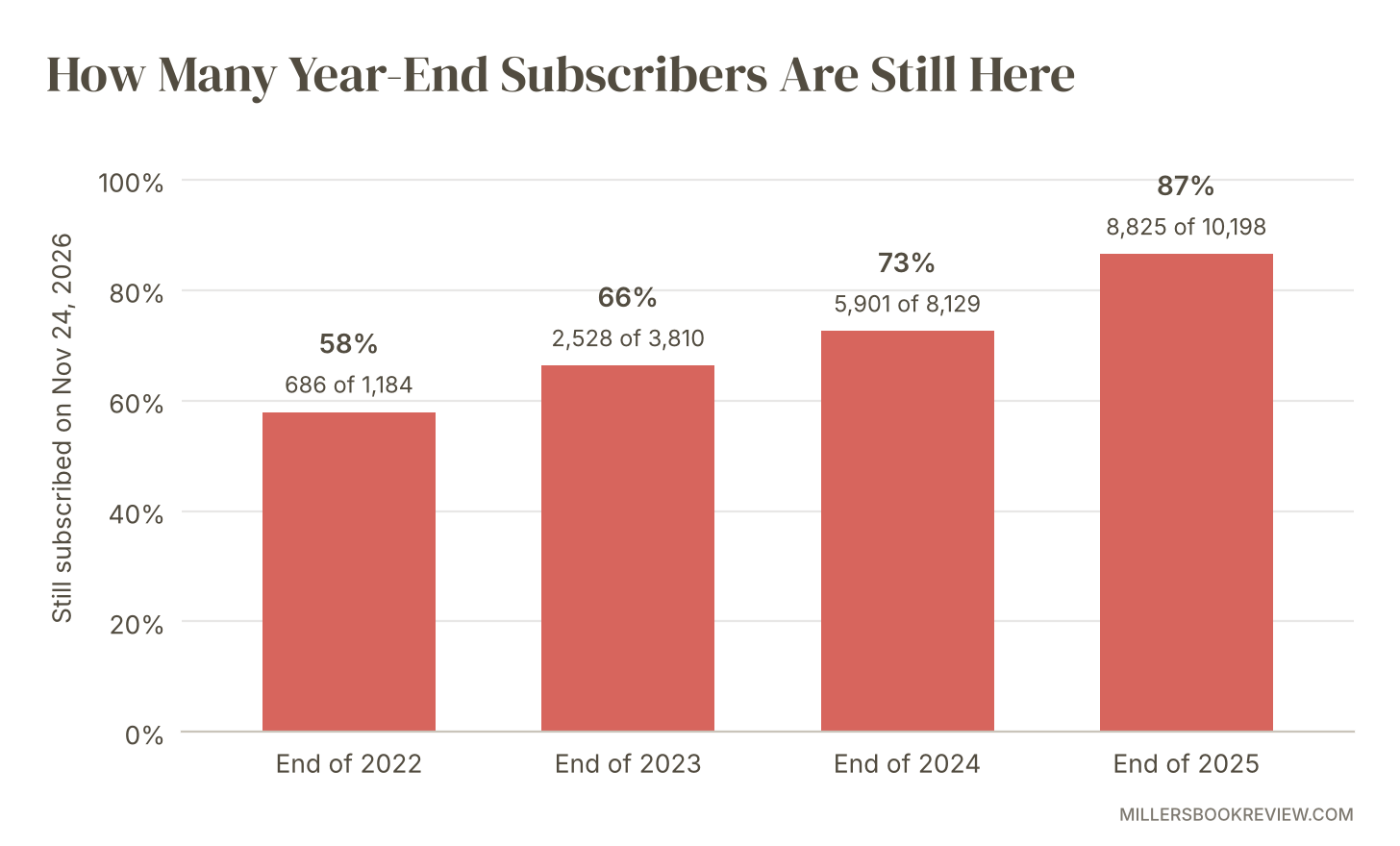
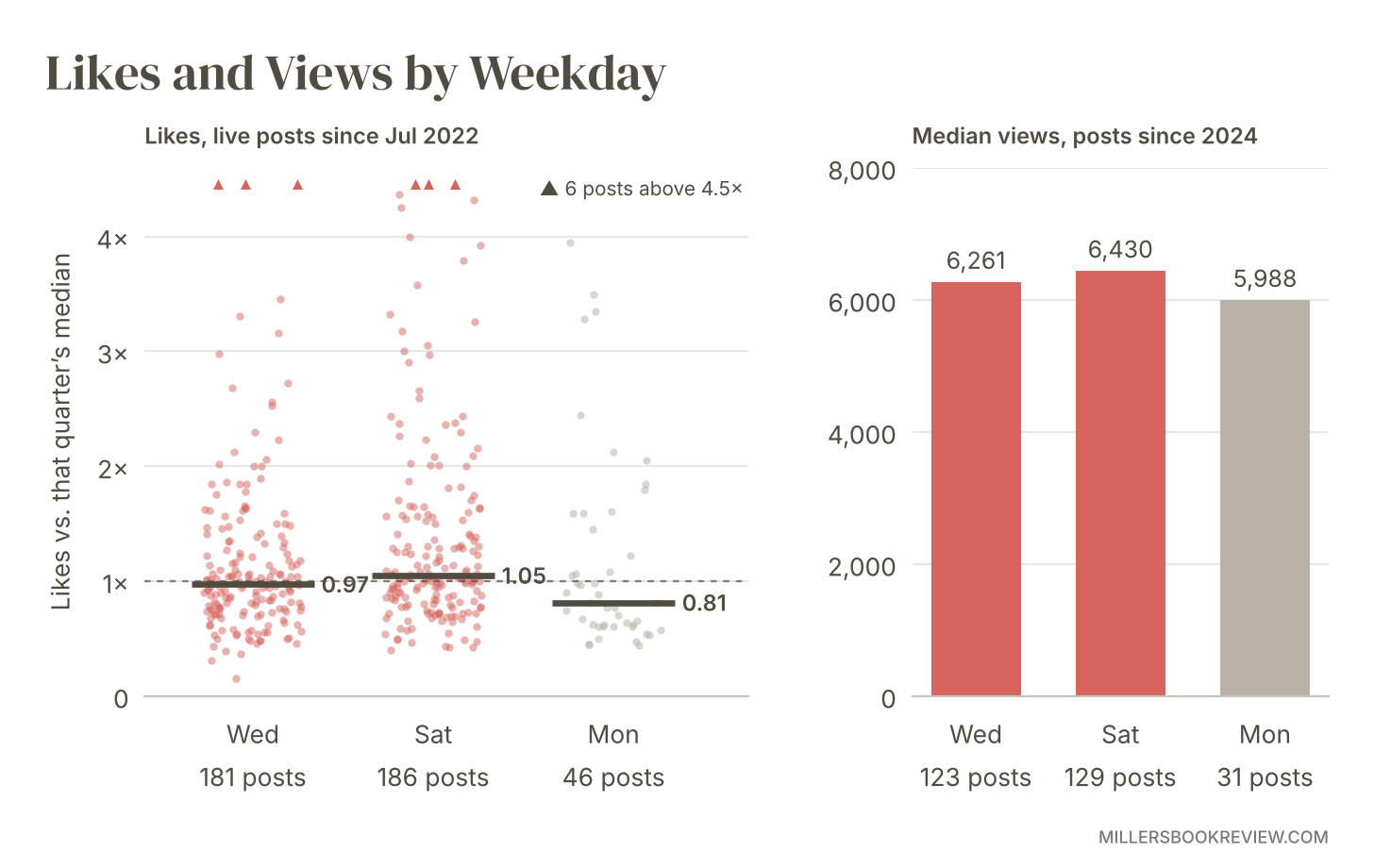
You’ll notice that number is significantly bigger than my current count; that’s because readers drop off. I’ve got a 58 percent lifetime stick rate—12,594 of 21,616 total signups are still subscribed. I actually lose subscribers every time I post. Net signups run around 6–11 per day on other days, but average 1.4 and 0.9 on my primary publishing days, Wednesday and Saturday. Obviously, I’m not for everyone, and every time I post I remind some subscribers of the fact. Bye, Felicia. Was it something I said? God only knows.
To show you how powerful recommendations have been, compare those 6,864 signups from internal traffic to external sources. In five years, Google has sent just 625 subscribers. (Can you look into that, Sergey?) The social media site formerly known as Twitter has sent 337, despite my having over eight thousand followers there. (Can you look into that, Elon?) And Facebook, just 209. (Zuck?) Not that I’m complaining! I’ll take any and all from wherever they come.
Readers now come from all 50 states (“I’m bad, I’m nationwide”—ZZ Top) and 141 countries (“Around the world, around the world”—Daft Punk). My top five states for subscribers are:
California (867)
Texas (729)
New York (575)
Florida (427)
Georgia (342)
What about followers vs. subscribers? I sometimes see people gripe that their follower count climbs while their subscriber count stalls. (Confession: I didn’t even know to look at this number until recently. Despite what you see here in this post, I’m fairly incurious about most of my stats. I’d rather be writing.) But here’s what I know: as of this morning, I’ve got 23,817 total followers—significantly higher than my subscribers. But, regardless of who gets my emails, I know some scattershot number of this larger list tends to see my Notes. And Notes are responsible for driving beaucoup signups. So I guess I’m thrilled with that number.
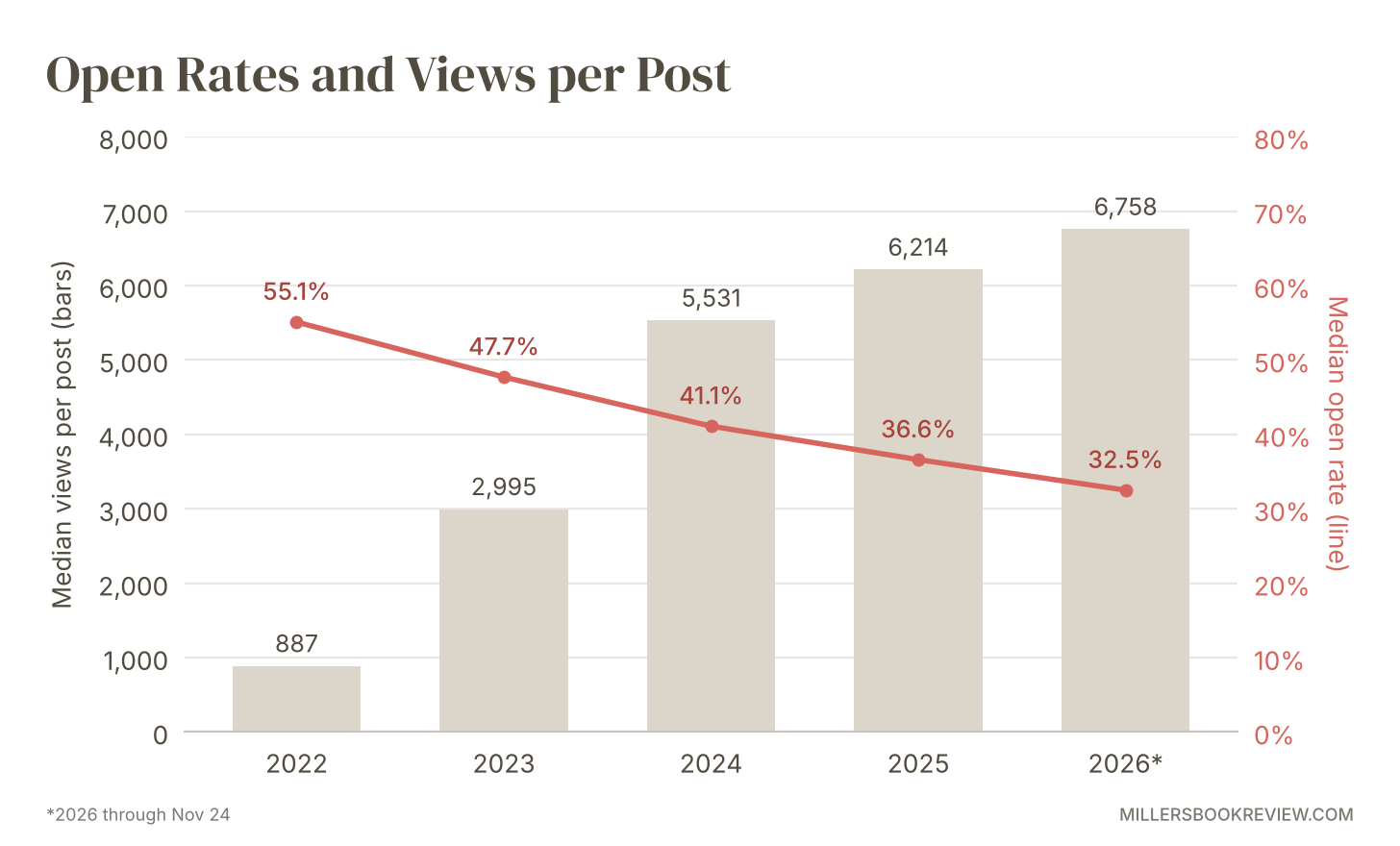
Here’s a humbling number: the share of subscribers opening any given email has slid from 55 percent in 2022 to about 33 percent this year. But the typical post now gets 6,758 views, up from 887, so far more eyeballs overall. (If any of you have any suggestions on re-engaging cold email subscribers, I’d love to hear your thoughts.)
Like what you’re reading? Subscribe, and new posts will ride an electron rollercoaster directly to your inbox twice a week. Free subscribers get two-week open access to every post; paid subscribers get the run of the archive, plus bonus content.
Show and Tell
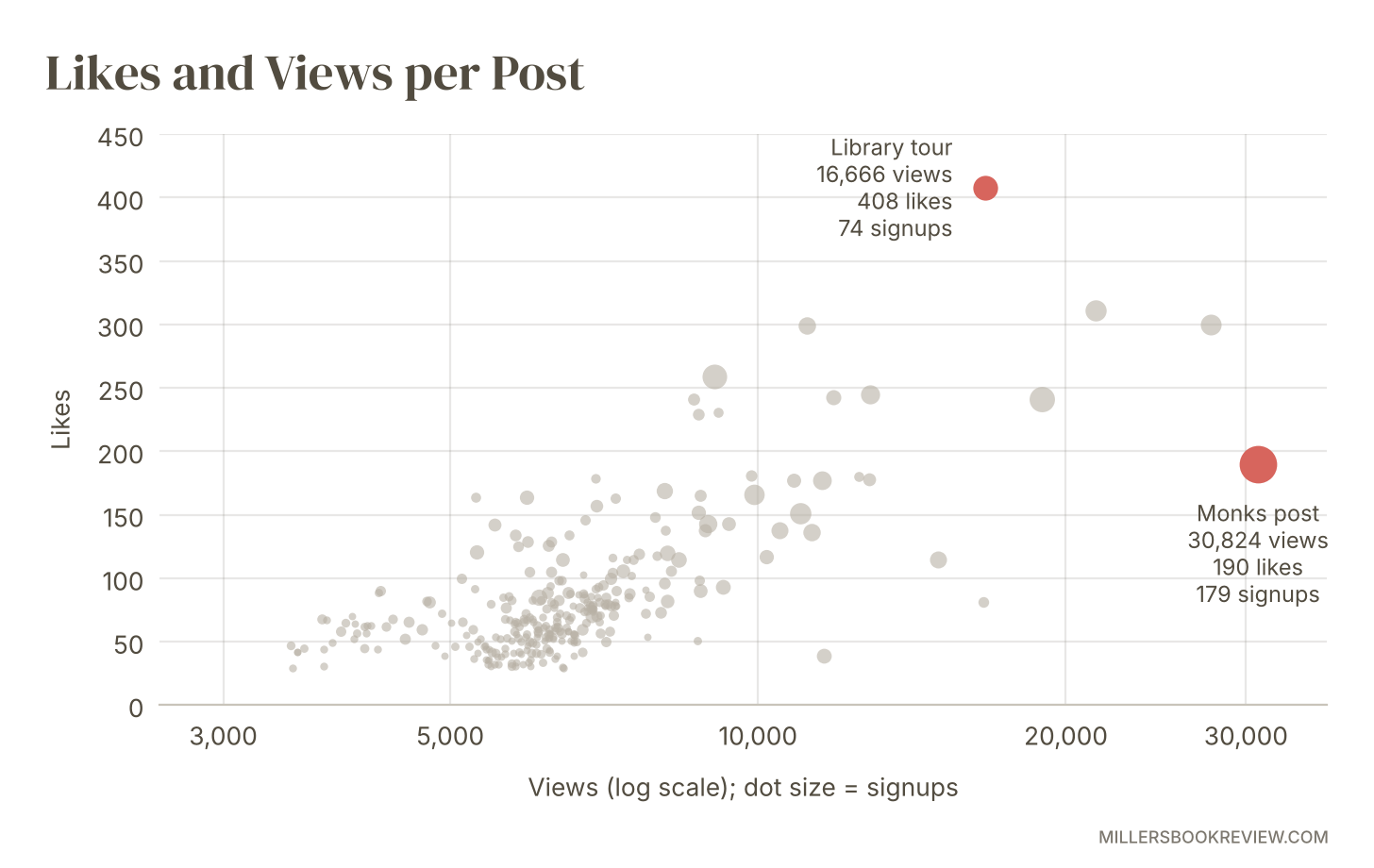
What do readers respond to? My most-viewed post has been “What Monks Know about Focus,” a review of Jamie Kreiner’s translation of fifth-century monastic John Cassian (30,824 views). Good book, but go figure. That’s followed by:
“No, Books Are Not Remotely Too Expensive” (27,704),
“Against Paul Kingsnorth’s ‘Against the Machine’” (21,364),
John Stamps’s guest review “Worth Every Ruble: Katz’s ‘Brothers Karamazov’” (19,105),
“Actually, Try Reading Several Books at Once” (19,034), and
“What’s the Big Deal about ‘Middlemarch’?” (18,961).
The most-liked post? It’s the tour of my library, “How Do You Organize 3,000 Books?” with 408 likes.
As far as I can tell, three kinds of posts do well, generally. First, any hand grenade tossed into the reading-crisis discourse or adjacent concerns. Posts on literacy, publishing, and the like represent only 18 out of 465 posts, but they have a median of 86 likes. My Bookish Diversions roundup posts, by comparison, have a median of 32.
And the hand grenades get shared; my five most-restacked posts are: “No, Books Are Not Remotely Too Expensive,” “Against Paul Kingsnorth’s ‘Against the Machine’,” “The Quiet Collapse of Reading,” “Protesting the Decline of Reading,” and “Before You Panic About That Atlantic Reading Piece.” Depending on how you look at it, four of those five deal with aspects of the same topic.
Second, posts on the reading life itself: personal libraries, reading several books at once, best-of lists, and so on. “Why Build a Personal Library?” brought in 130 signups on its own, second only to the monks post’s 179. This was a tremendous boost because it came in February of 2023, months before the big surge.
Third, reviews of classics, such as Middlemarch and The Brothers Karamazov. MBR readers are enthusiastic readers of the classics or aspire to be. Here’s a sampling of the interest readers show in these pieces.
Dostoevsky, The Brothers Karamazov (19,105 views, 63 signups, 83 likes)
George Eliot, Middlemarch (18,961 views, 78 signups, 241 likes)
Ray Bradbury, Something Wicked This Way Comes (16,601 views, 8 signups, 81 likes)
F. Scott Fitzgerald, The Great Gatsby (15,011 views, 31 signups, 115 likes)
John Steinbeck, East of Eden (11,554 views, 39 signups, 177 likes)
Kurt Vonnegut, Slaughterhouse-Five (10,198 views, 20 signups, 117 likes)
Bram Stoker, Dracula (8,737 views, 11 signups, 229 likes)
Dostoevsky, The Brothers Karamazov, my self-interview about finally finishing it (8,228 views, 9 signups, 106 likes)
Philip K. Dick, The Man in the High Castle (7,438 views, 2 signups, 115 likes)
Pär Lagerkvist, Barabbas (7,000 views, 4 signups, 81 likes)
If I were smart, I’d only review classics. Alas, I was dropped as a child.
MBR has mostly been me from the start, but not exclusively. When I see something I like on X or Notes that piques my interest, I sometimes ask the writer if they’d be willing to work up a guest post. So far I’ve run 24 guest posts by 15 writers since 2023, most of them since 2024. John Stamps’s Karamazov review is still the fourth most-viewed post on the site. Karen Swallow Prior’s “My Books Needed a House of Their Own” drew 241 likes, and Shemaiah Gonzalez’s “1 Mom, 2 Boys, and a Big Classic Novel” drew 164. I’ve also been pleased as punch to feature Jordan M. Poss, Suzanne Smith, adam hill, Alan Cornett, Lucy S. R. Austen, Bethel McGrew, Renee Hale, Jeff Goins, Nate Marshall, Latayne Scott, Conor Broll, and John Wilson.
MBR readers like to talk to each other. In the fall of 2023, I started doing Open Thread posts about questions I found interesting, asking y’all to weigh in. And weigh in you did (and do). Those posts consistently produce the longest comment sections on the site. “Open Thread: 100 Best Novels, Seriously?” drew 350 comments, and the answers became “100 Novels MBR Readers Would Die on a Hill For,” a crowdsourced list of the best novels in English, which racked up 11,856 views.
My favorite part of the Open Thread posts is the exchanges you all have amongst yourselves. It’s quite a joy to lurk in my own thread and see what y’all are getting up to. I’m also, I have to say, grateful for the fun and irenic exchange of ideas; in all the years of this publication, I’ve only ever blocked a handful of commenters for unnecessary jackassery.
Travelogue
Some of these posts have traveled much farther than I would have guessed. In April I published “No, Books Are Not Remotely Too Expensive,” initially irked by a post on X where someone was griping about the price of books. According to my banker, I buy too many, so if anyone should be complaining, it’s me. But no. I think the claim is nonsense. Among other data points, I compared what hardcovers cost in the early 1960s, adjusted for inflation, with what they cost now.
That same day, MBR reader and writer Barbara G. Tucker posted a rebuttal. Two days later Tyler Cowen linked to the post in Marginal Revolution, and then it reached Hacker News, where it drew 140 points and 210 comments—not all of them convinced. (“To be fair, this article is partially true,” one commenter generously allowed.) The next day Emily Starr Kwilinski of Slant Books shared it on LinkedIn, thanking me for “articulat[ing] these realities so clearly.” And then, James Marriott wrote about it in Cultural Capital: “Miller points out that relative to almost every other form of entertainment books are remarkably cheap.”
All of that happened in six days.
It wasn’t the first time. Cowen had linked MBR twice before, to my post on AI and the humanities in August 2024 and my conversation with Cynthia L. Haven that November. On Hacker News, MBR posts have been submitted at least 30 times, which is highly gratifying. To whoever keeps plugging my work there, thank you! Same with Micah Mattix and Prufrock, which has featured several pieces, and whoever’s running the show at RealClearBooks; they’ve run five MBR essays so far.
Readers have been extremely generous in public, too. David Swindle’s list of favorite Substacks named me “The Substack Writer With the Most Consistently Excellent Writing Both in Essays and on Substack Notes” and said I was “the strongest writer I’ve found on here since joining Substack in 2022.” (Blush.) Ephie Bernstein called me “perceptive, measured, and never alarmist.” I had the pleasure of meeting Ephie in person last year and can say the same about him. And my friend Jeff Goins ended his post “How I Fell Back in Love with Reading” with a line about MBR: “It’s unmissable.”
Some of the writers I most admire on Substack have sent their readers my way. Henry Oliver at The Common Reader cited my piece on college English enrollments in 2023, calling it “a good piece about the way English enrolments are changing, and in some places increasing.” This October, Ted Gioia’s “42 Milestones in the History of Conversation” at The Honest Broker cited my post on Henry James’s The Ambassadors. And the wonderful Virginia Postrel interviewed me about how publishing works and later linked a post on AI in “Sing, Digital Muse!”
You never know where this stuff is going to go. MBR posts are even cited as sources in the Wikipedia articles on Virginia Postrel, Cynthia Haven, and Tété-Michel Kpomassie.
Probably the biggest moment like that came when Nathan Heller from The New Yorker reached out. He’d read my piece arguing that, contrary to popular views, the nonfiction market is not cratering: “Is the Nonfiction Book Crisis for Real?” Heller was working on a profile of B&N CEO James Daunt, using the occasion to take stock of reading in general. We talked over Zoom in September, a little more than a week after I had heard Daunt speak at ECPA’s C-Suite Symposium, where I presented on AI and nonfiction sales.
“The New Age of Reading” ran in the October 26 issue. The problem with reading alarmism, in Heller’s view, is that it misses what’s happening on the ground: print sales up, independent bookstores multiplying, and Daunt laughing off the decline talk as “such nonsense.” I agree. Here’s the part where I come in:
Joel J. Miller, a former book editor and the author of a book about books (“The Idea Machine”), pored over data about the ostensible nonfiction crisis on his blog, Miller’s Book Review, this year, and found what he described to me as a dubious “confirmatory pattern that everything’s going to hell in a handbasket.” The media started measuring a decline, he noticed, at the peak of the pandemic, when adult-nonfiction sales had risen to unprecedented heights. When he zoomed out on the time span, total print sales came out slightly higher than they were before the pandemic. He factored in e-books and audiobooks, and they went higher still. The picture wasn’t of a crash but of a steady, gently climbing line with an anomalous hump in the middle.
“Hey, Mom, they quoted me in The New Yorker!”
Later in the piece Heller quotes me on AI and the books most exposed to cannibalization—self-help and pop-business titles that could easily be replaced by conversations with an LLM. I followed up with my own piece on Daunt, based on his talk at ECPA: “The Daunting Art of Selling Fewer Books.” You can also read a version of my own ECPA talk here, which explains how AI could be undermining nonfiction sales and what publishers can do about it: “Books Will Never Die.”
Thanks for reading! If you’re finding this post worthwhile, please restack it, hit the ❤️ below, and share.
Consistency Counts, Mostly
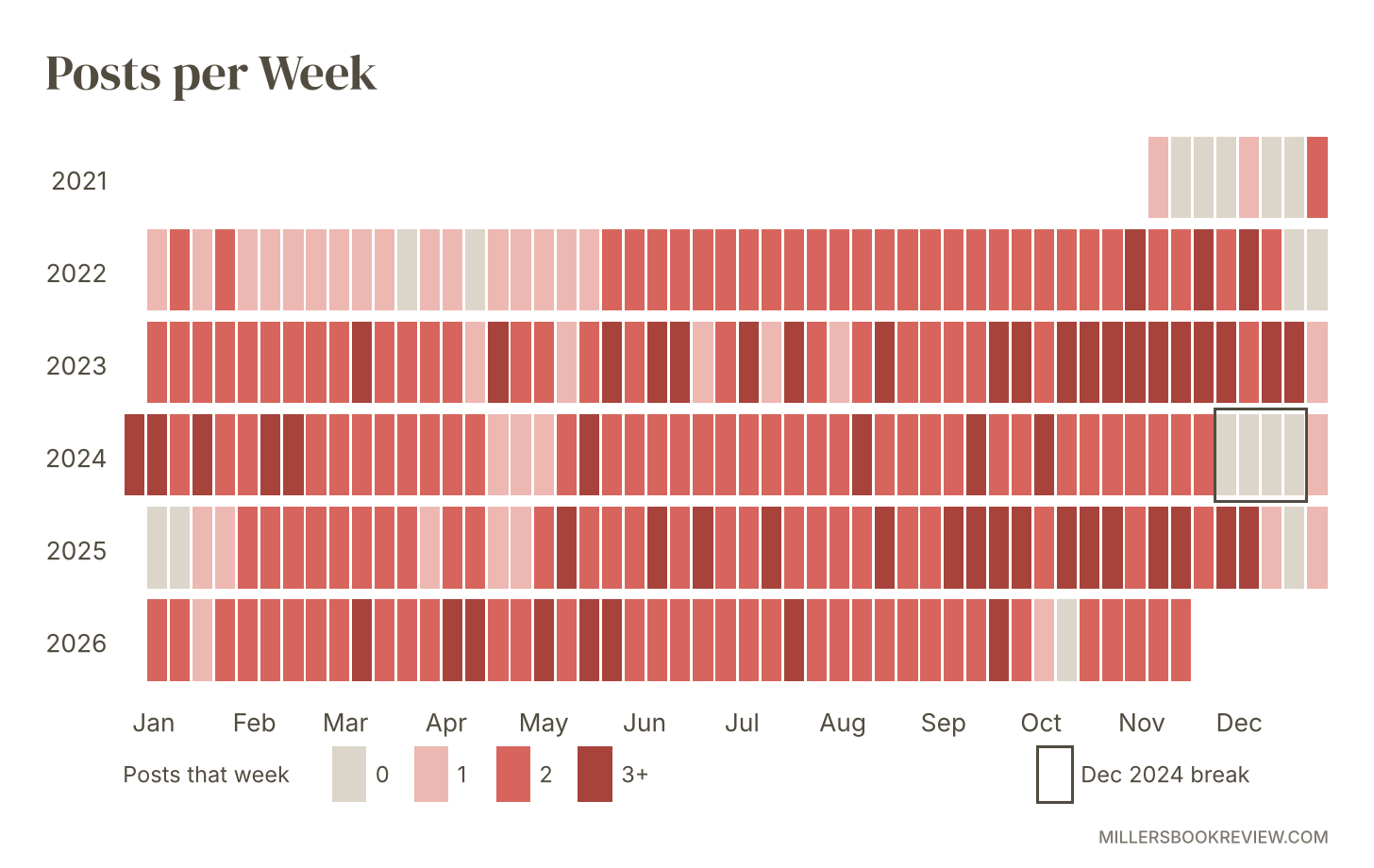
I’m undisciplined in a million ways, but I’m pretty regular at hitting that “send to everyone now” button. When I launched, I started with just Saturdays and then added Wednesdays in May 2022. As stated at the top, MBR now boasts 465 posts online and amounts to 771,496 words. So much typing. Counting the times I’ve revised and republished a post, the total actually rises to roughly 516 posts—about nine posts each month since the summer of 2022.
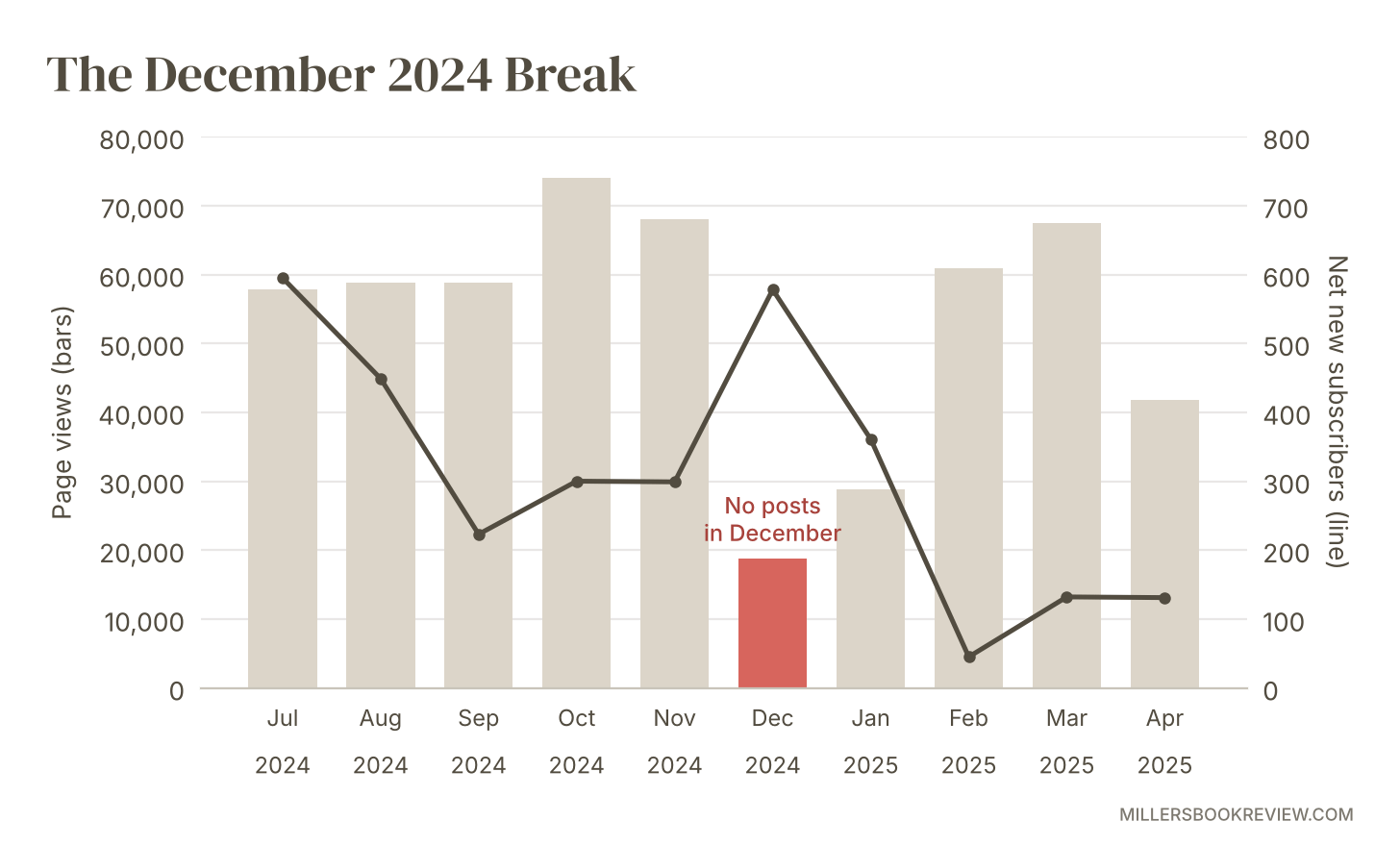
I’ve rarely missed along the way, except during some planned breaks, which I’ve announced in advance. This last October, for instance, I took a couple of weeks off to rest; summer was brutal. And I took a few weeks off from December 2024 into January 2025 to finish up my book, The Idea Machine. Here’s a chart showing my post density each week since I began.
Given that I publish midweek and over the weekend, you might wonder which day is better. I did. Turns out that it’s pretty much a wash. Even my occasional Monday posts do almost as well.
What about the correlation between post frequency and likes? There doesn’t seem to be one. Below, the bars show how often I posted, and the line shows how readers responded. For the first year or so, I was mostly talking to myself; likes barely registered; sad, as our president would say. But then they began climbing, peaking around 80 per post in mid-2024. Posting actually topped out before that, at roughly a dozen a month in late 2023, so more posting wasn’t the trick. Likes drooped through 2025 but bounced back into the 70s this year, even though my pace held pretty steady.
And now for what might be the weirdest stat in the whole dashboard: In December 2024, I took a break to finish my book. As a former full-time editor, I’m sensitive to inflicting unnecessary pain on those still in the trade. I wanted to be punctual, but I couldn’t wrap up the book and keep posting here. Ergo, hiatus time. With nothing new hitting the inbox, views fell 72 percent (no surprise), but I still picked up 578 subscribers (big surprise!), nearly twice November’s haul. Maybe I should take more Decembers off.
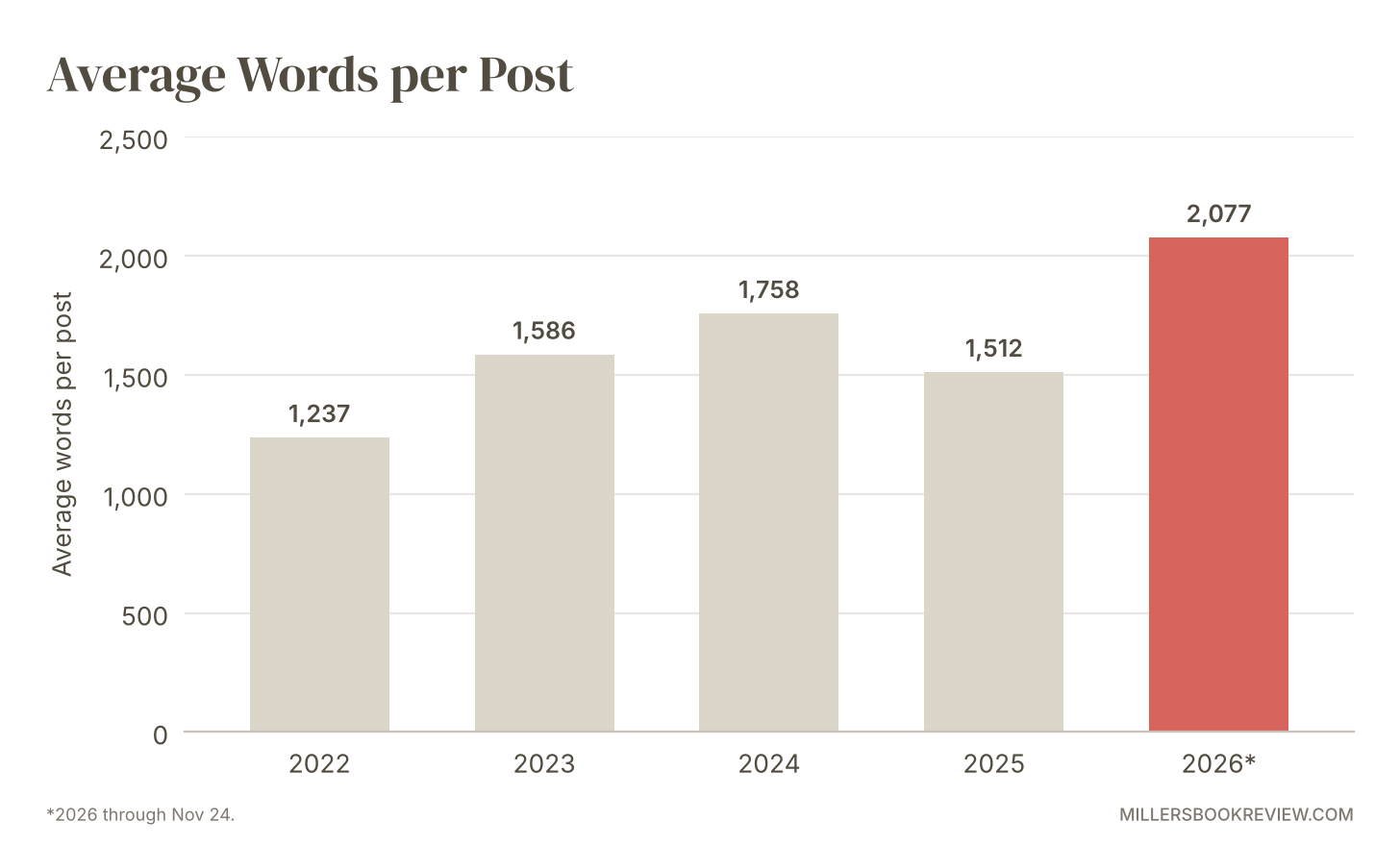
Then there’s the question of post length. I tend to write a little on the long side, and longer now than when I started. Posts averaged 1,237 words in 2022 and 2,077 this year. Interestingly, long posts contribute more to signups. My posts over 3,000 words have a median of 6.5 signups, versus 2 or 3 for shorter ones, though only 24 posts are that long. Meanwhile, the median post went from six likes in 2022 to 71.5 this year, and rank for rank, likes predict signups better than views do.
Speaking of likes, there are some posts I wish got more attention. They got about as many views as a typical post, but they didn’t get the likes. Cue the sad trombone if you’ve got one.
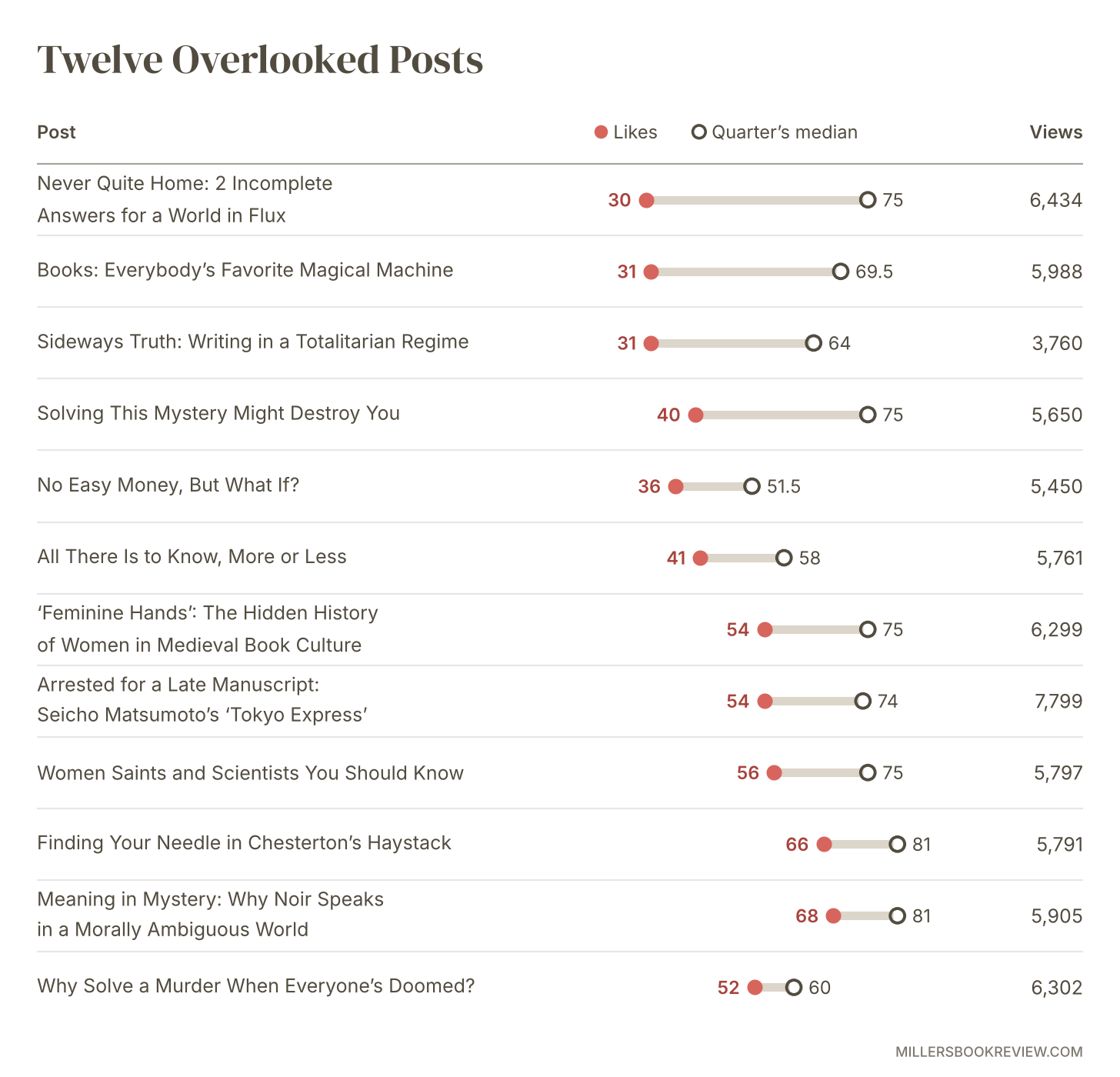
A few of these were criminally underappreciated. The “Sideways Truth” piece is about the amazing Yan Lianke—phenomenal novelist. I review two of his books and tell some of his story of trying to write books critical of the Chinese government while living in China. Here’s that review and the others if you want to give them a whirl:
“Never Quite Home: 2 Incomplete Answers for a World in Flux”
“‘Feminine Hands’: The Hidden History of Women in Medieval Book Culture”
“Arrested for a Late Manuscript: Seicho Matsumoto’s ‘Tokyo Express’”
“Meaning in Mystery: Why Noir Speaks in a Morally Ambiguous World”
And finally, some free advice—worth every penny—on growing your own newsletter.
Worth Every Penny
I see posts all the time from people on Substack about growing one’s newsletter. I mostly know nothing about this. I’ve done what I’ve done, and some of it has worked. But there might be some useful information in all this data, so here’s my best guess about what it might mean if you tried generalizing it.
Be consistent if you can. I started writing twice a week in May 2022, and since then I’ve gone a whole week without posting only ten times, and nine of those were breaks I announced in advance. I slipped to Sunday twice when I missed Saturday, and I hit send after noon five times (and again today, argh! This thing got so freaking detailed and loooong). I can’t prove that’s why the list grew, but I think consistency means readers have at least one less thing to trigger disappointment.
Make friends with the network. Recommendations and Notes account for 12,899 of the 21,616 signups I’ve ever had, about 60 percent. Google sent only a fraction of that. Whatever complaints I hear about the Substack engine, it’s worked for me. Whatever it takes work with that engine, would seem worth it—or at least worth considering.
Lob the occasional hand grenade. My posts on the reading crisis account for just 4 percent of what I’ve published, but they lead the site in likes (median 86) and hold four of the five most-restacked spots, which is how strangers stumble onto MBR. I’m not trying to follow the news. But I find people’s takes on this topic often miss details I consider important, and so every now and then I pull the pin and toss one over the fence. If you could generalize that, I’d say don’t be needlessly or excessively provocative—unless that’s your thing—but neither avoid controversy when you’ve got something meaningful to add.
Don’t be afraid of length. Write long if you think the piece deserves it. Since 2024, posts under 1,500 words and posts over 2,500 have drawn about the same median likes, 67 and 69. I don’t think readers care about length; I think they only care about what’s interesting. Nothing is too long if it’s interesting.
Write for your own amusement. I have no data to back this one up, other than whatever has happened so far, but longtime readers of MBR will know that my interests are wide, varied, and sometimes a little weird. I just write about what I find interesting, following my own whims wherever they go. I do this because it’s fun. And frankly, I think that keeps me out of a lot of trouble and keeps it fun for a wide range of readers—including you.
I’d say I’m honored beyond words, but I’ve just spilt about 4,000, so that’s obviously untrue. What I can’t fully express is how appreciative I am that you continue to open my emails and engage with my writing, commenting, liking, sharing, restacking, all of it. You’ve helped me build a pretty wonderful little community here, and I’m grateful you’re part of it.
Get a conversation going. If anything struck you, leave a comment.
By the way, teasing out some of this math, such as median likes per post, has been a little tricky because I’ve revised and republished posts from time to time, 44 in all, and that monkeys with some of the annual numbers. I had Grok Bot consult the pensieve of the internet, the Wayback Machine, and reconcile the figures. I’m guessing it’s pretty close.
Loved the article Joel! My son tells me that I spend too much time reading about reading rather than reading! Next year, that is in 30 days time, I will be starting on my year of reading books that are made of trees which also means that I should be spending less time on reading articles online, including your own. You are in fact one of the few survivors of a culling which zapped about 80% of the email posts I used to get daily. Most of those were men shouting at the government…. I enjoy your posts very much and will continue to read them with joy when I have time. I do tend to disagree with you regarding Mr Kingsnorth’s book but that's maybe because of a Bruderhof viewpoint (everything’s going to hell and we are as happy as clams because we told you so back in 1550…). Please don't think that you have to post this or anything else that I send you. But right now I am sitting with my brand new bookshelf looming behind me loaded with next year's reading. I wish you and yours a wonderful Advent and Christmas.
Your Substack is growing greatly because you inspire us to greatness. In a world of unfocused multitasking, you create in your readers a longing for the varied worlds of wonder found only in the focused escape books bring. Thank you. I hope you invite me to your high school graduation party!