

When I was a girl of about seven years old, I placed my books on a small bookcase in the finished basement of my house and opened a library where my friends could check out books. I’m not sure if my friends wanted to do this, but I wanted them to, and thus my first library was born. (I write about that library and my lifelong love of libraries in my memoir, Booked: Literature in the Soul of Me.)
While I loved the libraries of my hometown and my public schools, I loved even more having my own books and keeping them. I was one of those kids who couldn’t wait for the big box from the Scholastic Book Fair to arrive on my teacher’s desk and for the teacher to pull my order out of the box, where they would sit in a pile on the corner of my desk until the school day was over.
My library-building had just begun.
Building Libraries
Just before I graduated from college as an English major, having already been accepted into a Ph.D. program, one of my English professors retired. She invited me to her house to take many—so many—of her books. Forty years later, I still have some of those books. They have been hauled from apartment to apartment, house to house, across state lines, and they now rest in my new library. More on that in a moment.
This was the start of my professional library. As a Ph.D. student, I didn’t have a permanent office, so most of my books were at home. When my husband, Roy, built a set of floor-to-ceiling bookcases for our small home, I filled the shelves right away. When I received my first academic appointment and an office of my own, most of my books found a home in my office. As it turned out, that office wasn’t permanent either because my institution kept building and moving departments and offices. Still my books moved from office to office, being boxed and unboxed, time and time again.
Here are a just a few treasured books I own:
A pop-up book my parents got me when I was five and getting my tonsils out
The cheap paperback copy of Jane Eyre I read in high school
Ditto for Great Expectations
An abridged copy of Les Misérables in French from my high school French class.
A 1776 two-volume, first American edition of Samuel Richardson’s Pamela (given to me by professor when I completed my Ph.D.)
An 1890 leather-bound edition of The Pilgrim’s Progress by John Bunyan
1907 editions of McGuffy’s Fifth and Sixth Readers
A first edition of Harper Lee’s To Kill a Mockingbird
Antiquarian sets of books by Charles Dickens, George Eliot, and Leo Tolstoy, all given to me by friends
A beautiful Oxford University Press two-volume set of the poetry of John Donne
A first edition of T.S. Eliot’s Four Quartets, given to me by a student
A sizable collection of works by Vladimir Nabokov
It’s so nice to have these and a number of other collections finally together in one place!
By the time I finished twenty-four years of full-time teaching, half of my books were at home, and half were in my school office. Once again, at home (a different home by now), my husband had built me more floor-to-ceiling bookcases. In fact, we made one small room into a library. But even before I left my last academic position (and my last office), my books at home were piling up on the floor in the library we built in the house. Then in the spare room. Then everywhere.
When I left my last office, we hurriedly threw all the books in boxes where they sat in a trailer until we could make room for them at home. It was a big trailer.
The plan was to turn our spare bedroom into a second library. Roy started sizing things up and talking about things like “load-bearing walls” and “can’t attach a bookcase here” and “can’t attach a bookcase there,” and the dream died a little.
A Better Plan
Worried about space, I had one of my former students come over and we spent a day in the trailer sorting through all the boxes of books, putting some in boxes labeled “keep,” others labeled “sell.” My former student was as ruthless in helping me put many in the “sell” box as I needed her to be. I had about fifteen boxes marked “sell.” Most of them ended up at Goodwill.
In the midst of all this, a friend sent me one of those ubiquitous TikToks featuring a “she-shed” made into a library. “Roy needs to build one of these for you,” she said.
I showed it to my husband. “Wouldn’t you rather just build me a stand-alone library than renovate the room upstairs?” I asked, sort of kidding and sort of not. To my surprise, he said, “Yes.” As any builder will tell you, it’s easier to start from scratch than to remodel an old structure.
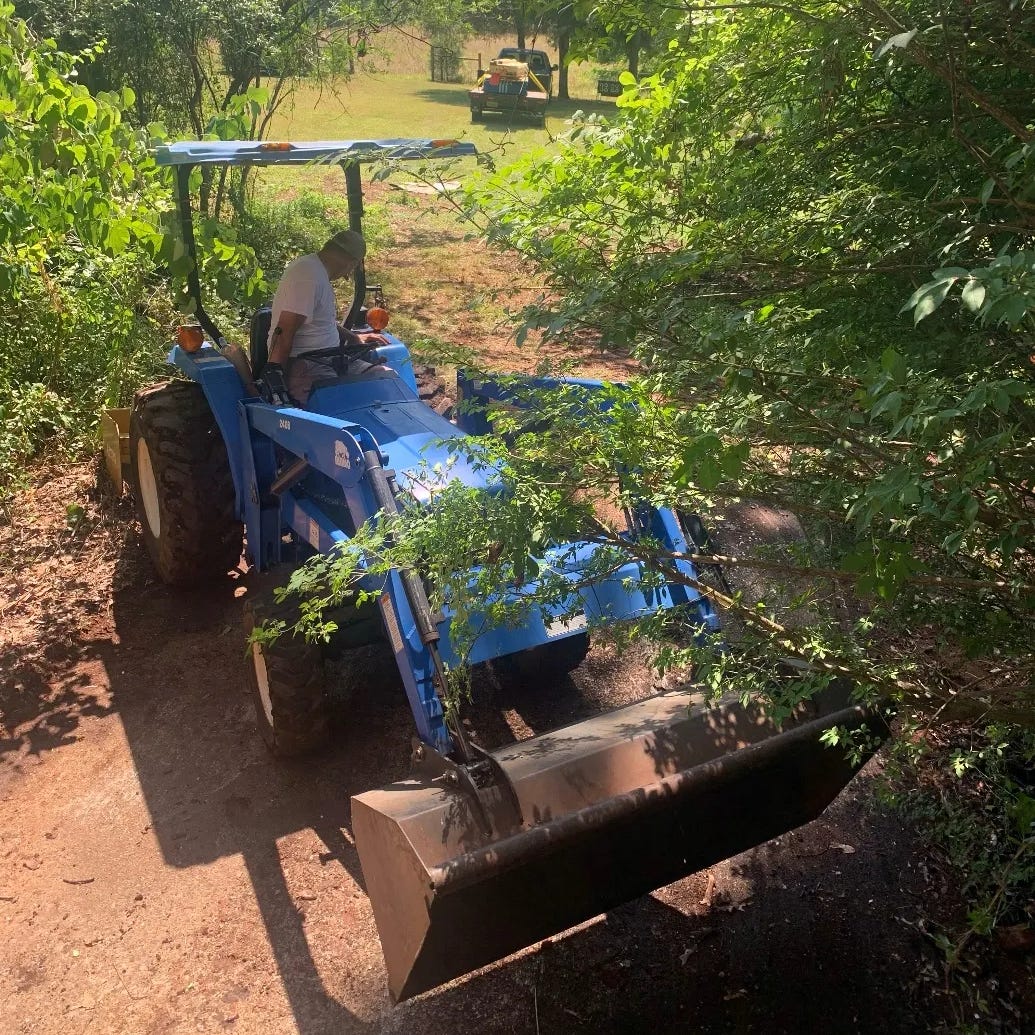
Coincidentally and conveniently, there was a large concrete slab on the side of our old house that had been used by previous owners as some kind of gardening work station. We had talked now and then about turning it into a patio of some sort, but had not done anything with yet, so it had mostly overgrown with foliage and weeds.
It was a perfect foundation for a shed. A large shed. A library.
My husband began drawing plans.
Extra Space
Now, when most people think of these shed libraries, they think of the videos showing cozy chairs or daybeds, frilly curtains, throw rugs, reading lamps, and a few bookshelves. These libraries are adorable. I get it.
But I needed shelves. Lots of shelves. Even when I had an office and more space for books, my books were never all together, so I didn’t always know if this particular book or that one was at home or at the office. I don’t even want to know how many minutes and hours I have spent looking for a book I knew I had but did not know where it was. It’s a lot. (I have a lot of duplicates for that reason.) I needed space to put my books in an organized way so I would know where they are.
Making space for a reading chair or working desk would take away precious shelf space. Moreover, my seating and workspace needs are very particular since being in an accident several years ago. And besides all that, when I work, my dogs are with me. So that requires room for me and room for them. I have plenty of places in my house for me, but not enough for my books. This library is for the books.
Because my books had never been in one location for all these years, I could only guess how much space would be needed for which categories. And now I would have not just the new library but the first one my husband built me in the house which had been long outgrown and needed to be repainted. This was all very daunting. Overwhelming, to be honest.


My husband designed and built. I picked out flooring and paint and lights and finish for the wood ceiling. That part was fun. My husband had planned to build the shelves, too, and we came up with a shelf-maximizing plan that would be aesthetically pleasing. (That wasn’t easy.) But then my husband’s school, which was undergoing a major renovation, was getting rid of some of their library shelves (solid wood, adjustable shelves), and we snagged them. My husband even surprised me completely by putting our long-discussed patio in front!
Building (and Arranging) the Priory
The physical moving and arranging of the books was the paralyzing part. (I have now estimated that my library has between 3,000 and 3,500 books. My next project will be building a digital database!)
All told, the project took more than two years. One year to build and finish (in my husband’s spare time), which was from approximately June 2024 to June 2025. It took me another year to organize and shelve the books (in my spare time).


Here are some of the steps we went through once the physical library was done.
1. July 2025. I have to empty the trailer of the boxed books because my husband needs the trailer back. I invite a neighbor kid over and we quickly unbox the books and put on the shelves in no order, just to get them unboxed and get the trailer empty.
2. August 2025. I move all the books off the shelves in my inside upstairs library into another upstairs room, stacked in piles, so my husband can repaint those shelves, and I can begin to see how many books I have in various categories and where they need to go.
3. I move all the books in my downstairs library into boxes to be moved either upstairs or into the outside library. (Did I forget to tell you I also have a very small library downstairs? That’s three separate spaces. I hope you see now why I was so overwhelmed!)
4. December 2025. I get another neighborhood kid to move the books from upstairs that need to go in the outside library out there, as well as moving the books downstairs that need to go upstairs. (Thank God for strapping young men!)
5. Now all my books are in the room (or at least the floor) where they need to be—at last.
6. I finally start to have a sense of how much space is needed for each category of books. (I will get to the categories below.) I know that the small space in my downstairs room will hold my antiquarian books because they are safest there and the aesthetics of the wood paneled room matches the books. Beyond that, I am stymied about how to divide my books between the outside shed library and the indoor upstairs library. This paralyzes me for a long time.
7. Finally, I decide to put all my novels, plays, poetry, and anthologies in the upstairs library. A friend gives me the word for this. She calls it my “leisure library.” Yes! That’s it. This means the outdoor library is my “research library.” There is some overlap, quite a bit actually, but in the end, I decide based on use and aesthetics. (Are my Norton Critical editions research or leisure? It could go either way, but I decide on leisure based on use and aesthetics.)


8. January 2026: I visit my brother in Florida and my husband paints the shelves in the upstairs library while I’m gone.
9. January 2026. I spend a winter day putting all my fiction (that takes up a wall in my upstairs library) in alphabetical order in the leisure library. That’s fun. In that same library, I group smaller collections of poetry and drama and particular, special authors (like Flannery O’Connor) on the other wall, in groups but not in alphabetical order.
10. May 2026. I enlist two former students (both English majors) to come over one day to unbox, organize, and shelve the books that are sitting in the research library. I use subject groupings because this is how I use the books and think about them. Here are the categories, roughly, not exhaustive but close:
Literary criticism
Reading (books on books and on reading)
Aesthetics, art, and beauty
Writing (technique, craft)
English literature: Old English, Middle English, Renaissance, seventeenth century, eighteenth century, nineteenth century, the novel (history and criticism), Victorian, Modern
Classical literature and philosophy
Church fathers
Virtue ethics
Philosophy
Biblical studies
Theology
Cultural criticism
Animal welfare and creation care
Vocation
Newer, uncategorized Christian living books (all lumped together for now)
11. July 2026. Roy hangs things on the wall. I place an antique chair I buy on a whim in a local shop in the corner and a little secretary desk I found online in the other corner.
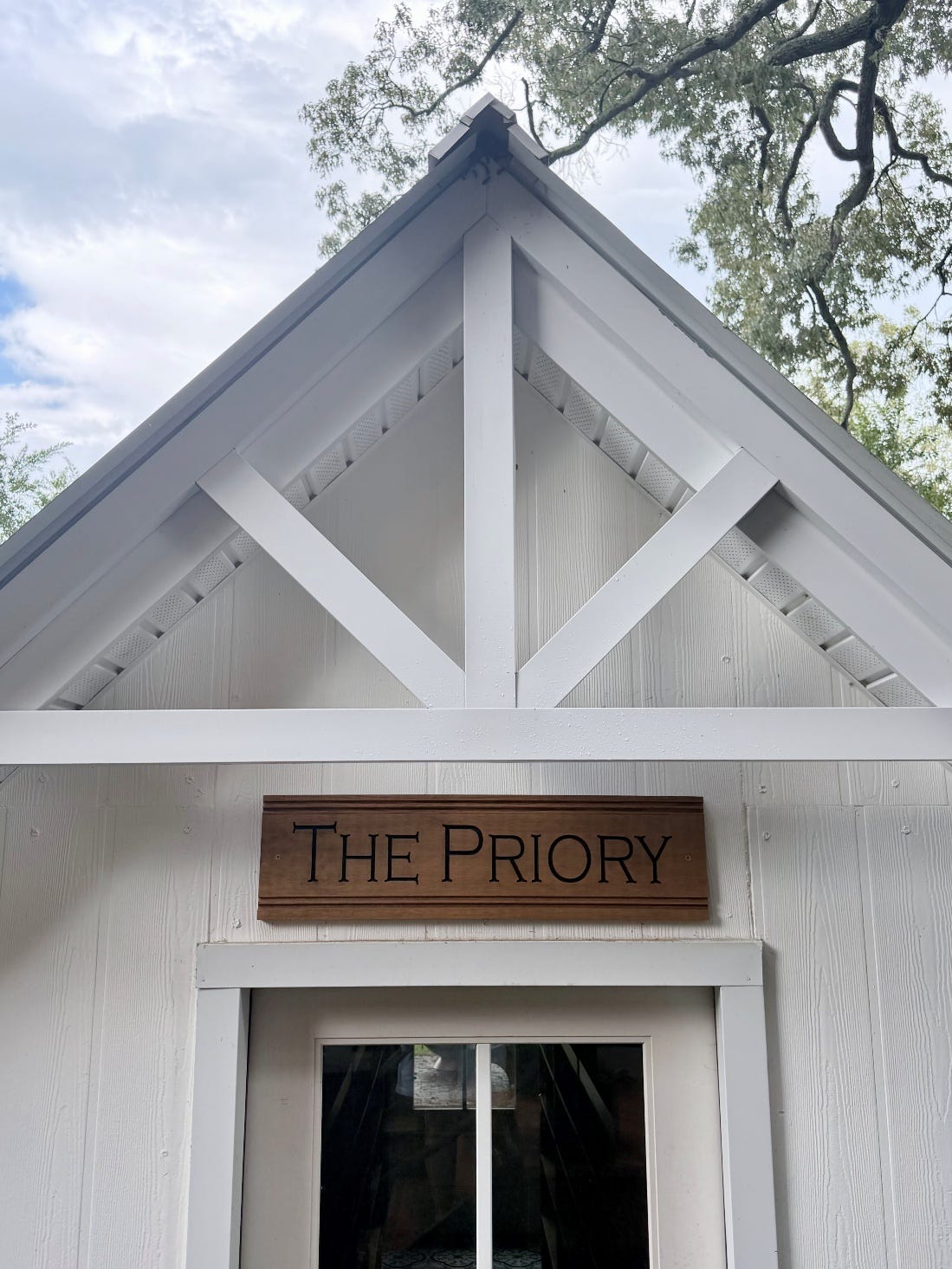
12. September 2026. Roy makes and hangs a sign above the door of my library, now named The Priory.
Welcome to The Priory. It took a village and a lifetime to make.
Like what you’re reading? Please hit the ❤️ below, restack, discuss, and share.
And consider subscribing: Free subscribers get two-week access to all new posts. Paid subscribers get the run of the complete archive, plus bonus content.
Before you go, check these out:


Here is a video tour: https://substack.com/@karenswallowprior/note/c-340774325?r=90e4e&utm_medium=ios&utm_source=notes-share-action
Thanks for telling the tale and including the pictures. Wonderful. As the owner of 3,500+ volumes — and nearing retirement — I’m hoping g to keep much of my library with me. 📚