

A well-stocked indie bookstore might carry around 10,000 titles. Then there’s Barnes & Noble, where any individual location might carry five, even ten times that number. In a pre-internet era, massive inventories conferred a competitive advantage. More selection meant customers were more likely to find what they were looking for. How could smaller shops compete? In the 1990s Barnes & Noble swept the land, putting indies out of business.
In 1998, Tom Hanks and Meg Ryan dramatized the Darwinian struggle in You’ve Got Mail, where Hanks’s massive book chain Fox Books opens a location near Ryan’s quaint Shop Around the Corner, soon to shutter its doors as its customers, dazzled by wider selection, migrate to the evil competitor.
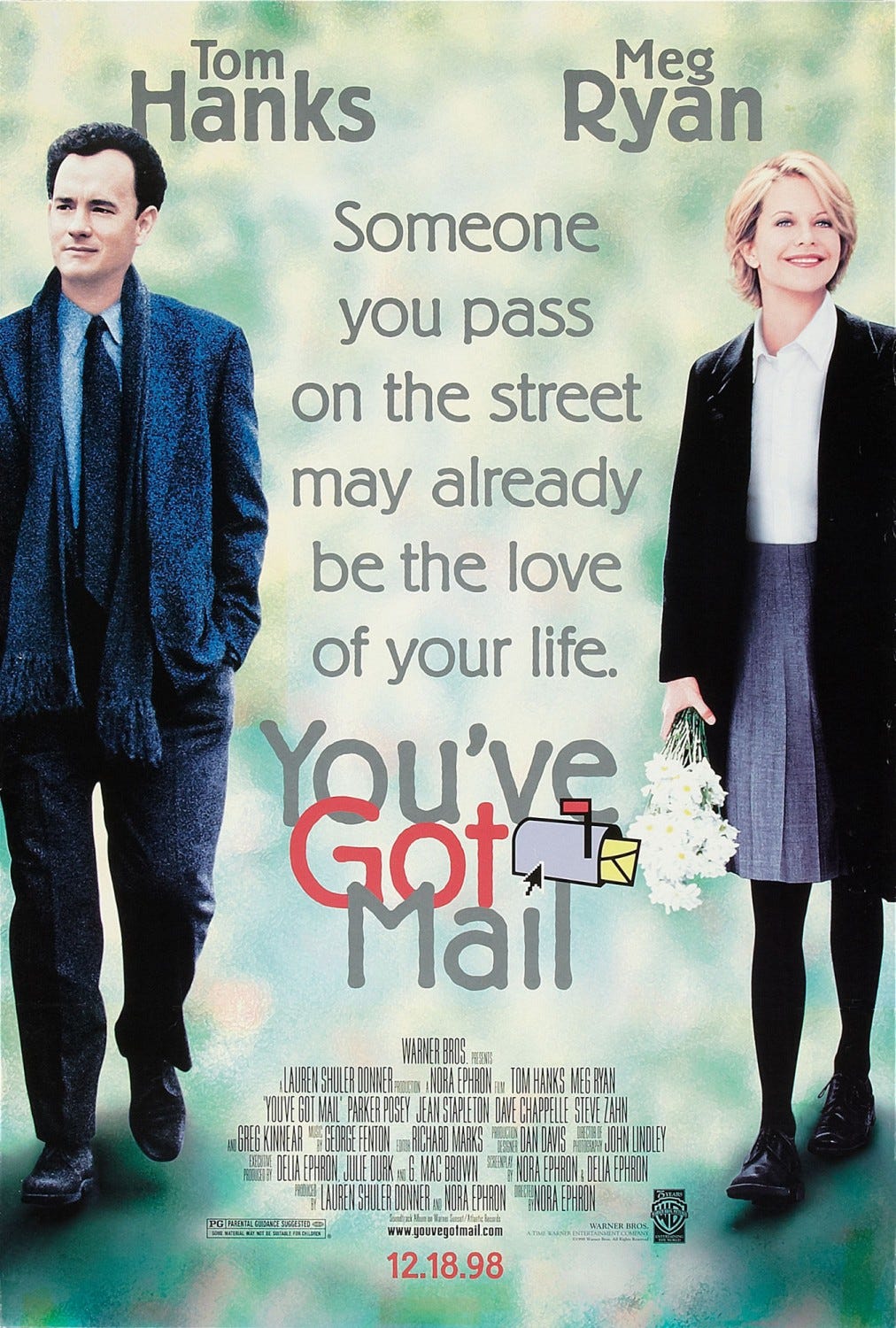
But if the timeline of the movie stretched into the future, the picture would look much different—signaled by something in the title. If you can send and receive messages online, why not books? In the sequel, Fox Books would be going out of business, beaten at the selection game by a new and fearsome online competitor.
Amazon went live in 1995, and while its prospects appeared rocky at the start, it boasted inventories vastly bigger than the best-stocked B&N locations, more than a million titles and always expanding. Didn’t matter how old, weird, or specialized—for any given title a customer had a better shot at finding it while sitting at home on their duff than scanning the shelves at B&N—and usually at a lower price.
At its peak in 2009, Barnes & Noble boasted more than 700 locations. But competition with Amazon over the next decade and change chipped that number down below 600 and brought the company to the edge of ruin. Goliath met a bigger Goliath.
Then came new investors and a new CEO, James Daunt, with a radical idea: What if Goliath behaved more like David? It helps that Daunt got his start in indie bookselling.
Building a Serendipity Engine
In its Goliath days, Barnes & Noble operated on the assumption that a bookstore should stock whatever a buyer came looking for. The assumption behind that assumption? A customer knows what they want; the bookseller’s job is to simply point them to the right shelf. The business strategy that accompanies those two assumptions is obvious: get a big-ass building and pack it with as many titles as possible—less a bookshop than a warehouse.
But David wouldn’t play that game, nor does Daunt.
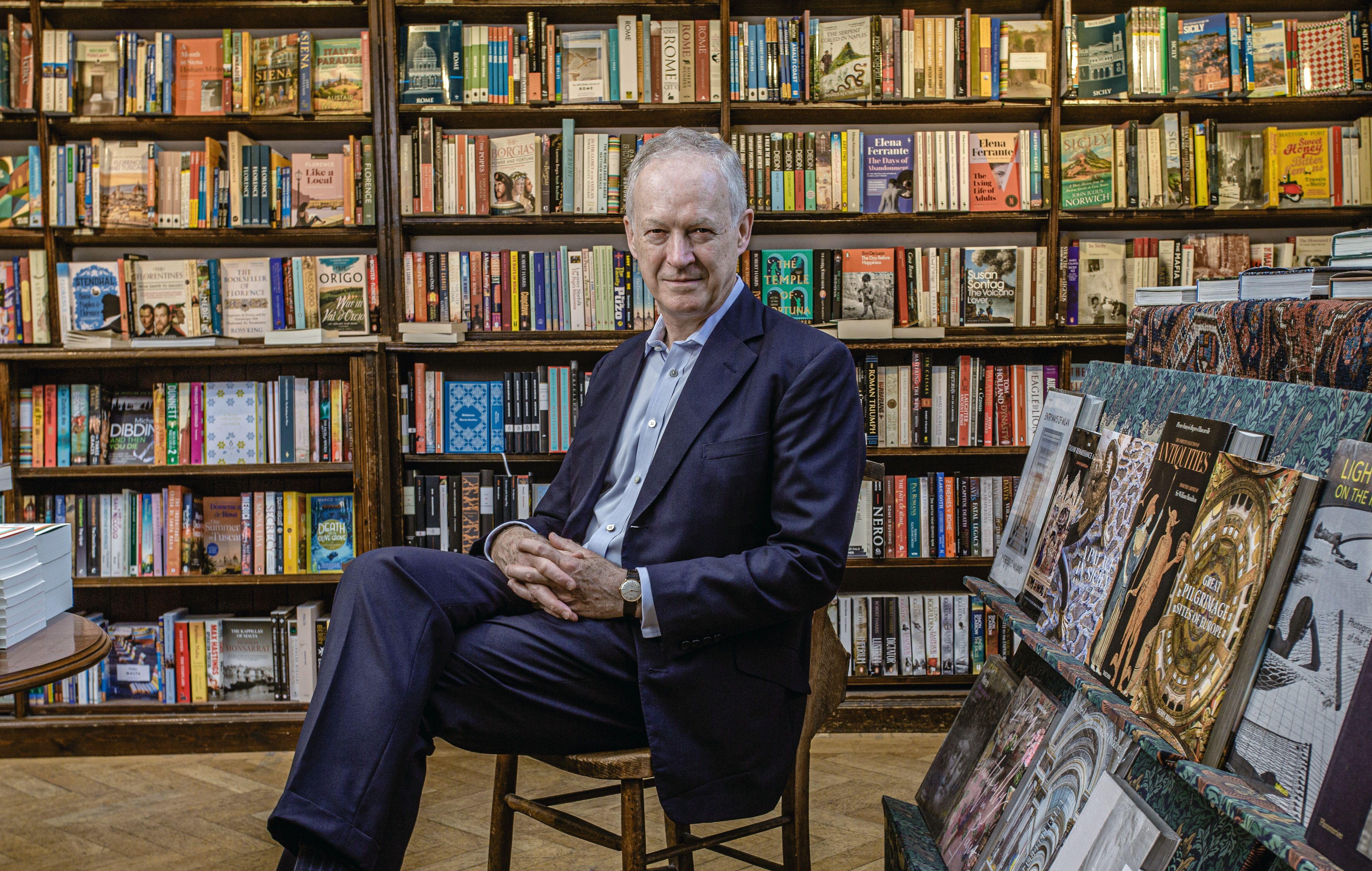
“That is so fundamentally to misunderstand what physical bookstores are about and what they need to be doing in the modern world,” Daunt told a room packed with publishing executives for the 2026 ECPA C-Suite Symposium in September, a gathering held in Asheville, North Carolina. I spoke at the event and, as someone concerned about the infrastructure of reading and all things bookish, stayed to hear Daunt speak.
A brick-and-mortar retailer can’t out-Amazon Amazon, but a bookshop has a different job. “Our role in life is,” said Daunt, “to have the best curated array of books that will most interest the community that we are serving.” That’s a different strategy resting on a different idea of the customer.
For the new B&N, the ideal buyer is not only the one who arrives knowing what book they want; it’s the one who arrives wanting a book, curious, and open to whatever the serendipity engine of good curation and merchandising might supply.
The warehouse model provides more selection than a smaller indie shop but nowhere near what Amazon can supply, while consuming space that could showcase newer and more appealing books. To succeed in the new environment requires a far different approach—five smooth stones, carefully chosen, as it were.
“Our belief is that we have too many books in our stores and not the right books,” Daunt said. Hardcovers present a particular problem. “If you don’t move through your new title publishing, particularly your new hardcover titles, you don’t have enough space for the new to ever find and be given the visibility that it requires.”
The problem is twofold. The warehouse model leads to poor merchandising, so the best books get swallowed up by the meh books, don’t stand out, and don’t move. And then that sclerotic mass just sits there, occupying space that might allow other books to be faced out, put on tables, or otherwise brought to a customer’s attention. If you’ve got too many books on the shelves and they don’t move, said Daunt, “they might as well be wallpaper.”
For a serendipity engine, you need fewer, better curated books. “The irony is that the less you carry and the more focused you are about that, the more you sell of what you do carry,” he said.
Friction in the Gears
“All machines,” said Thoreau, “have their friction.” That’s as true for Daunt’s serendipity engine as anything else, in this case rubbing up against the expectations of publishers, starting with their initial orders. Gone are the days when B&N would order huge quantities of everything, hope for the best, and then just ship back to the publisher whatever didn’t move—“returns” in industry parlance, spoken with a shudder.
A bookseller determined to carry fewer, better books has to say no more often. To keep inventory moving and returns low, B&N now places smaller, more selective orders, which publisher’s aren’t thrilled about. But it works. Under Daunt’s leadership, UK bookseller Waterstones cut returns from about 25 percent to just 3 or 4 percent, concentrated in new hardcovers with backlist close to zero. Daunt wants Barnes & Noble moving in the same direction.
“Returns has long been the curse of our industry,” he said. “As we’re able to buy better and as we’re able to assort better, we should be able to eliminate returns.”
But there are tensions here. Fewer books in stores may mean that some titles never get a chance to break out. What’s more, a book can fail at publication and find readers years later. But this is where online life creates interesting synergies. Online retail can’t compete with physical bookstores for serendipity, but online communities excel at it.
“The act of reading, and how we perceive readers, has changed,” said actor and longtime Reading Rainbow host LeVar Burton in GQ’s recent State of Books survey of writers, editors, publishers, and readers. “What was once seen as a solitary act has become a social one.” With the decline in traditional book coverage from mainstream media, readers have turned to social platforms like Substack, TikTok, and Instagram to share and discover what literature excites them. “I think they [BookTok and Bookstagram] function best as reader spaces and as spaces where readers and critics and reviewers are talking to each other,” novelist R.F. Kuang told GQ.
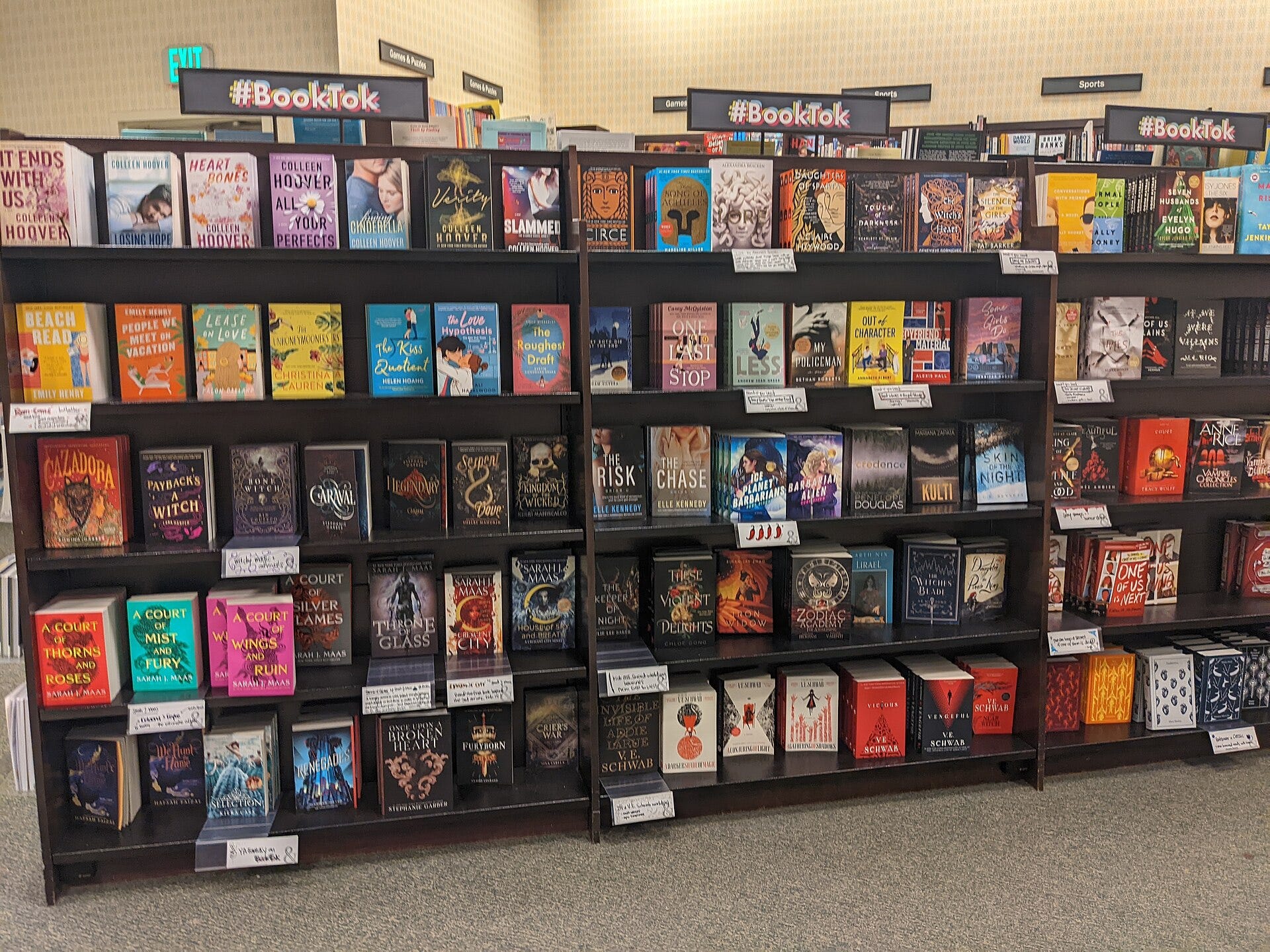
All that talk can turn readers on to neglected books. “BookTok sells books in sometimes surprising directions,” Emma Straub, a novelist and co-owner of Books Are Magic, told GQ. “Just this week, my husband, who does our reorders at the store, said to me, ‘We’ve been selling a lot of copies of Stoner.’ And it’s BookTok!” John Williams’s 1965 novel of a seemingly unremarkable professor has received a whole new life because of social media chatter; I regularly see it in my X feed. Powell’s store manager Bryanne Hoeg pointed to a similar effect with novelist Larry McMurtry: “Lonesome Dove is having a real hot moment right now. That book was published 40 years ago.”
Bookstores and online communities work through the same basic mechanism: one human being placing a book in front of another and saying, Give this a go. Here’s a shorthand way of understanding the bookselling landscape at the moment; this overstates and understates, but it’s directionally right: Amazon fulfills demand, but local bookstore merchandising and online communities work together to stoke it in the first place.
Inside the bookstore, especially Daunt’s B&N, that means not simply rows of titles filed A to Z, but tables and sections designed for readers to browse and find something worthwhile. Doing it well is how physical bookstores keep the sale in-house instead of someone seeing what they like and buying on their phone (always a risk).
Build Nationally, Shelve Locally
One of the ways Barnes & Noble makes selling fewer and selling better work is to give its local stores more autonomy in curating their own inventory. Contrary to popular accounts, it’s not fully decentralized. But it’s not like the Goliath days of B&N, either, when central buyers in New York set the inventory for the entire nation.
“The PR is that we have happy, informed, lovely, brilliant booksellers in every single one of our stores who buy absolutely whatever they like,” Daunt told the ECPA gathering, “and they fill up their stores with beautiful and wonderful books, and everything is just roses.” After a pause, he added: “That isn’t the case.”
Said Daunt, “The initial stocking is a central decision.” The decentralization comes next. Once a centrally approved title is in the system, the local store gets much more say over whether to restock it, whether to bring in approved titles performing elsewhere, how much space a category deserves, and how the section is presented. And there’s a feedback loop; success in a handful of stores can also persuade the central team to expand a title more widely.
The result is neither old-fashioned Goliath-style retail nor 700-plus independent bookstores. It’s more like centralized gatekeeping with decentralized learning, and since every bookstore is located in a different community, over time those stores take on a local feel while remaining identifiably B&N.
In a world where Goliath acts more like David, the religion section at the Barnes & Noble on Fifth Avenue in New York will look different than the same section in Cool Springs, Tennessee. More Buddhism, Judaism, and Islam in Manhattan; more evangelical Christianity in Nashville, reflecting the community interest, even when those local interests run counter to what B&N corporate might prefer.
In his profile of Daunt for the New Yorker, Nathan Heller offers a politically charged example. Barnes & Noble supported a Cheyenne, Wyoming, store that mounted a display of MAGA books because that reflected local taste. “We can’t believe in free speech and the importance of resisting censorship and then censor ourselves,” Daunt told Heller. For Daunt, local autonomy and pluralism play together; a national bookseller should not claim to respect a community and then refuse to stock the books that community wants.
This sort of approach requires careful selection and management of store sections. “Curating is not about racking up books A to Z,” said Daunt. Especially in nonfiction, he wants booksellers to decide which books belong together, how customers will understand the section, which titles deserve display, and which ones should get the boot. That sounds simple until you ask who is capable of doing it. An algorithm can’t do it, and neither can most people.
The Human Infrastructure of Reading
There is a lot of talk now about the infrastructure of reading, usually focused on schools, libraries, phones, and literacy. Bookstores and booksellers are part of that infrastructure too.
An algorithm can identify correlations among purchases. But a bookseller can spend years developing critical taste, notice that a section feels somehow “wrong,” learn that a customer who likes one strange book might like another, or understand that a book nobody knows needs to sit beside one everybody does. A well-run bookstore becomes a serendipity engine because the people running it accumulate judgment. Unfortunately, humans don’t come ready-made with those instincts; they come at high cost.
At ECPA Daunt freely admitted that Barnes & Noble does not yet have enough of those people. “We have highly variable knowledge sets within our stores, and we have highly variable execution within our stores,” he said. Leaning on his Waterstones experience, Daunt is slowly building the necessary expertise at B&N, targeting about 100 to 150 subject specialists across the chain who can each support five or six individual stores.
The difficulty caused by this lack of expertise came to the fore during the Q&A session at ECPA. One attendee challenged Daunt over what she saw as a bias against Christian books in Barnes & Noble stores. Her concern? Some Christian titles were being left out, and the books that did make it into stores were often poorly presented.
Daunt agreed that the execution could be poor but rejected the idea that bias or hostility was the cause. People tend to be more stupid than malicious, as Karl Popper somewhere said. It’s the same at B&N. A young workforce, hopped up on fantasy and romantasy, might know next to nothing about religious titles. Put a twenty-one-year-old unfamiliar with the category in charge of that section and, said Daunt, “They really won’t have a clue.” The same problem afflicts other sections, such as business. But the remedy is not another corporate planogram; it’s more knowledgeable people: training them, retaining them, and moving that expertise among stores.
That requires investment, and Daunt is game for it. “We’re investing hugely more in pay and promotions, so [we] are able to employ more full-timers and retain good talent,” he said. “Book selling skill, particularly at the subject level, takes time to develop.” A good bookstore is not simply a set of inventory rules. It depends on people who cultivate expertise around subjects, customer desires, and connecting the two.
Building a Literary Culture
Near the end of the ECPA session, Daunt was asked about political polarization, technology, declining reading, and the future of bookselling. He rejected the premise of decline, which I was personally glad to hear. He earlier brushed aside the worry that nonfiction reading was collapsing as “absolute stuff and nonsense.” Daunt was similarly skeptical of larger claims that people no longer read. Instead, he pointed especially to readers from their late teens through their mid-twenties. “They’re in our stores,” he said. “They’re buying physical books.”
Heller’s reporting for the New Yorker points the same direction; the booksellers he interviewed consistently described stronger book-buying among younger customers. And GQ heard much the same thing from elsewhere in Booklandia. “What we know at the bookstore is that people are reading—people of all ages,” said Straub. “Young people in particular are interested in an analog lifestyle.” Kuang highlighted the same thing: “I’m honestly excited by the younger readers I encounter. That’s what gives me hope—seeing my students get really excited about the stories I assign them.”
Daunt thinks bookstores invigorate and enliven this culture of reading. “We are, broadly speaking, a positive civilizing institution within the communities in which we represent ourselves,” he said. “We’re committed to carrying the opinions and the voices of all the complete spectrum of opinion,” Daunt said. “But we are also committed to kindness and to the fact that knowledge and engagement with ideas generally will improve and civilize our communities.”
Having founded Daunt Books in London, Daunt’s an independent bookseller at heart. But he also knows there can be drawbacks with independent stores for this sort of culture building. A small shop can unintentionally signal it only exists for a particular kind of reader; outsiders might feel unwelcome. But a large B&N can do something different.
“These huge, great, big, all-embracing stores where everybody piles into them,” he said, “I think are doing something much more important within our communities.” B&N’s scale gives its stores a unique sort of accessibility: teenagers can drop in after school, meet friends, wander the aisles, and leave without buying anything. “That’s fine,” said Daunt.
All it’s done is work. The rebound took years after Daunt’s arrival, but Barnes & Noble has climbed from a low of about 580 stores to more than 730 at the most recent count. Had B&N tried out-competing Amazon, that wouldn’t have happened. Instead, Daunt reminded the chain that it was in a different business. Rather than merely fulfilling demand, B&N’s serendipity engine fulfills curiosity.
Thanks for reading! Get a conversation going. If anything struck you, leave a comment below.
If you found this post interesting, helpful, or only mildly aggravating, please 🔄 restack it, hit the ❤️ below, and share.
And consider subscribing: Free subscribers get two-week access to all new posts. Paid subscribers get the run of the complete archive, plus bonus content.
Also see:


Fantastic piece. I've been so intrigued by the changes at B&N. I like Daunt at the helm. All of the ones I visit have moved into smaller buildings and they each have different vibes. I drive an extra 20 min to hit the one I like most now.
Wow I didn’t know Daunt’s involvement with B&N or Waterstones. Interesting, enjoyable read. Thanks.