

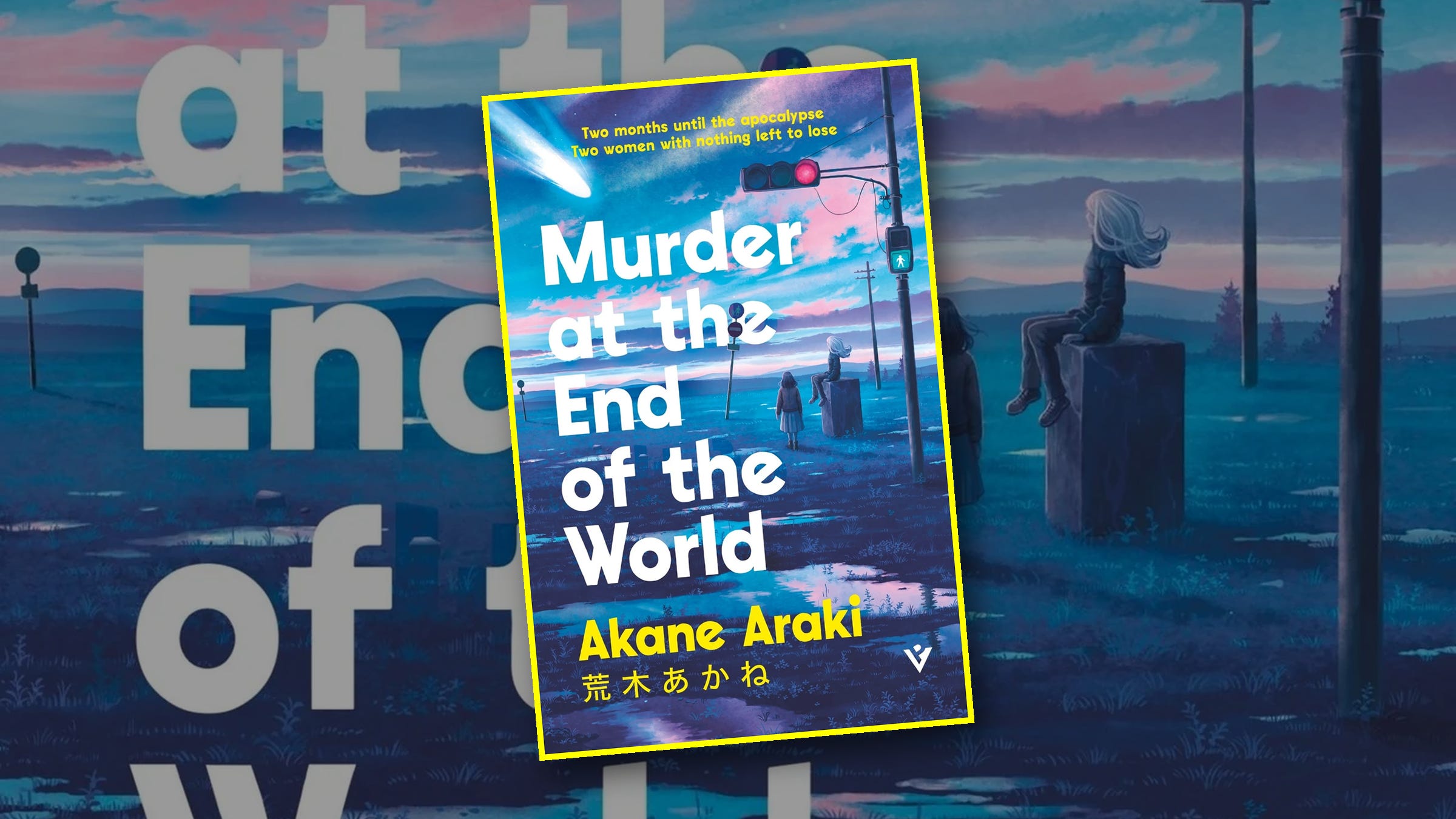
If you discovered a string of homicides but knew the world was ending in a couple of months, would you bother trying to solve the crime? In Akane Araki’s Murder at the End of the World, a giant, 7.7-kilometer asteroid is hurtling toward Earth. Japan, where the story is set, is expected to take the worst of the impact.
Not that anyone elsewhere should get comfortable. “Over 3 billion people would die in the initial shockwave,” the twenty-three-year-old narrator Haru explains. “After that, the gigantic dust cloud kicked up by the impact would linger in the troposphere, blocking out the sun . . . The 5 billion who survived would then starve or freeze to death.” Hello, dinosaurs. It’s us, humanity.
Following an announcement of the impending cataclysm, global society collapses, as panicked “asteroid refugees” from Asia and Oceania begin fleeing for shelter in “safer” locales, such as South America, in a vain hope of surviving the anticipated disaster. And those unable to leave, including Haru, who lives near the expected site of impact? The stragglers reconcile themselves to their grim fate by one means or another. Countless people choose suicide, including Haru’s father. But Haru has a different plan.
Never having learned to drive in her school years, she wants to finally get her license. Fortunately for her, a local driving instructor, Isagawa, is also stuck and agrees to give Haru lessons. There’s no electricity and supplies of everything—especially food and petrol—are dwindling, but the training cars at the driving school have enough gas. Life goes on until it can’t.
The story begins when Haru pops the trunk of a random car on the lot, only to be met by the vacant eyes of a violently murdered woman. “I’d only chosen [the car] because it was parked at the end of the row,” she says. “By sheer coincidence, I’d managed to pick the one vehicle out of fifty that had a body in the boot.”
Horrified, Haru can barely look. But Isagawa immediately begins inspecting the bruised, gashed, and mangled body. She proves considerably more competent at examining the corpse than Haru expects a driving instructor to be; it turns out she used to be a police officer before getting kicked off the force for misconduct.
Haru has no idea what to do next. Emergency services are kaput. But the police should be alerted, no? The practical question points to the philosophical question on which the story turns. Even with doom descending on the entire planet, don’t we owe it to the victim, to whatever remnants of society we have left, to pursue justice?
The answer is an obvious yes to Isagawa, but it’s not so obvious to Haru. Still, what else can she do? Eager instructor and reluctant pupil close the trunk and head to the local police station in their portable crime scene with their victim stowed away in the back.
Like what you’re reading? Subscribe, and new posts will ride an electron rollercoaster directly to your inbox twice a week. Free subscribers get two-week open access to every post; paid subscribers get the run of the archive, plus bonus content.
A complication emerges the moment they arrive. As the population dwindles, the police are shuttering stations, and theirs is next. The officer overseeing the shutdown, Hajime Ichimura, knows Isagawa from her time in uniform. Unable to manage a murder investigation himself, and not seeing much point in one anyway, he gives the pair permission to investigate on their own.
Electricity, cell service, and the internet can no longer be counted on. The usual resources of a murder investigation are largely unavailable, leaving Haru and Isagawa to work with whatever they can find and whoever they can get to help, including a pair of siblings, the Ryodo brothers, trying to lay low because one of the pair is an escaped convict.
As the stakes rise, Haru and Isagawa can’t afford to be too choosy. And the mystery only deepens when two more bodies are discovered bearing signs of the same excessive violence: extensive bruising and repeated stab wounds. There’s a serial killer on the loose.
Eventually, the two uncover a link between the woman in the trunk and one of the other victims. Then, to Haru’s dismay, the investigation suggests a connection to her own brother. A recluse, he hasn’t left his room in ages—or so she believes. Could he have been slipping out? Could he be the killer?
The investigation takes Haru, Isagawa, the Ryodo brothers, and an orphaned girl picked up along the way out of town, where they encounter a community that has improvised a functioning social order amid the collapse, trying to live together while they wait for the asteroid. They also have a more immediate problem: At night someone is mowing pedestrians down with an automobile.
The introduction of “the taxi killer” raises the disturbing possibility: that there are two murderers at work. Could the cases be linked? All the dots finally connect when Isagawa and Haru discover the taxi killer’s victims piled up in a classroom at a local school.
Thanks for reading! If you’re finding this post worthwhile, please restack it, hit the ❤️ below, and share.
Murder at the End of the World is Akane Araki’s debut novel, written on her smartphone during work breaks and her commute. Originally published in Japan in 2022 when Araki was just twenty-three, the novel won the prestigious Edogawa Rampo Prize, making Araki the youngest winner in the long history of the award. It’s now available in English, thanks to Jesse Kirkwood’s translation.

According to an interview with the Japanese literary magazine Shosetsu Maru, the idea for Murder at the End of the World came to Araki while learning to drive:
I’m not good at driving, and it became a chore to go to driving school. To change my mood, I started imagining, “What kind of story would it be if I were to write a mystery set in this driving school?” The first thing that came to mind was a plot where a body is found in the trunk of a training car, and the instructor and students investigate the mystery. But that wouldn’t work in reality because the police would take the lead in the investigation. I thought it might be possible if the police were shut down, so I decided to have humanity go extinct (laughs).
As oil-and-water characters, Haru and Isagawa make a compelling investigative duo. Haru is quiet and passive; Isagawa brash and impulsive. But as the extent of the crimes expands and Haru’s own brother is implicated, they come to rely on each other, even when Haru’s trust is strained and Isagawa’s impulsivity points to something darker at work.
When Haru finds the body in the trunk, she wonders why anybody would bother murdering someone when everyone on the planet will die in a couple of months anyway. She thinks through various reasons, and none fully satisfy. The same applies to her quest with Isagawa to find the killer.
But, as with any of the two-steps-removed questions of life, the time and inclination to answer are often swallowed up by the immediacy of our circumstances. Nonetheless, the question persists: Is justice worthwhile when everything is falling apart?


https://en.wikipedia.org/wiki/The_Last_Policeman
"The Last Policeman is a 2012 American science fiction mystery novel by Ben H. Winters. It follows a police detective in New Hampshire as he investigates a suicide he believes was really a murder. His efforts are complicated by the social, political and economic effects of preparations for, and anticipation of, an asteroid impact six months in the future."
Interesting premise; reminds me somewhat of Nevil Shute's 'On the Beach'; as fallout from a nuclear war drifts South, people in Australia carry on with their lives even as the inevitable end draws near.