

Some people love reading goals. Others? Not so much. I’m in the first camp, but the research on reading goals is admittedly mixed. One study by Yasaman Jafari and colleagues of Goodreads challenges, for instance, found the vast majority of participants—81 percent of 787 users—logged more books during years they participated in challenges than those they didn’t. Score one for goals!

But, as with a lot of goals, our initial enthusiasm can outstrip our daily reality. These same researchers also examined a larger group with more than 3 million reading challenges; whereas the average goal was about 37 books, the final completed tally was more like 23.
As if to underscore the point, the researchers collected 418,913 Instagram posts and 48,320 tweets about reading challenges. January accounted for not one twelfth of posts—as you might expect if activity were evenly distributed—but 19 percent for Instagram and 22 percent for Twitter. One fifth of the buzz happened in the first month of the year alone.
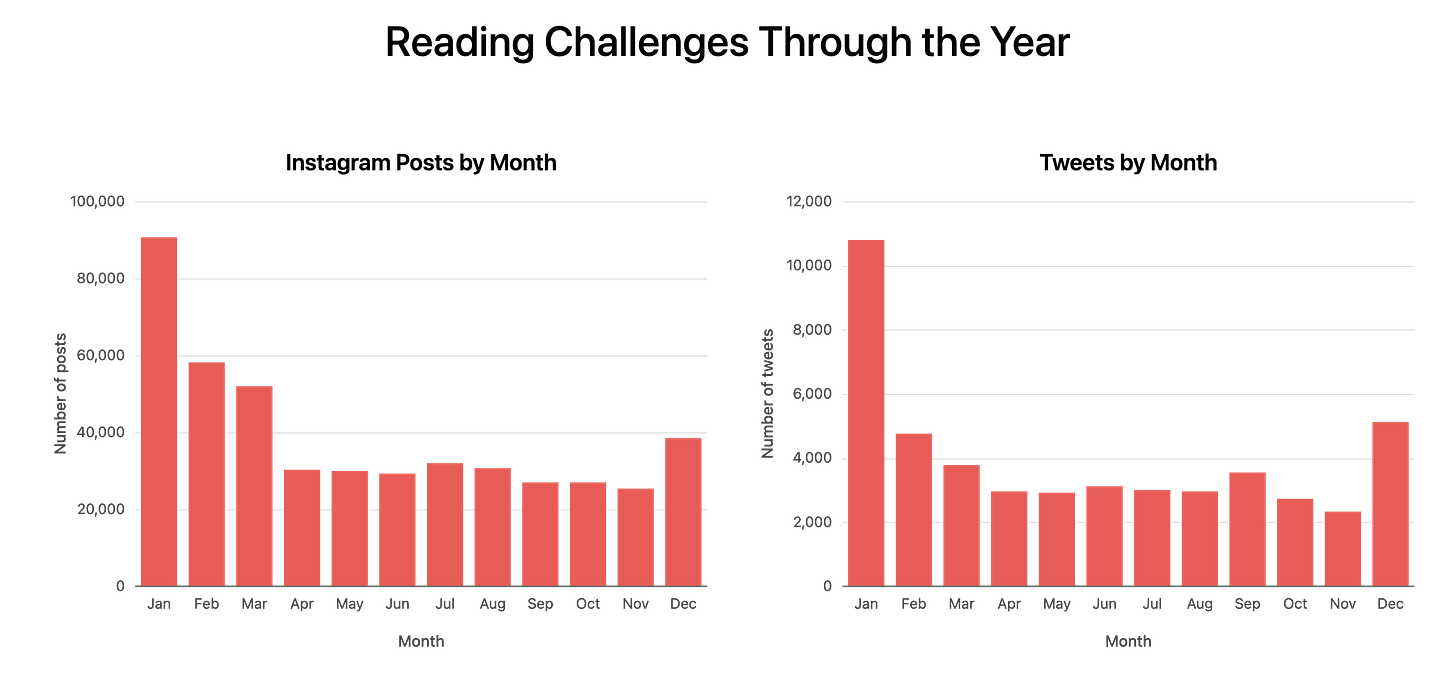
This distribution fits a wider pattern researchers call the fresh-start effect in which temporal landmarks, like stumbling into a new calendar year, prompt our determination to get our lives together in one way or another: working out, dieting, keeping a budget, all the usuals. January offers a clean slate; unfortunately, it doesn’t supply will power, sustainable motivation, or more days on a person’s calendar. Reading challenge posts rebounded somewhat in December but coughed, sputtered, and strained to reach heights which would only produce sneers in January.
I know the feeling well.
My Big-Ass Classics Goal
Late last year I committed to reading a dozen of the big-ass classics, books like Steinbeck’s East of Eden and Dostoevsky’s Crime and Punishment. I’ve set a reading goal like this every year since 2023, but this was my most ambitious yet. Like anyone intoxicated by the fresh start effect, I came out of the gate strong, oblivious to Paul Thorn’s down-home wisdom: “Everybody looks good at the starting line.”
I jumped into East of Eden in December 2025, finished in January, and reviewed it the same month. In February, I then dove feet-first into Wilkie Collins’s The Woman in White, followed by Crime and Punishment, getting an early start on my March book. I breezed through C&P fast enough that, while it wasn’t on my goal list, I set aside my prior hesitations about The Brothers Karamazov and read it next. I cleared both those Russian doorstops in about two weeks apiece, revising all my earlier opinions about their intimidating stature in the pantheon of daunting literature. Nonsense. They were—dare I say it?—fun.
Not my April book, David Copperfield, inexplicably Dickens’s favorite among his many novels and a reminder that no one is a good judge of their own work. I spent the first half of April slogging through the chapters, begging the author to give me one thing to care about. Despairing of life itself, I took the suggestion of many of you and pivoted to A Tale of Two Cities, which wasn’t on my list but proved far easier and more enjoyable to traverse.
So, with Two Cities under my belt—sufficiently confident I would survive a renewed assault—I returned to David Copperfield early in May, finished it, and reviewed it that same month; I ended up liking it, despite the fact I found little to recommend the titular character. I’d happily read A Tale of Two Cities again; it’s enough to have reached the end of David Copperfield once.
This should come as no surprise, but researchers find that enjoyment is a significant predictor on sticking with our goals. Whether a goal is good, useful, valuable, or important doesn’t matter if you hate doing it. But boredom and disengagement are only some of the potential risks, nor did they play a significant role in my experience. Rather, four complications converged, and then everything got weird—some of which the goal research can help explain.
Complications Commence
First, my mother got deathly ill. I spent about three weeks in California with her at the hospital in late April and May. Sitting by her bedside while she slept (or watched Bobby Flay and golf tournaments), I had enough distance from regular life to plow through both A Tale of Two Cities and David Copperfield, but—who am I kidding?—I found it hard to focus.
I did read in the margins and squeezed those big books out, along with a few others, including Ada Palmer’s Inventing the Renaissance (a monster itself) and Tim Berners-Lee’s history of the World Wide Web, This Is for Everyone. But my reading ambitions were actually curtailed; understandably enough, I had other matters to attend to. Throw all that in a cocktail shaker and what poured out was a late start on May’s book, Henry Fielding’s magnificent Tom Jones. Thankfully, Fielding’s book practically reads itself.
But here I need to introduce the second of my four complications. Earlier in the year, I took on part of a marketing project for work. It’s out of my expertise, but I’m a quick study. Unfortunately, the project metastasized into a second job. I’m still wrangling this behemoth, which I’m happy to do, but the beast has devoured a big share of my personal margin. And since reading is largely an interstitial activity for most of us, including me, I’ve watched my daily reading time dwindle as this project mutates and grows.
Thank God, the team is actively working to get this off my plate. But I hadn’t really reckoned with the impact as late as June. Stupid me—because that was the month I chose to read Laurence Sterne’s Tristram Shandy.
When he first waded into those sparkling waters, C.S. Lewis didn’t know what to make of the experience. “I have read today,” he wrote a friend, “some ten pages of Tristram Shandy and am wondering whether I like it. It is certainly the maddest book ever written . . . It gives you the impression of an escaped lunatic’s conversation while chasing his hat on a windy May morning.”
Honestly, that sounded right up my alley. I love a zany book, and Tristram Shandy is reputed to be one of the greatest comic novels ever written. Reputation or not, I couldn’t follow the lunatic or his whirligigging hat. The further I ventured, the more lost I got. Finally, I did something I hadn’t done with any other book in this reading challenge, not even David Copperfield: DNF.
But I can’t really blame poor Sterne, inert and harmless in his grave after all these centuries. No, it’s not Sterne’s fault. The third of my confounding complications occurred while I was supposed to be reading his novel: I decided to write my own.
Competing Demands
My difficulty with Tristram Shandy hit at the same fraught moment a (fingers crossed!) brilliant idea for a detective novel occurred to me. I spent God knows how much time in June and July avoiding Sterne’s digressive masterpiece and writing, writing, writing. Poor Tristram, I blame myself. I will come back to him in time. First, I have a mystery to write.
Except, I don’t—or didn’t. It’s complicated. August and September are a blur.
Back in January ECPA president Jeff Crosby read The Idea Machine and, to my delight, invited me to speak at his organization’s C-Suite Symposium for publishing executives—also known as the fourth of my converging complications. Naturally, I agreed to the gig, and I had well more than half the year to get my speech ready. Also naturally? I waited until about six weeks before the date to get started. If you’re keeping track of the timeline here, these six weeks roughly coincide with the mounting calendarical train wreck I’ve been describing so far.
I pretty much knew what I wanted to say, but actually writing the presentation and preparing the presenter deck took weeks and weeks—a further reduction of my marginal reading hours.
To ensure I delivered an excellent speech, writing my mystery also tumbled into the backseat. I had moments of intensity in August, but it was bupkis for all of September. Still, invoking Sts. Paul and James, in everything give thanks; I’m doing my best to count it all joy. I figure this separation will give me a little distance that’ll help me come back, evaluate, and tighten things up before pushing forward this fall.
My Past Me, that Bastard
What all this tells me is that my future self has a much roomier calendar than my actual self. The dumb thing? I know this already, pretty sure we all do. In several experiments, Gal Zauberman and John Lynch found that people generally expect more spare time in the future than they have in the present. January me: “Give Future Joel a speech, a novel, and a stack of classic doorstops. What? No! He’ll have plenty of time.” Present me: “You bastard.”
The future is wide and expansive, full of all the room required for our goals to materialize out of the ether. But the future looks pretty much like the present in all these quotidian details because the present is what we’re dragging around in our pockets all day long, and it’ll still be in there when you take your jeans out of the wash tomorrow.
Now, it’s worth saying that despite running into these obstacles—mostly of my own making—I wasn’t totally deterred from my big-ass classics goal. After all, I’d publicly declared this goal, and I knew you readers (at least some of you, God bless you) were awaiting the promised reviews.
Such arrangements often work for goal adherence. I’ve completed every reading goal I set for 2023, 2024, and 2025 in part because I announced the goals publicly and kept you posted on my progress. Knowing I owed you an update helped me keep turning pages and penning takes. I had loads of fun doing it, of course, but I’m highly distractible and accountability has its perks.
Research backs up this approach. One review of 138 experimental studies with almost 20,000 participants (mostly involving health goals) found monitoring progress contributed to goal achievement. What’s more, the effects loomed larger when progress was reported or made public, and when it was physically recorded. That’s basically the arrangement I’ve had with you: not just announcing what I intend to read, but monitoring progress throughout the year and reporting what I actually read. I had all the accountability I needed! I just forgot to fully factor the time.
A Man’s Got to Know His Limitations
I now need to backtrack and catch you up on my reading life, post Tristram Shandy. Despite all the foregoing, in July I recovered my momentum somewhat and made it through a big hunk of Miguel de Cervantes’s Don Quixote. I was hanging onto the madman’s saddle strap well into August; but better late than never (doubly so for the review that didn’t appear until September, nearly on the eve of ECPA). By then I should have also read and reviewed Melville’s Moby-Dick.
I did catch the white whale in August, but I’ve yet to review it. One of the things I discovered after finishing these great and mighty classics involves finding anything interesting to say about them. It’s a bit of a stretch; so much has already been said! The past me wasn’t clever enough to imagine that problem. I think I’ve got my angle on Moby-Dick at this point, and I took good notes. But it’ll take a few more weeks for me to get to it.
And right now? I’m supposed to be reading Vasily Grossman’s Life and Fate. But Tolstoy’s War and Peace, my September book, has gobbled up all of its appointed month and spilled into October, where it sits like a Southern California rental-home squatter. Worse, I’m only about a third of the way through it. Did I underestimate that fella or what? It’s marvelous! And also demands more of my attention than I’ve been able to supply, given all the goings-on I’ve already mentioned . . . and which you’re probably tired of hearing about . . . and which I’m twitching telling about.
And I still have Grossman’s Life and Fate, Denis Johnson’s Tree of Smoke, and George Eliot’s Daniel Deronda waiting for October, November, and December. Present me is back with more invectives for January me.
I dug my own grave, I freely admit. My mother’s illness couldn’t have been avoided, nor could I have avoided the extra work that intensified over the summer. But the rest? That was all of my own doing. “I am,” to quote my sixteen-year-old son, “a victim of my own desires”—beyond even the detective novel and the speech, of course, because I filled up my reading time with plenty of other books along the way. On top of the big-ass classics I’ve read this year, I’ve managed to read forty others.
But Harry Callahan was right: A man’s got to know his limitations.
I’ve come to the end of myself. So where does this leave me and my big-ass classics goal? I don’t feel great blitzing through War and Peace. That would be a crime, and I’d be answerable to Dirty Harry for yet another act of malfeasance. And what, if anything, does this situation reveal about reading goals?
Revising My Plan
Be careful which high-schoolers you tell, but there’s a difference between reading books and getting them over with. In Jeroen Dera’s interviews with twenty young reading-challenge participants, thirteen said they bumped up their numbers, but six described choosing skimpier books to keep up, and four said they read faster to meet the challenge. I get the temptation. But I chose the big-ass classics to get me into books I’d long avoided—not tempt me to dodge or hurry through them.
If reading is a chore, we won’t do it. That’s what I take from Jordan Etkin’s reading experiments in which tracking pages increased the amount people read while simultaneously reducing their enjoyment. In one experiment, only 27.3 percent of the tracking group chose to keep reading afterward, compared with 48.5 percent of the untracked group. Keeping count doesn’t always spoil the fun—but it can. If it feels more like work than wonder, people will fire up YouTube instead. Which brings me back to my detective novel and how I’m planning to revise my reading goal through year end.
Totally unforeseen at the beginning of the year, this little side project popped up in June, and I don’t regret working on it for a single second, regardless of the havoc it’s played on my reading schedule. I’m jonesing to get back to it, and for the moment, I’d rank it higher in importance than reading the rest of my classics list for the year. That doesn’t mean I’m abandoning my goal, but it does mean I’m changing it—a little reluctantly, but until they figure out how to mint more than 168 hours in a week, that’s the choice I’m going to make.
Revising my plan isn’t the same as jumping ship. One analysis of 235 studies found staying flexible in goal pursuit pairs with better well-being and greater progress toward goals. If you don’t bend, you break. I still want these books, but I also want to write my own. Something’s gotta give and, based on what I’d like to happen in my future, that something is my big-ass classics timetable.
I’m still going to read the rest of this year’s books, but here’s my revised plan:
I’m going to give myself the rest of the year to read War and Peace. I’m planning on starting back on page one and reading it through by December 31. That’s one of the three volumes of the Everyman’s edition for each month between now and the end of the year. As for starting over, I can’t say I read the first third as attentively as I wish I had, and I don’t want to shortchange the experience. I’m going to start the book over after Fall Break and take it at a measured pace.
Grossman, Johnson, and Eliot I’ll push into 2027, and probably give myself two months apiece. I burned through Steinbeck, Collins, Dostoevsky, and Fielding. I think that gave me a false sense of what these books would require of me. A little extra space will be helpful. What, did I learn nothing from this year? January me is still a rat bastard, and I need to hold him in check.
I’ll fold these final three into my new reading goal for 2027. Because, yes, that’s right: I’ll still be setting another reading goal for 2027. What will it be? I don’t know yet. I’ll wait till December to think it through, but I know it’ll contain these three at roughly the pace I’ve stated above. In and amongst them? As of this moment, God only knows.
What I do know is that I’m off next week for Fall Break. This will be my last post for a short bit. I’m fried and I’m looking forward to a breather. I plan on hanging out with family, sleeping, reading, writing, and getting some sun before it vanishes for the winter. I’ll still be poking around on Notes, but I won’t be posting essays or reviews to the newsletter.
What that means for you? No posts October 10, 14, or 17. But I’ll be back with a fresh essay or review Wednesday, October 21. What will it be? Maybe Moby-Dick will finally breach the surface. In the meantime, I’ll probably be working on my detective novel while I’m out. And let me know if you’d like to learn more about it and my publishing plans. I’d love to connect with any of you who are interested. Here’s a tease: my working title is Balance Due.
If you found this post interesting or helpful, please restack it 🔄, hit the ❤️ below, discuss, and share.
And consider subscribing: Free subscribers get two-week access to all new posts. Paid subscribers get the run of the complete archive, plus bonus content.
I am so sorry to hear about your mother, I hope she has improved. I often plan out my year, knowing that it will change a million times by the end of the year. I find that going in knowing that it’s a rough outline helps me not get too upset if I don’t read them all.
Good for you on letting yourself slow down - at the beginning, I did think that a list that included Dostoevsky, Cervantes, and Tolstoy, plus 9 other long classics, would be a bit much for one year. I can never keep a steady pace at reading through the year: some months, I devour words, others I hardly touch a book, and sickness really interferes with my ability to concentrate on reading.