
David Copperfield: A Hero Beside the Point
Reviewing Charles Dickens’s Beloved Classic and Risking My Own Hide in the Process

I hated it, I hated it, I hated it. Then I liked it. What’s that? You want me to elaborate. I’m not sure you do. One thing I realized when I posted a Substack Note about my struggles with David Copperfield is how beloved it is. Makes sense; a book only persists 175 years, give or take, because it has fans. Saying something critical is bound to irk some readers.
But I also discovered the book has its haters; an author with output as varied as Charles Dickens’s bibliography won’t resonate with every book every time. So saying something positive is bound to induce involuntary eye rolling—at minimum—among a certain portion of the audience. I’m hosed either way.
Oh, well. My insurance is up to date, and I’m wearing asbestos undergarments. Bring on the fire!
Here’s what I hated: mostly just David himself. If you’re familiar with the story, you know little Davey is an unfortunate child. His dad dies, then his mother. Before she passes away, the young widow marries a hideous man with a hideous sister, the Murdstones, who make David’s life miserable before packing him off to a terrible school. After his mother’s death, David’s hideous step-father yanks him out of school and sends him to work in an oppressive bottle-washing shop where Mr. Murdstone is a partner.
Dickens breaks up the otherwise unrelenting woe with passages of love and warmth. David’s mother has a family servant, Peggotty, who delights in him. He’s allowed to go with her to visit her brother, Mr. Peggotty, who’s raising two orphaned cousins, Em’ly and Ham, by the sea. There’s his school friend Traddles. And after a grueling, grimy day of washing bottles, David returns each night to his hosts, the impossibly optimistic Micawbers.
There’s a lot of life in the first few hundred pages of David Copperfield, and much afterward as well. But you can barely guess what David thinks about any of it besides his flat recitation of events.
Dickens presents his tale in the first person, the first time he’d tried the approach. He proves unsuccessful in the attempt. A first-person narrative, one where the conscious “I” is a character, begs for the interiority the form provides. We are not looking at David; we are practically within David. And yet, David allows us little entrance to himself. Outside a few moments, he is remarkably unreflective about his life except to relay its many, many occurrences.
If David Copperfield were the sea he occasionally visits, we’d see people and events move across the waves like ships but rarely glimpse any of the life below the surface. This strikes me as all the stranger since the novel is heavily autobiographical. Dickens was originally planning to write an autobiography, found it too revealing, and opted for transmuting his tale into that of young Copperfield.
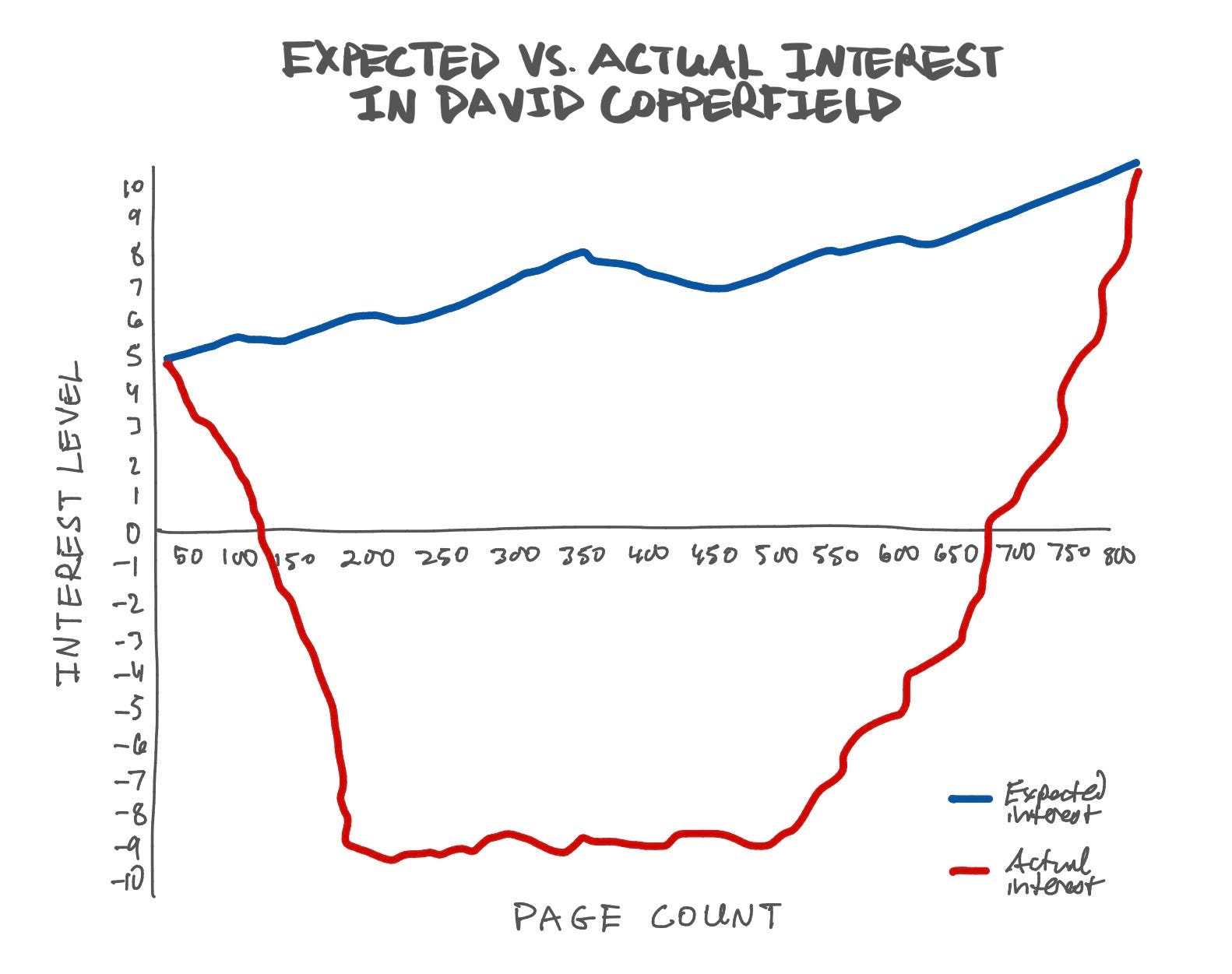
But the hedging and self-protection mar the effect. As illustrated by the crude, hand-drawn graph below, I struggled to maintain an iota of interest in Dickens’s central character. I couldn’t work up any care about him and so didn’t care for him. And I’m not alone in this complaint.
In his 1933 analysis of Dickens’s life and his work, unimaginatively entitled Charles Dickens: His Life and Work, Stephen Leacock lobs this very issue into view—despite heralding the novel’s greatness. “One of the strangest things in the book David Copperfield is David Copperfield himself,” he says, adding:
Few people perhaps have noted the fact, but many will admit it when said, that there is, so to speak, no such person. David is merely the looking-glass in which we see the other characters, the voice through which they speak. He himself has no more character than a spiritualist medium.
In his 1921 The Craft of Fiction, Percy Lubbock offers something just as blunt:
The sole need is for the reader to see what David sees; it matters little how his mind works, or what the effect of it all may be upon himself. It is the story of what happened around him, not within. David offers a pair of eyes and a memory, nothing further is demanded of him.
Richard J. Dunn agrees in a 1965 piece for English Journal, though with a little less rhetorical verve. “The narrator,” he says, “by not focusing with increasing acuity on his growth through his reactions to unusual experiences, sacrifices depth of characterization.” The circumstances of David’s life change radically over the course of the novel. (You’d expect as much; it’s nearly nine hundred pages long.) But does David, as a character, change? It’s hard to tell because he gives you so little work with. When he’s not flat, he’s hollow and seemingly disinterested in what’s happening within his own mind.
The only thing that saves the book—in fact, does more than save it; Leacock, Lubbock, and all Dunn praise it despite this core defect—concerns who and what David’s looking-glass eyes behold. “Our interest is purely in the people who circulate in David’s life,” says Lubbock, “Betsey Trotwood, and the Micawbers, Uriah Heep and his mother and Mr. Spenlow and, above all, Dora. . . . All we want is to hear what happened to the others, not to him.”
That’s where the action is: young Em’ly, seduced and ruined by none other than David’s dearest friend Steerforth; the heart-sickened Mr. Peggotty, who refuses to give up hope that he’ll find her; the slimy Uriah Heep, ingratiating and insinuating while working schemes that destitute his victims; crotchety old Aunt Betsey, constantly complaining about donkeys in her garden, who though dismayed that David was born a boy and not a girl, nonetheless becomes his foremost champion and defender; Mr. Micawber, one of Dickens’s most buoyant characters, always behind the 8 ball, never aware it’s his own fault, and yet constantly striving to figure out how to make the next plan work; and many, many others, including David’s daffy young wife Dora.
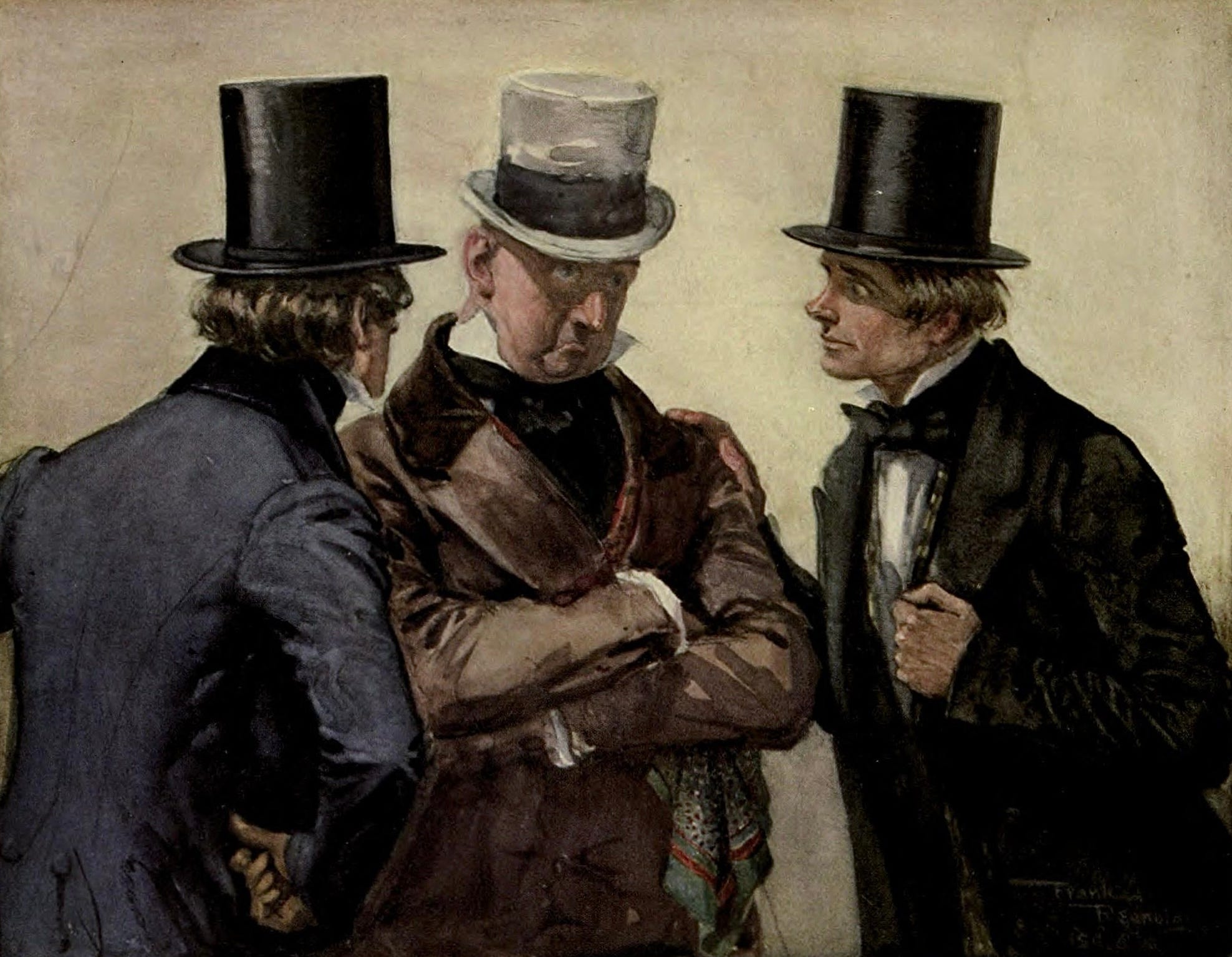
I cared little for David except how his life ricocheted around theirs—though, I must say, I cared even less for Dora. Drop her, David! Agnes is right there!
The magic of David Copperfield, and where the actual line of interest eventually sailed upward on my handy graph, is how Dickens takes all the people with whom he’s surrounded his drab mannequin and resolves their stories, tragically for some and joyously for others. Does he leave a single knot untied? Somehow it all comes together, and as Dickens begins cinching the strands I couldn’t help but lean forward in my chair and wish I could turn the pages faster.
My favorite of these moments is Mr. Micawber’s exposé of the snake Uriah Heep. Distanced from his family, including his long-suffering wife, Micawber seems lost for a while but then rebounds with a fiery, apoplectic denunciation of Heep, blurting out his name like an accusation and an expletive. Here’s a taste, complete with enough em-dashes to supply ChatGPT with hives:
“I’ll put my hand in no man’s hand,” said Mr. Micawber, gasping, puffing, and sobbing, to that degree that he was like a man fighting with cold water, “until I have—blown to fragments—the—a—detestable—serpent—HEEP! I’ll partake of no one’s hospitality, until I have—a—moved Mount Vesuvius—to eruption—on—a—the abandoned rascal—HEEP! Refreshment—a—underneath this roof—particularly punch—would—a—choke me—unless—I had—previously—choked the eyes—out of the head—a—of—interminable cheat, and liar—HEEP! I—a—I’ll know nobody—and—a—say nothing—and—a—live nowhere—until I have crushed—to—a—undiscoverable atoms—the—transcendent and immortal hypocrite and perjurer—HEEP!”
And on he goes. All I could do was laugh and cheer—for Micawber, of course, but for Dickens too. With a first-person narrator, the keystone character, as unreflective as David Copperfield, the novel shouldn’t work. And yet it does.
“Whether I shall turn out to be the hero of my own life, or whether that station will be held by anybody else, these pages must show,” says David at the outset of the story. Dickens does something better and far more surprising than prove it either way; he gives us a novel in which the hero is beside the point.
I’m reading twelve big-ass classic novels this year. Here’s the full schedule for 2026. Dickens’s David Copperfield was my April novel. Apologies for the delay in posting the review. I’m running behind on Tom Jones, as well; I’m only on page 3. Ack!
January: John Steinbeck, East of Eden
February: Wilkie Collins, The Woman in White
March: Fyodor Dostoevsky, Crime and Punishment
April: Charles Dickens, David Copperfield
May: Henry Fielding, Tom Jones
June: Laurence Sterne, Tristram Shandy
July: Miguel de Cervantes, Don Quixote
August: Herman Melville, Moby-Dick
September: Leo Tolstoy, War and Peace
October: Vasily Grossman, Life and Fate
November: Denis Johnson, Tree of Smoke
December: George Eliot, Daniel Deronda
Bonus big-ass classic: Fyodor Dostoevsky, The Brothers Karamazov.
Thanks for reading! If you enjoyed this post, please hit the ❤️ below and share it with your friends (especially if they have strong opinions about Dickens).
Not a subscriber? Take a moment and sign up. I’ll send you my top-fifteen quotes about books and reading. Thanks again!
And check out my book, The Idea Machine: How Books Built Our World and Shape Our Future—one of Big Think’s favorite books of 2025.👇


Yes, you got it - David isn't the hero of his own story, he is the observer and narrator of other heroes and heroines.
I'm pretty sure Dickens missed his true calling in life, that of an investigative journalist. His exposure of Victorian hypocrisy is biting, if bleak, satire, and his character sketches are two-dimensional but memorable. That being said, I don't love his style or his simply atrocious pacing, and I would be far more interested in a scholarly biography of his life and times.
If only he had kept this book as an autobiography! Thanks for the review.