The Killer and the Harlot: Dostoevsky’s ‘Crime and Punishment’
A Murderer’s Excuse, a Prostitute’s Love, and the One Road to Redemption
“I’m sure that everything you do is quite wonderful,” his mother says, gladdened to see her son Raskolnikov at last. “Don’t be so sure,” Raskolnikov replies with a twisted smile. She has no idea what he might do—what he’s already done. And neither, in a sense, does he.
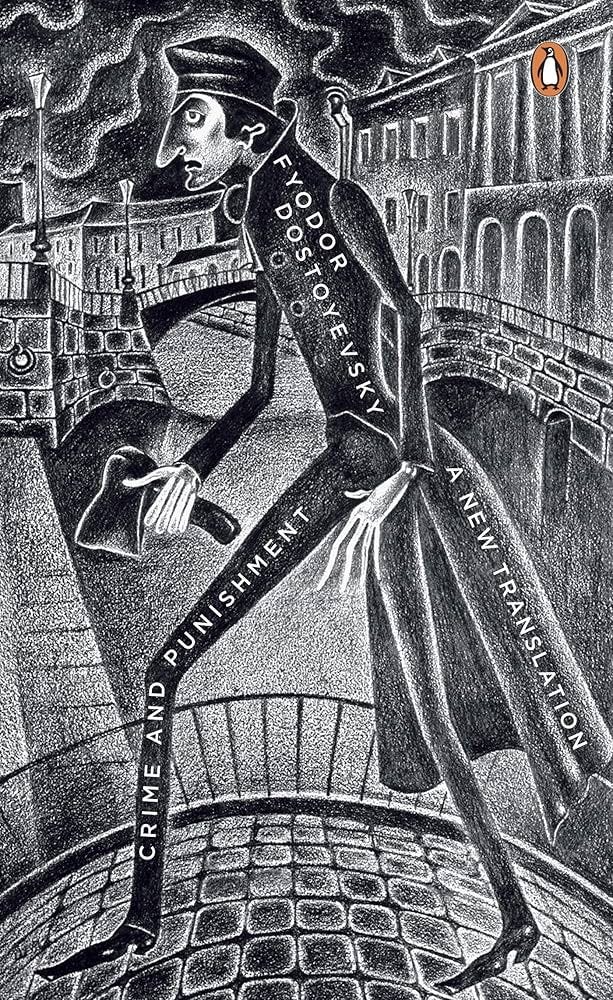
Walls Closing In
Few novels make the reader feel so physically and psychologically cramped as Fyodor Dostoevsky’s Crime and Punishment. At least, I felt cramped, and I know I’m not alone. Many people describe the narrative’s claustrophobic effect.
With all of St. Petersburg and the surrounding countryside at his disposal, Dostoevsky constrains his universe to a series of pinched rooms, tight stairwells, and crowded taverns—all suffocating interiors. Raskolnikov’s apartment, barely bigger than a closet, is so low and cramped it presses down on him. In Oliver Ready’s translation—the one I read—his mother compares it to a “coffin” (mogila in Russian, literally “grave”).
The pawnbroker’s apartment—the bloody scene of the titular crime—starts off airy and well-lit, neat and fresh. But once Raskolnikov levels the axe, he becomes trapped inside, men rattling on the doorknob to get in. A steep, narrow staircase and a warren of stinking, stifling rooms comprise the police station, “all so tiny and low.” And while doors are rarely locked, characters press against the walls, constantly barging in on each other; any breathing room is crowded out by incessant jabbering and the unremitting density of human presence.
But the most claustrophobic feature of all? Raskolnikov’s fevered mind. In so many ways he’s locked inside his own skull, and Dostoevsky lures the reader (against our better judgment?) into that perilous echo chamber.
Raskolnikov conceives of a grand theory about grand men, that they stand above the law (much like Count Fosco in Wilkie Collins’s The Woman in White), able to act however they please to bring about their grand designs. Extraordinary individuals may transgress any bounds to serve a higher purpose. Raskolnikov is so confident in his carnivorous thesis he publishes a version of the argument in an article. Before the crime—which he conceives as the realization of his theory—he lives so deeply within the idea, despite his vacillations, he can “no longer find within himself a single conscious objection.”
Muhammad didn’t hesitate. Napoleon did not hesitate. Why should he? The old pawnbroker, he insists, is a louse, not even human. Her death might very well enable future good. “I wanted to become a Napoleon,” he later admits to the harlot Sonya, “that’s why I killed.”
But the narrator offers a warning embedded in Raskolnikov’s own reasoning. “Criminals,” he reflects, “almost without exception, succumb at the moment of the crime to a weakening of the faculties of reason and will, which are replaced, in stark contrast, by the thoughtlessness of a childish and quite extraordinary kind, at precisely the moment when reason and caution are most essential.”
Raskolnikov believes he won’t falter. “He decided that morbid reversals of this kind could not befall him personally in this venture; that his reason and will would not and could not desert him at any moment during the execution of his plan, for the simple reason that his plan was ‘not a crime.’” Based on his theory, it’s not.
Of course, he’s wrong on both counts.
Self-Made Traps
The murder happens in Part One. When Raskolnikov strikes the old woman with the axe, “the blood poured out, as from a toppled glass. . . .” But then the pawnbroker’s half-sister Lizaveta arrives. His perfectly planned crime is already spoiled. He now must kill her; down falls the axe again. Then, as if the situation couldn’t get any worse, any more outside Raskolnikov’s control, two men come to the door. Luckily, it’s locked. But now he’s trapped inside the apartment, crouching behind the door, waiting for a moment when it’s safe to escape the scene.

This moment of panic telegraphs the shape taken by the rest of the novel. From this moment forward, Raskolnikov is hemmed in—by police action, yes, by possible witnesses, by evidence, but mostly by the revolt of his own nature against what he has done.
When he is summoned to the police station on an unrelated matter, “something entirely unfamiliar was happening to him, something new, sudden and completely unprecedented.” His faculties begin to fail. His will, his judgment, his calmness under pressure—all of it starts falling apart. After leaving, he suffers a nightmare in which the police superintendent’s assistant beats his landlady. He wakes to find it was only a dream. Nastasya, the servant, tells him: “That’s your blood yelling inside you.”
The line echoes Genesis, Abel’s blood crying out from the ground. But here the crime is not only against the pawnbroker. Raskolnikov has injured himself first. “It was myself I killed,” he later tells Sonya, “not her. I murdered myself in one fell blow, for all time. And the hag was killed by the devil, not me.”
Throughout the novel, Raskolnikov oscillates between defiance and collapse. At one moment he reassures himself: “My wits haven’t deserted me completely yet, nor my memory, and I can still put two and two together, if I caught myself in time.” He sighs with relief—his critical faculties are still with him! But they’re not. They’re slipping.
After observing him from a distance on the street, a tradesman who happened to be in the building on the day of the murder confronts him directly: “You’re the killer.” How does he know? But he does! Raskolnikov is certain. He retreats into self-rationalization, comparing himself again to Napoleon. And yet he recognizes the contradiction. After murdering the woman, he rifled through her room for anything of value—money, pawned items. Would Napoleon do that? His justification and subsequent behavior cannot bear the gravity of his crime.
“Yes,” he thinks, “I really am a louse.” He killed a woman to prove otherwise, a great man, and the deed revealed him to be exactly that. But is he convinced? In that claustrophobic space between his ears he ricochets between these two poles, greatness and worthlessness. How can he possibly resolve the question? It’s a testament to Dostoevsky’s skill of characterization that we care to find out.
And cracking the lid of Raskolnikov’s coffin comes Sonya.
The Harlot’s Path to Freedom
Reduced to prostitution—she’s taken a “yellow ticket,” the state ID for her trade—because her father Marmeladov, a drunken civil servant, has functionally abandoned his wife, children, and everyone else counting on him, Sonya sells herself to feed her siblings and her consumptive stepmother. It’s a miserable existence.
Entranced, Raskolnikov is fascinated by her endurance. “What on earth,” he wonders, “could have kept her from ending it all?” In a word, love: Sonya lives for others. As Raskolnikov contemplates her sacrifice, he’s drawn to her. “Everything about Sonya was becoming stranger and more wondrous to him with each minute,” says the narrator. Here is a woman who is in almost every way his opposite: Where he has reasoned himself into isolation and destruction, she has suffered herself into connection and devotion.
But Raskolnikov is more than drawn to Sonya. He can’t keep away from her. Her life suggests something his theory says didn’t—can’t—exist: moral greatness without dominance. She’s the living, breathing refutation of his chosen path. Yet instead of being repulsed by her, he’s pulled ever closer. Why?
She’s the open window in his suffocating room. Walled inside the strictures of his theory, its ramifications, its consequences, unable to handle the strain, Raskolnikov sees something in Sonya that offers not just reprieve but (does he even know this yet?) a way out.
And there’s more. As someone whose response to human degradation was unquestioning love, she alone can hear—can tolerate—his confession. And so he unburdens himself, tells her the whole sordid story, not as prelude to repentance, but to explain himself to another human he has no reason to fear.
“I haven’t talked to anyone for so long, Sonya,” he admits. “My head’s aching terribly.” At first, he justifies the murder; he only killed a louse, after all. Sonya corrects him: “A human being, not a louse.” Raskolnikov admits he’s been lying—to himself, to everyone. “I’m lying . . . I’ve been lying for so long.”
The minute I finished Crime and Punishment I started Dostoevsky’s later novel, The Brothers Karamazov. There’s a wonderful overlap here with Elder Zosima’s advice about honesty. “Above all,” says the elder, “don’t lie to yourself. The man who lies to himself and listens to his own lie comes to such a pass that he cannot distinguish the truth within him, or around him, and so loses all respect for himself and for others.”
Raskolnikov presents the elder’s best possible case study, a man whose self-delusions have thoroughly corrupted himself. As he admits to Sonya in a rare moment of honesty, “Better for you to assume (yes! it really is better!) that I’m vain, envious, angry, loathsome, vindictive . . . and—why not?—prone to madness as well.”
The narrator describes Raskolnikov’s theory as a “gloomy catechism that had become his creed and law”—and like any creed, it fences him in. “I realized that power is given only to the man who dares to stoop and grab. One thing, just one: to dare!” he tells Sonya. “I killed for a dare . . . and that is the whole reason!” And yet he is no Napoleon. The theory won’t hold. What’s more, he won’t hold. Raskolnikov‘s heart and mind are not up to the burden of his actions.
Sonia offers him a crucifix. He agrees to take it, mostly for fear of upsetting her. “Together we will suffer,” she tells him. “Together we’ll carry the cross.” He has no idea what he’s signing up for. But as she hands it to him, he refuses. “Not now . . . Better later.”
Despite his refusal, he sees their fates as intertwined. “There’s one road before us,” he says to her in an earlier exchange, recognizing something he cannot yet explain. “One aim!” They’re weirdly connected—“the murderer and the harlot”—and it’s Raskolnikov’s only hope.
The Noose Closes
While Raskolnikov’s interior world tightens, external pressure builds as well. Porfiry Petrovich, the lead investigator working the case, knows Raskolnikov is guilty.
The pair have three encounters. In the first, Raskolnikov visits the police station, ostensibly about items he’d earlier pawned to his victim. Porfiry lures him into an uncomfortable discussion of his “extraordinary man” article, egging Raskolnikov on about his incriminating theory. The inspector sits back and watches how he reacts. It’s enough to nudge him toward suspicion.
In the second, Porfiry summons Raskolnikov for formal questioning. Now Porfiry knows; the tradesman has told him. As he darts around his tiny office, Porfiry taunts Raskolnikov by showing enough of his cards to make the murderer squirm in his seat. But just as the vise tightens, the painter Mikolai explodes into the room and confesses. “These aren’t his own words,” Porfiry mutters to himself, a phrase he throws in Mikolai’s own face a moment later. Mikolai performs his bogus confession, so Porfiry suspects, as a misguided religious gesture of suffering rather than an admission of fact. But that’s all it takes for Raskolnikov to escape Porfiry’s trap, and it’s also enough to sour the tradesmen’s belief that Raskolnikov is the criminal. With Mikolai’s confession and the only person close to a witness in doubt, the case against Raskolnikov dissolves.
In the third encounter, Porfiry lays all his cards on the table. He visits Raskolnikov’s apartment, explains away Mikolai’s nonsense, tells him plainly he knows he’s the murderer, and admits he has no hard evidence but is giving him a chance to voluntarily confess. To sweeten the inducement, Porfiry dangles the prospect of a reduced sentence if Raskolnikov fesses up.
Across these three meetings, the arc moves from suspicion to pressure to a strange kind of mercy, one offered because the merciful is out of options. Porfiry tightens the noose, then loosens it just enough for Raskolnikov to slip his own head inside. But he won’t do it—not for Porfiry.

Why won’t he confess? The problem is that Porfiry, unlike Sonya, is clever but possesses no love. Though he offers mercy, Raskolnikov can’t—or won’t—take him up on it. The police are at an impasse, and Raskolnikov could conceivably walk free. The big problem? Someone else knows, and Raskolnikov knows he could bring down an axe of his own at any moment.
True Freedom
Svidrigailov—a predatory but cultured rake, pursuing Raskolnikov’s sister for his own—had rented the room next to Sonya’s and overheard Raskolnikov’s confession through the wall. He confronts Raskolnikov and now has him where he wants. A man already rumored to have killed his own wife, Svidrigailov implicitly threatens blackmail. As his own defenses crumble, Raskolnikov is out of alternatives. He can go to the police himself, or let Svidrigailov hold it over his head forever.
He decides to give himself in, and Sonya urges him on. She gives him a cross, and this time he takes it. He won’t go to Porfiry. But he must go regardless. As he ascends the narrow stairs of the police station, he decides to confess to Ilya Petrovich, the same officer he dreamed was beating his landlady.
The two begin talking, but before he confesses, Ilya—knowing nothing about the barrel over which Svidrigailov has Raskolnikov—lets him know that they found his body earlier that day: suicide. After Raskolnikov’s sister violently rejected him, Svidrigailov has nothing left to strive for and ends it. But! That means the only impediment to Raskolnikov’s freedom is now suddenly gone.
Instead of confessing, Raskolnikov excuses himself and heads for the door. He doesn’t have to turn himself in. He can walk free, and does—until he sees Sonya waiting outside the police station, “numb and deathly pale . . . wild eyed.” She hopes for something radically different for him. She’s agreed to follow him to prison exile in Siberia, to wait for him. But she won’t go anywhere with him like this, not without an accounting. And Raskolnikov knows it, he finally knows it. He turns around and goes back inside.
“It was me,” he admits.
And now the oppressive, claustrophobic feel finally lifts. The close of the story shifts the drama to Raskolnikov’s exile in Siberia, and the shift of geography—away from the cramped streets of St. Petersburg, to “the sun-drenched, boundless steppe”—signals the possibility of openness and redemption for Raskolnikov. Though imprisoned, he at last has an opportunity for the freedom he long desired but misunderstood.
It’s not instantaneous. Raskolnikov remains inwardly sealed. He resents Sonya’s devotion. He’s maintains a sense of superiority even in prison. His internal Jericho has not yet crumbled. But Sonya’s selfless persistence has its effect. Sitting by a river bank, looking at the expanse across the stream with Sonya by his side, Raskolnikov breaks down and comes to himself. “He’d been raised to new life he and knew it.”
The Siberian steppe, wide and open after all those endless, airless spaces, stands as an icon of Raskolnikov‘s redemption, received at long last through surrender.
I should say here that I’ve left out a million things from this review. It’s difficult to describe how much Dostoevsky crams into this overcrowded novel. But a few things I’d love to highlight from outside the book:
I’ve previously reviewed two excellent books that directly relate to Crime and Punishment. The first is Kevin Birmingham’s The Sinner and the Saint: Dostoevsky and the Gentleman Murderer Who Inspired a Masterpiece, which tells the story of the novel and the real double murder in Paris that got Dostoevsky’s wheels turning.
The second is a book I cannot praise enough: Andrew D. Kaufman’s incredible biography of Dostoevsky’s wife, Anna, The Gambler Wife: The True Story of Love, Risk, and the Woman Who Saved Dostoyevsky. Anna came into Dostoevsky’s life as he was writing The Gambler, but she had a small hand in helping him finish Crime and Punishment. She had a large hand in everything that followed; it’s safe to say we would not be reading Dostoevsky today without Anna. I was so taken with Kaufman’s biography I reached out to interview him. He agreed. You can read that here.
My mention of The Brothers Karamazov in the review gives me an excuse here to mention John Stamps’s excellent guest review of Michael R. Katz’s new translation. I’m currently reading David McDuff’s translation and hope to have a review in the next few weeks. Stay tuned.
Finally, on lighter(?) note, axe murder has always had a perverse connection to comedy, as Rachel McCarthy James’s history Whack Job shows. And the taking of human life, as Andrew Klavan argues in The Kingdom of Cain, has much to teach us about being human in the first place. I review both books here.
I’m reading twelve big-ass classic novels this year. Fyodor Dostoevsky’s Crime and Punishment is the third. (I read it a bit early.) Here’s the full schedule for 2026.
January: John Steinbeck, East of Eden
February: Wilkie Collins, The Woman in White
March: Fyodor Dostoevsky, Crime and Punishment
April: Charles Dickens, David Copperfield
May: Henry Fielding, Tom Jones
June: Laurence Sterne, Tristram Shandy
July: Miguel de Cervantes, Don Quixote
August: Herman Melville, Moby-Dick
September: Leo Tolstoy, War and Peace
October: Vasily Grossman, Life and Fate
November: Denis Johnson, Tree of Smoke
December: George Eliot, Daniel Deronda
Thanks for reading! If you enjoyed this post, please hit the ❤️ below and share it with your friends (even if they’re currently behind bars for double murder).
Not a subscriber? Take a moment and sign up. I’ll send you my top-fifteen quotes about books and reading. Thanks again!
And check out my new book, The Idea Machine: How Books Built Our World and Shape Our Future—one of Big Think’s favorite books for 2025. 👇


Fantastic book and great review that also makes me want to revisit brothers K… I got only halfway through it when I was a teen. Have heard some translations are far better than others.
Nailed it with the claustrophobic feel of this book! That's exactly the feeling I got. I just read it for the first time last month and I couldn't put it down. The Russians are just built different. The Kingdom of Cain by Andrew Klavan got me to read this one.