
I Finally Finished ‘The Brothers Karamazov’
Then I Picked a Fight with Myself About What It Means

Question: You recently read Dostoevsky’s Crime and Punishment. What prompted you to jump right into The Brothers Karamazov? Self-loathing, masochism, what?
Answer: Possibly. I found Crime and Punishment riveting, and I’ve been putting off The Brothers Karamazov for over a decade.
Did you finish it?
Yes!
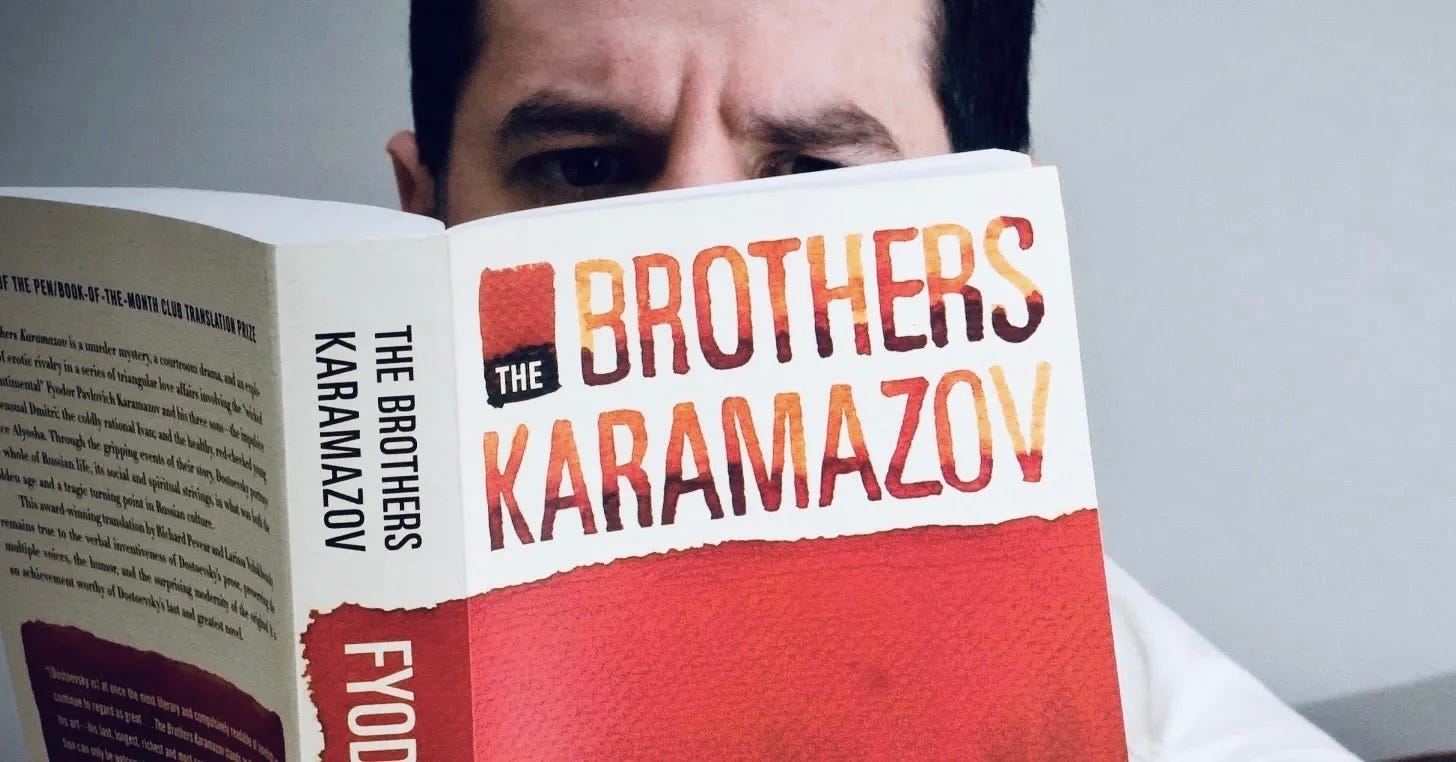
Great. Do you want to say your stupid joke? You know this is the last time you’re allowed to use it.
I sometimes say I’ve quit The Brothers Karamazov more times than other people quit smoking. Not anymore. I finally dropped the bad habit! If I had a nickel for every time I avoided the book, I could have bought two houses by now.
Congratulations, I suppose. Welcome to what probably millions have already accomplished. I mean, I’ve read it too; so, it’s not much of a brag, is it?
. . .
What surprised you most?
That it was actually easy, maybe, nearly unputdownable. I read it in about two weeks. Previously, I’d bounce off an invisible wall of boredom and disinterest around page 100. I was never quite resigned to that fate, however. I knew I’d eventually come back to it and find my way to the end.
Did you struggle at all with the usual complaints: challenging names, the rambling, discursive style, all that?
For whatever reason, not this time through. I read the David McDuff translation.
Not one of the better regarded . . .
True, but it’s serviceable. I think probably all modern translations are fine, honestly. I don’t buy the idea that any one translation so vastly exceeds the others that we should only allow our eyes to absorb that one cherished, sainted version.
Once you’re really in it, all the standard complaints disappear, including the pedantry about the “right” translation. Yes, Dostoevsky is all over the place. Yes, there are more names to manage than a phone book. Yes, yes, yes. But who cares?
It’s actually a breeze, and a thousand pages blow by. You just need—I certainly needed—my sails pointed in the right direction. Maybe that’s what Crime and Punishment did for me.
Now having finished both, I’d say The Brothers Karamazov is the better novel.
You’re wrong about that.
Crime and Punishment is dark, claustrophobic, and oppressive, like the ceiling is coming down on your head.
Yes, but you can’t stop reading because cramming all that drama through such a narrow aperture creates a sense of propulsion. You’re confined within the murderer Raskolnikov’s fevered brain as he frets his way to the conclusion. Hold on! Or you’ll get blown off the back.
Okay, but The Brothers Karamazov has those same propulsive episodes, too. You’ve got Dmitry’s midnight bacchanal, Ivan’s story of the Grand Inquisitor, and his conversation with the devil. But on the whole, the novel is more airy and exuberant, even comical, despite the fact it’s about a murder.
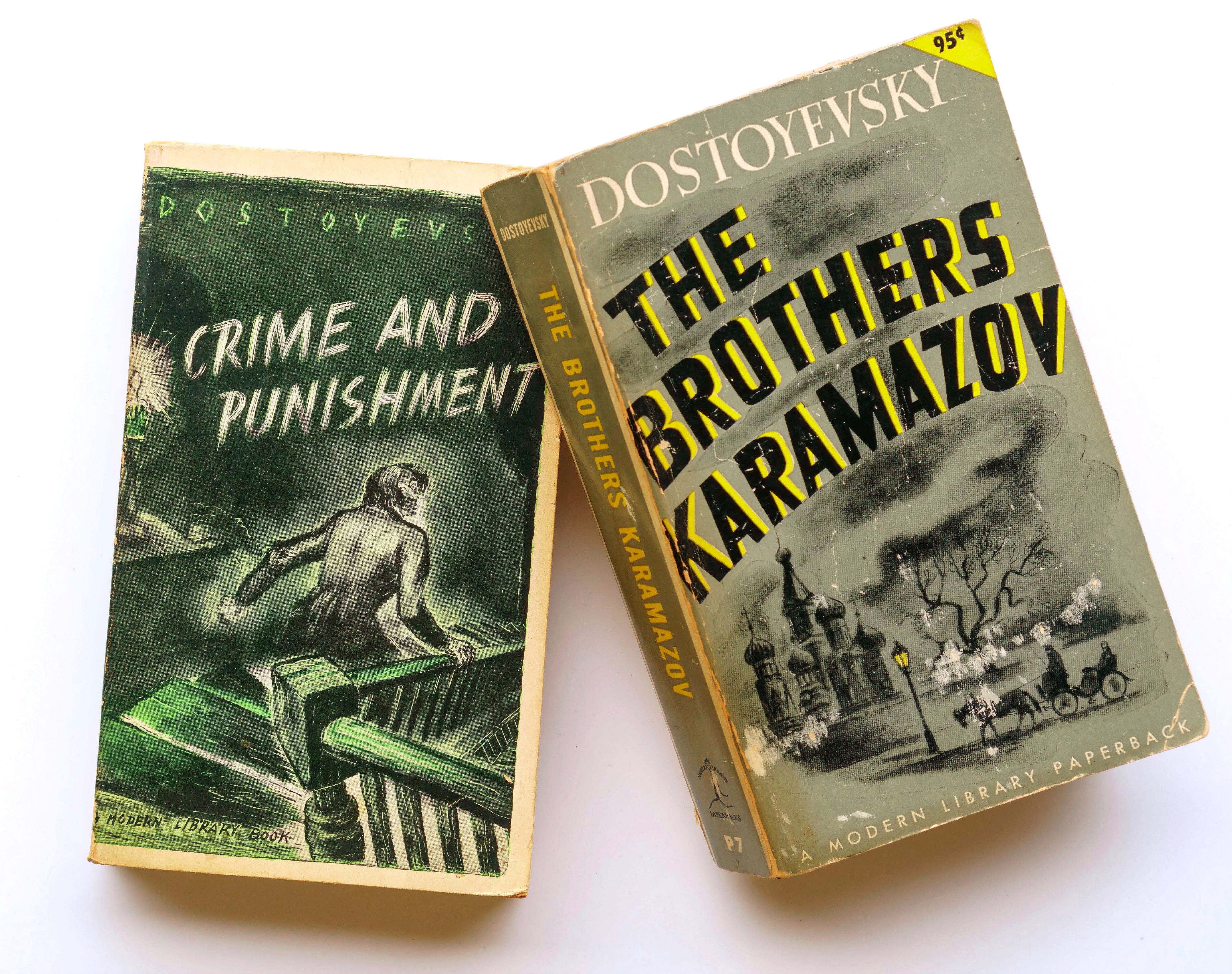
Did that surprise you? So far, I’ve only read two novels by Dostoevsky, same as you—unless you’re somehow reading behind my back. Both turn on murder.
True crime and crime fiction was a big deal in Russia at the time, apparently. The government had recently opened the courts for public attendance and also expanded press freedom. According to literary critic Jennifer Wilson, “The two developments created a Russian reading public that was rabid for shocking tales of murder and a liberated press that was happy to supply them.”
So Dostoevsky was capitalizing on the trend?
Sure. He was writing about people amid social and cultural upheaval. The nineteenth century was boiling with ideas, progressive proposals, reactionary responses, and all the people in the middle trying to work it out for themselves.
But it’s not like Dostoevsky was going to write a treatise or a manifesto or whatever. He was a novelist. Crime stories gave him a vehicle to explore the direction Russian society was headed in a mode he could exploit.
This is where we probably wander into a real disagreement.
How so?
Well, one standard treatment of the novel, which it sounds like you’re endorsing, is to essentially back-read the Bolshevik Revolution into it, and elevate Dostoevsky as some kind of prophet who saw all this doom descending on his country. The book was written, what, almost forty years before everything hit the fan.
Maybe, but if we’re going to have it out, I think we need to set up the basic storyline.
Start with the three titular brothers.
Dmitry is the oldest. He’s sensual and impulsive, a total hothead. Aggrieved that his father, Fyodor, has squandered his inheritance, Dmitry believes he’s owed a substantial sum.
Worse, though he’s engaged to be married, he’s infatuated with another woman, Grushenka, and his father is loopy for the same woman. Father and son are bound to tangle.
Right, then there’s Ivan, the ambidextrous atheist who can play the religious game when needed but who submits to no real authority higher than himself. All three boys were foisted off on others to raise, but Ivan comes home as a young adult and, despite loathing his father, gets along with him. Fyodor assumes he’s loyal and faithful but has no idea what creatures are growling behind the boy’s eyes.
And then, finally, we have the youngest of the dysfunctional brood—
Maury Povich would’ve strangled his own mother for an hour with these people—
I can’t believe you said that, but yes. The youngest, Alyosha. Contemplating becoming a monk, Alyosha genuinely loves his father and both brothers, despite the fact none of them are lovable—not even very likable—and all fail to understand him in the slightest.
But this is where the cookie-cutter interpretation takes over, isn’t it? These aren’t characters so much as templates. Dmitry is the mass of Russian society, Ivan the new breed of radical, and Alyosha the faithful Orthodox Christian whose way of life represents the only real reconciliation and thus salvation for the nation.
Wait, before we get there, we’ve got the murder. The father, Fyodor, is a repulsive fool with no trouble making enemies and finally gets it. They find him dead in his house with his money missing.
I think any reader will easily track up to this point and follow the narrative like a standard crime narrative. The question of who killed Dad drives the plot. You’ve got suspects, motives, a trial—all the basic pantry items for baking a flavorful whodunit.
But then Dostoevsky complicates the recipe. In some ways, the guilty party is beside the point—at least in the sense that the typical murder mystery reader would care.
You’re going to spoil it if you’re not careful.
No, I’m just saying that Dostoevsky is not interested in a doing a typical procedural. He’s up to something else, and that gets you headed in the direction of the ideological reading—I reject that label, by the way—that you’re rejecting.
You can’t have it both ways. Either this is the most disappointing murder mystery ever written, or Dostoevsky has another point in mind.
I would like to introduce you to the concept of the false dilemma. I can accept that Dostoevsky isn’t Erle Stanley Gardner without buying your paint-by-numbers interpretation.
I haven’t even offered an interpretation yet. You’re projecting.
Then how do you read it?
Disintegration. The whole novel is a study in what happens when people lie to themselves—about what they believe, about what they want, about the gap between their ideas and their actions.
Early on, we meet Father Zosima, the elder at the monastery where Alyosha is a novice. Zosima is the spiritual center of the novel, and one of his core teachings concerns the danger of lying to yourself. The person who lies to himself, Zosima warns, loses the ability to sort the bogus from the believably true.
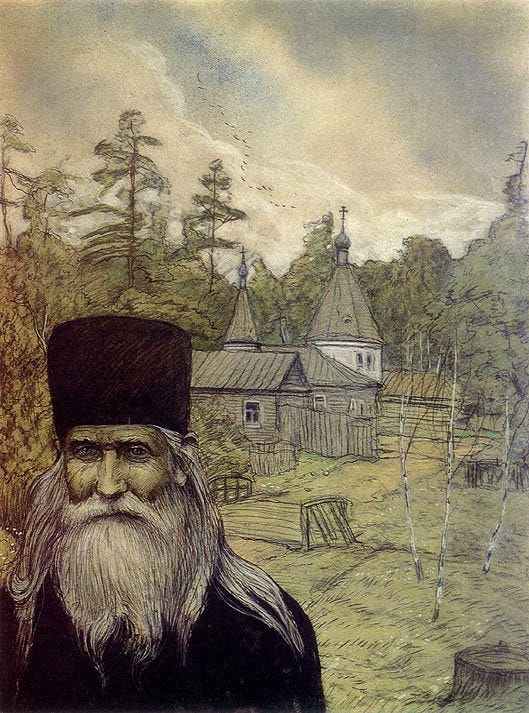
It sounds like a monastic chestnut, but it’s the key to the entire novel. Because what Dostoevsky keeps showing us is that self-deception results in disintegration. Your ideas say one thing; your life says another. And as the gap widens, you can’t psychologically cohere any longer. You fracture.
Show me how that works with each brother.
Dmitry is all action, no thought. He’s the easiest to read because his self-deception is the thinnest. He knows he’s dissolute and degraded. He knows he’s capable of violence. But he keeps telling himself a story about his own nobility (his honor, his officer’s code) that doesn’t survive contact with his actual behavior—excluding one blazing insight near the end.
Ivan is the more dangerous case, because his self-deception is sophisticated enough to pass for philosophy. You prefer Crime and Punishment; Ivan is one half of Raskolnikov. All theory and no action. There’s a fundamental dishonesty in his character—no integration between what he believes and does.
He’s constructed an elaborate case that without God, everything is permitted. For him it’s an intellectual game. But ideas don’t idle in the salon. They wander outdoors; they enter other minds and have consequences.
You’re coming dangerously close to ruining the story as far as one of the suspects goes.
How am I supposed to say more without saying more? Let’s just say that others, whom I shall leave unnamed, suffer from the reverse problem. They’re stupid enough to act but don’t have any ideas of their own. It’s a perverse division of labor for moral evasion: the intellectual gets plausible deniability and his agents get permission.
Fair enough. And Alyosha?
Alyosha is the opposite of Ivan, and he’s the only major character who’s fully honest with himself, despite all the struggles that presents him. And on that note, let me just argue with someone not in the room right now.
I’ve heard several people say Alyosha is just too good; he’s not believable. I don’t get that. Dostoevsky repeatedly places him in spots that test any sort of integrity he possesses. He stumbles through like anyone attempting to live true to his convictions. That’s not only believable, it’s almost boringly normal. This is why you’re wrong about the template comment, too. Each of the main characters is fully realized given the stuff they’re made of.
But the point is that where Ivan’s incoherence drives him nearly mad—or actually so—Alyosha’s integration produces a coherent ethic rooted in love with the moral courage to live it out.
So, this is an ideological reading. The clever will sit and burble in their parlors, while the clamjamfry will take those ideas into the streets. The nation will suffer dire consequences because of the dangerous ideas of the intellectuals and the mindless actions of the common people. Meanwhile, the only person capable of resisting such a future is someone who, in your terms, is fully integrated—and whose integration tends toward the good.
Frankly, I don’t see how this isn’t just back-reading the Bolsheviks into the book.
Forget the Bolsheviks!
Give me a second. The interpretation does have one virtue: It might help make sense of puzzling subplot—the boys. Woven through the main plot is a storyline involving a group of school kids and Alyosha’s friendship with them. On first reading, these sections feel extraneous, Dostoevsky just being undisciplined. Paid by the page? But on your reading you can see them as part of Dostoevsky’s warning—maybe even his counterproposal.
Supposedly, Dostoevsky originally intended to write a novel about the youth of Russia. And then his son, incidentally named Alyosha, died. It drained the life from Dostoevsky.
(I find it telling, by the way, that he not only names his most virtuous character after his departed son but gives his buffoonish murder victim the name Fyodor. And I accused you of projection.)
Ivan’s philosophical rebellion is the novel’s great question: Can God be justified in a world that tortures children? That’s the backdrop for his Grand Inquisitor story. And Christ’s only answer for all the misery in the world is a kiss. How does that suffice? Especially when you realize that Dostoevsky is writing this in the wake of his own son’s death. Alyosha’s patient, embodied love for actual children is the answer.
But if I take your reading correctly, that’s really only half the explanation for why the subplot exists. The boy Kolya is a Raskolnikov—maybe even a Bolshevik—in waiting. He’s brilliant, precocious, already posturing with borrowed ideas about socialism and rationalism. He could become another Ivan. Or he could follow Alyosha. Your reading not only makes sense of his character but also the ideological reading you seem attached to—precisely because he’s a child and therefore represents the future and its possibilities, both good and terrible.
And Dostoevsky leaves his fate undecided at the novel’s end—again, pointing to future possibilities. So, you’re conceding my point?
No. But it’s the least boring thing you’ve suggested. What about Elder Zosima’s rotting corpse: How does that work with your integration idea? He preaches holiness, but in Orthodox understanding incorruptibility is a mark of sainthood. And yet, despite his reputation for sanctity, when he dies his body immediately begins to stink. It’s like a judgment, right? Meanwhile, at the funeral of Ilyusha—another of the boys and not particularly holy—the casket emits no smell of death. How do you square that?
I can’t exactly. The monks are scandalized. But grace doesn’t always square with merit. There’s nothing incongruous about that, at least not in Christian terms.
Of course there is! Your reading depends on knowing these people by their fruit, and Zosima leaves a barrel of rotten apples.
No, I don’t think so. My disintegration argument hinges on self-deception. Zosima wasn’t deceived; the problem is that everyone around him is. They’ve told themselves a story about what sanctity looks like and expect a miracle of incorruptibility as a result.
If anything Dostoevsky uses the scandal as a test of Alyosha’s integration. He attends Zosima during his life; few people know him better. Will he trust the evidence of his own experience, or succumb to the pressure of the crowd?
This is exactly what I was getting at earlier, saying that Alyosha is not portrayed as simply, uncomplicatedly good. Zosima’s corpse is a crisis for him. If he believes the lie that Zosima wasn’t who he witnessed on a daily basis, he falls apart. If he resists the lie, he maintains his integrity. Alyosha passes the test—it’s the one event that validates everything he does next, back to his coherent ethic of love with the moral courage to live it out.
I take your point, but I think I’m with Karl Ove Knausgaard. It’s not about the ideological struggle or any of that. Knausgaard says the minute we step back from the novel and try to see it as about freedom or obligation or morality, we’re losing sight of what it really is.
Say more.
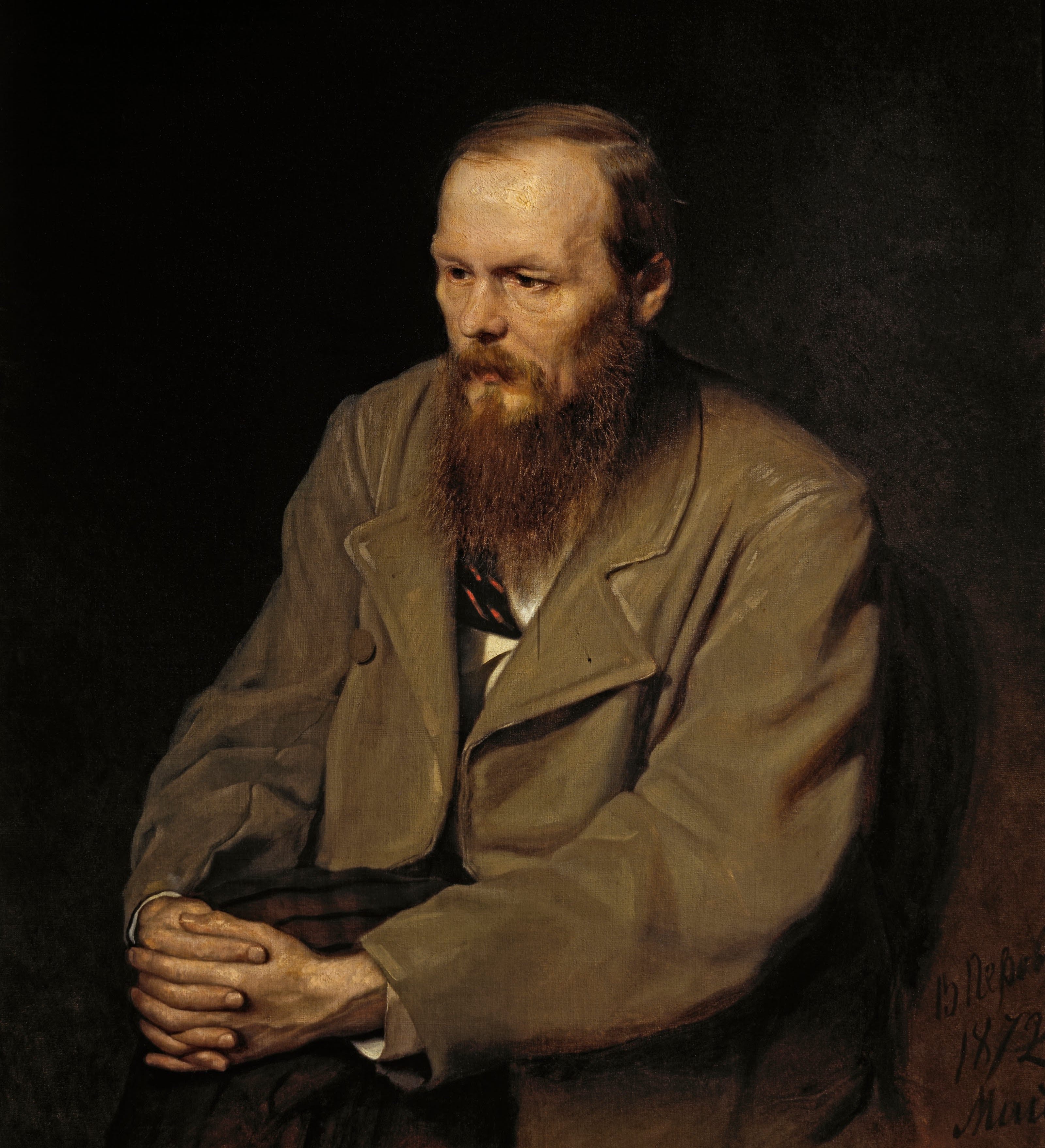
Well, focus on the ideological angle. It reduces all the verve and vitality of these characters to abstractions. Suddenly, they’re all just premises in an argument. Who wants to read that?
I mean, plenty. Even people like me who struggle multiple times to get through it.
Yes! Because there’s something more here than a thesis dressed up in costumes. The ideological thing gets it backwards. Knausgaard says, “If this novel is drawn toward anything it is to the place where ideas and abstractions dissolve into life.” There’s simply too much life here to boil it down to a battle of ideas, or faiths, or philosophies, or what have you. You’re killing the book when you do that.
I didn’t find that killed the book at all.
Because you didn’t understand what was happening when you read it.
When you’re in the story, it has an energy that comes directly from the sheer life of it all, the characters, their animosities, their fears, their doubts, all the stuff that humans feel and deal with. You’re reading yourself in that; the characters hijack your cognitive and emotional faculties and put them to their ends. But the minute you step out from that immersion and try to dissect it with this ideological argle-bargle, you sour the magic.
That’s what I mean by saying you’re reducing the characters to templates. They’re nothing of the sort! They’re people. And they’re recognizably like us in a thousand ways.
I’m not conceding an inch, but what’s good about your approach is that it does allow the multivocality of the story to mean something. One feature of the story is the insane number of perspectives—most of which clash. I’ve seen many people describe the novel as polyphonic or even cacophonous. All these voices competing to be heard.
Knausgaard says that.
I think everyone says that. Wilson, who I quoted earlier, she says that too. She also says the story “unfurls at the mad and authentic pace of human emotion.”
That’s how it captures some of the sorcery of Crime and Punishment.
But here we disagree again. The Brothers Karamazov does that at, like, ten times the scale and intensity. It’s not just a battle of ideologies—and I still reject that term—it’s a battle of conflicting wills and emotions. I also have to push back at your template characterization. The characters aren’t caricatures; they’re fully realized.
But that’s precisely why it doesn’t do to reduce them to ideas; they’re not! If they were, then Dostoevsky wouldn’t care for them all the way he does. Alyosha would simply emerge as the winner of the struggle, but he doesn’t. Everyone’s perspective is challenged, and everyone’s position is treated as if it’s legitimate on its own terms—even Fyodor’s terrible way of living. Very little is actually resolved in the story, right? You’d have to admit that.
True. But that doesn’t mean that Dostoevsky wasn’t trying to say something through these fully realized characters.
Maybe. But that’s the only reason you’d read a thousand pages about them—the fact that they suffer and strive like us: because they are us. Lean too far your direction and you suck the life out of what Dostoevsky was trying to do.
But lean too far your direction and you completely miss what he was trying to do.
One thing I like about your approach is that by highlighting the multivocality of it—all those competing perspectives crammed into the skulls of incredibly relatable characters—it brings the relevance of novel into the present day. The limitation of my view is that it risks ossifying the interpretation into something that feels of its time. But the book is timeless precisely because it speaks to the present moment with all our competing truth claims and arguments about which way is up.
We’re living in Dostoevsky’s world, or at least this novelization of it.
Yes. On that we can agree.
Which our therapist will probably appreciate.
I was going to say the same thing.
I’m reading twelve big-ass classic novels this year, but I’m throwing in some bonuses! Fyodor Dostoevsky’s The Brothers Karamazov was one of my supplementals. Here’s the full schedule for 2026. I’m reading Dickens’s David Copperfield right now.
January: John Steinbeck, East of Eden
February: Wilkie Collins, The Woman in White
March: Fyodor Dostoevsky, Crime and Punishment
April: Charles Dickens, David Copperfield
May: Henry Fielding, Tom Jones
June: Laurence Sterne, Tristram Shandy
July: Miguel de Cervantes, Don Quixote
August: Herman Melville, Moby-Dick
September: Leo Tolstoy, War and Peace
October: Vasily Grossman, Life and Fate
November: Denis Johnson, Tree of Smoke
December: George Eliot, Daniel Deronda
Thanks for reading! If you enjoyed this post, please hit the ❤️ below and share it with your friends (even if they’re part of an impossibly dysfunctional family).
Not a subscriber? Take a moment and sign up. I’ll send you my top-fifteen quotes about books and reading. Thanks again!
And check out my new book, The Idea Machine: How Books Built Our World and Shape Our Future—one of Big Think’s favorite books for 2025.👇

See also John Stamp’s guest review of Michael R. Katz’s translation of The Brothers Karamazov.👇


I read Crime and Punishment a couple of years ago. I detested it. I've been wondering ever since about why Dostoyevsky has been having such a moment of late (apart from him being Jordan Peterson's favorite author).
I think you have made me see why in this essay. You clearly had immense fun writing it. And looking back on Crime and Punishment, I can readily see that it would be great fun to write essays about it too. Not fun to read, but fun to analyze. And from all the analysis of The Brothers Karamazov that I have read, I can tell that it must be even more fun to analyze.
I'm not sure how I feel about this. People are entitled to their enjoyments, of course. And it seems that the development of literary studies has created a whole new hobby, which, like many hobbies before it, has become for many a profession. And it makes sense that if you are steeped in this hobby of literary interpretation, either as an amateur or as a professional, that you will tend to rank books based not on whether they are a joy to read but on whether they are a joy to analyze. So I guess that's okay. It just isn't what I want from a novel.
The kind of book that you read and then close with perhaps a tear in the eye and a deeply satisfying feeling that there is nothing more to be said, and that to speak now would be to shatter the perfect solitity and joy of the moment, a book that is an absolute and perfect joy to read, is not going to give you the same rush of a adrenaline as one where the last word is just the jumping off point for writing a penetrating analytical essay. I want the former experience, not the latter. If I finish a book and immediately take pen in hand, that means it is a bad book, and I am consumed with the desire to tell the world why it is bad. If I write essays about particular books, it is almost always to refute silly things other people have said in essays about that book, almost never to offer an analysis of my own.
There are, of course, books that are a joy by both standards. Pride and Prejudice is a joy to read and, apparently, a joy to analyze as well, though much of the analysis of it that I have read is patently absurd. Dostoyevsky seems to be in the other camp. Turgid to read but even more fun to analyze.
Each to his own. I have only one plea: do not recommend as a joy to read books which are, in fact, only a joy to analyze but an absolute purgatory to read.
I used the public domain translation, which is not considered the best, to read The Brothers Karamazov, and despite the slogging translation, the brilliance of the book shone through. It is a wild ride. The simile of a troika, the traditional Russian sleigh drawn by three horses (three brothers?) comes to mind: in Russian culture, troika rides are portrayed as insane races across the landscape, pursued by wolfpacks and/or driven by the drunken. That's it! The Brothers Karamazov is a troika of a book.