
Too Much to Read? How Reading Habits Change
A Narrow Review of Joel Halldorf’s ‘Reading Matters: A History for the Digital Age’

In my book The Idea Machine, I contrast two libraries: Machiavelli’s and Montaigne’s. Machiavelli owned maybe a dozen books, some of them copied by his own hand; Montaigne owned a thousand.
Both were men of the Renaissance, but a couple generations divided the pair. Born in 1469 two decades after the dawn of print, Machiavelli’s still trafficked in a manuscript world; born in 1533, Montaigne’s was suffused with print, his entire fame resting on a product of the press: his Essays.
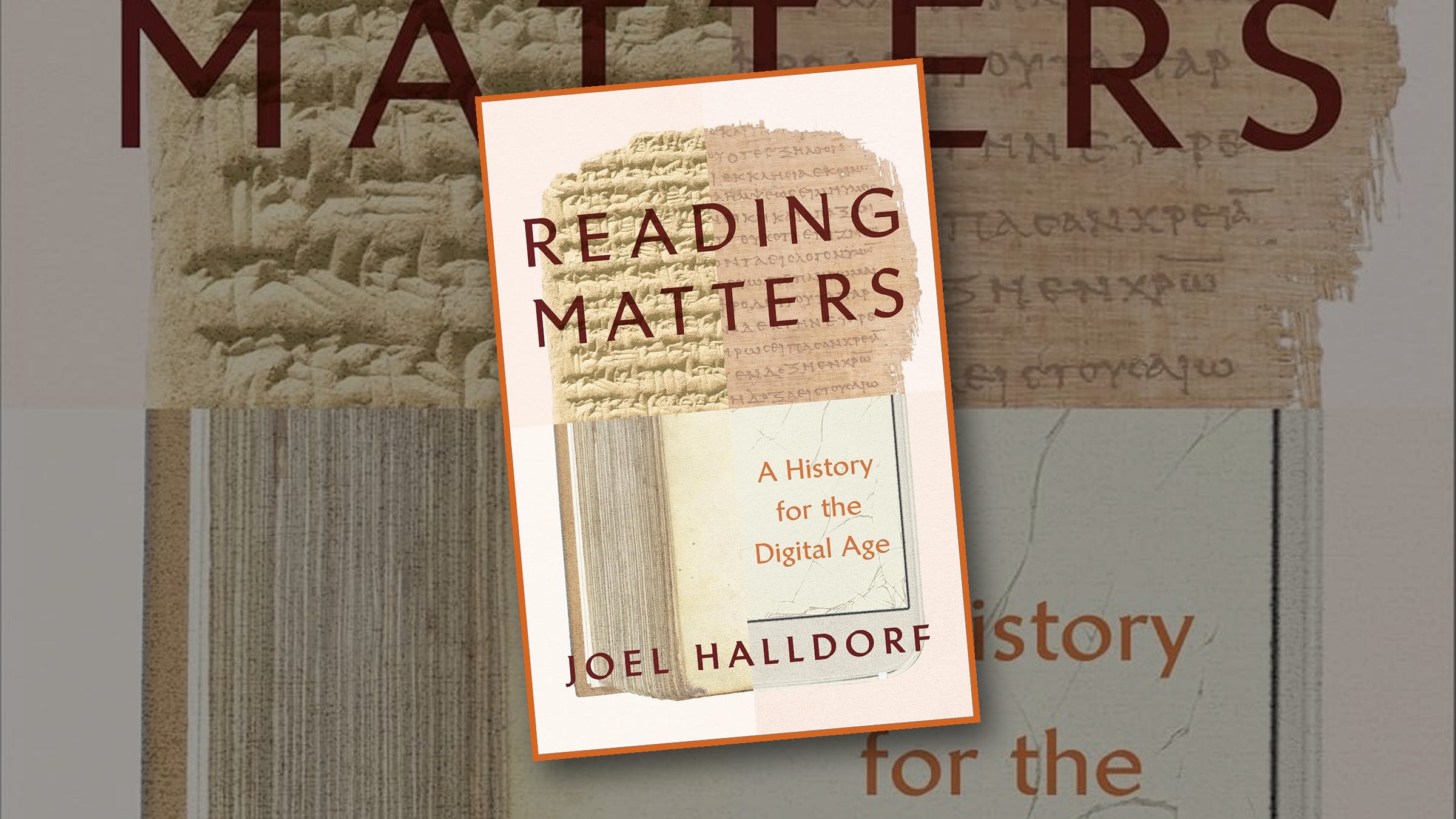
I mention this duo to mention Joel Halldorf’s excellent history of the book, Reading Matters: A History for the Digital Age. I reviewed one aspect of the book for Reason magazine; you can read that here (please do!). But I wanted to return to Reading Matters to discuss an under-considered side of book history; depending on when readers lived along the timeline of bookish evolution, the term reading meant different things. This seems relevant today as we fret about the reading crisis.
Start with Machiavelli and his dozen books. Partial to authors like Thucydides, Plutarch, Tacitus, Livy, Lucretius, and Dante, Machiavelli scoured the books available to him—reading them closely, penetratively, absorbing their observations as he puzzled through the challenges of his own day.
Montaigne on the other hand? His approach was decidedly more casual, more haphazard. “There”—in his library, built in an old tower on his estate—“I leaf through now one book, now another, without order and without plan.” In Florio’s Elizabethan translation, Montaigne “ransack[s]” his books.
Ransack a copy of the Essays for yourself and you can see the result. Each piece is riddled with quotations; every successive edition lards up more. Depending on the sources you consult, Montaigne included some 1,300 verbatim quotations from 100 different authors, and the numbers jump to roughly 2,000 if you include allusions and more than 270 sources if you count unnamed borrowing.


Despite their historical proximity, Machiavelli and Montaigne read differently, a difference attributable to at least three interconnected developments: cultural, technological, and economic. “Change often happens when ideas and material conditions pull in the same direction,” writes Halldorf. I cover some of this ground in The Idea Machine, but Halldorf pays particular, close attention to changing reading habits.
Monks and Schoolmen
As monasticism spread throughout Europe in the Middle Ages, monasteries became the intellectual hubs of the continent. The Benedictines were known for their motto, ora et labora: pray and work. But Halldorf says a more complete motto would have been “pray, work, and study.”
Going back to the earliest days of monasticism, study was part of work: copying manuscripts was grueling; scribes gripe about it in the margins and colophons of their work. “No one can know what efforts are demanded,” penned one. “Three fingers write, two eyes see. One tongue speaks, the entire body labors.” It took an entire day to produce three or four pages. And reading wasn’t any easier; the ancient manuscripts the monks copied were first written in scripta continua, a style inherited from the classical world that jammed the words together with no spaces between them.
This led to a particularly meditative form of reading. There were few books to read, and monks poured over them with scrutiny we have a hard time fathoming today. “The goal,” writes Halldorf,
wasn’t to finish the book as fast as possible but to become immersed in the text and allow it to fill their hearts . . . [B]ooks were not primarily vessels of information but tools for contemplation.
But then came the scholastics.
Irish and Anglo-Saxon scribes began inserting spaces between words to ease reading and improve interpretation, a slow-moving innovation that eventually caught on. Around the same time, thanks to the reforms of Charlemagne, book production ramped up. Add to that mix the influx of translated texts from Muslim lands—especially Aristotle and his Islamic commentators—and Christian Europe had a challenge: managing its ever-expanding libraries and the increasing number of apparent contradictions that multiplied across all these books.
Enter those schoolmen. “Through logic, rigorous analysis, and tireless synthesis, the scholastics aimed to reconcile these contradictions and present a coherent and unified interpretation,” writes Halldorf.
The monks of the older approach disliked this process—hence the tiff between Bernard of Clairvaux and Abelard. What Halldorf argues is that these two men argued downriver of a change in reading habits:
The scholastics practiced a different kind of reading than the old monks: they flipped through books in search of persuasive arguments for their theses. This required an ability to scan texts to grasp their general content and locate specific quotes. In short, sometimes the scholastics skimmed—and this was a mode of reading distinct from the contemplative deep reading practiced in the monasteries.
The cultural development (new ideas to reconcile) matched with technological and economic developments (new, more readable books and gobs of them) to produce a new way of interacting with books—and that new way had repercussions in, first, how theology was done and, subsequently, philosophy, medicine, science, and so on. Halldorf notes that philosopher Ivan Illich called this transition a “bookquake.” Scholars had to develop new tools such as tables of contents, indices, and concordances to help them navigate.
To stay grounded in our comparison of Machiavelli and Montaigne, the former read more like a monk—something that would have amused him to imagine—the latter more like a schoolman. But that’s not strictly true because the scale changes once we throw print and paper into the equation.
The Advent of Print
To get a sense of the scope of this transformation, consider book production statistics. As I document in The Idea Machine and Halldorf explores in Reading Matters, print exploded the number of available books across Europe.
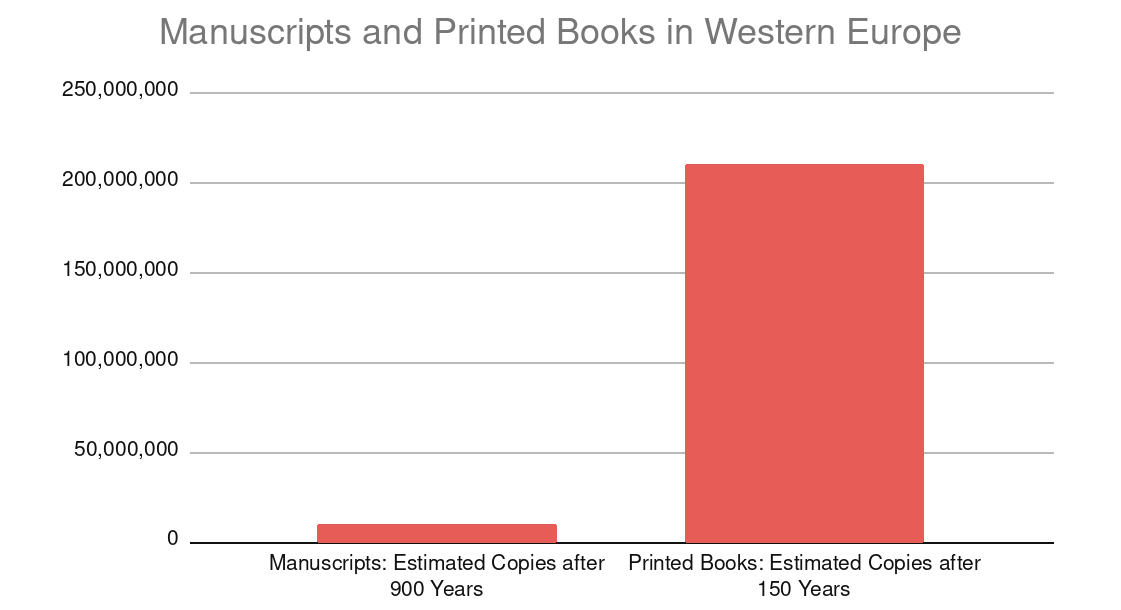
From the sixth to the fifteenth centuries, all those toiling—and occasionally complaining—scribes in Western Europe produced nearly 11 million books by hand; that’s roughly twelve thousand individual copies per year. Yet in just 150 years of print, between 1452 and 1600, printers, aided by cheap and plentiful paper, produced some 212 million; that’s 1.4 million individual copies per year, an increase of 1,846 percent in a blip of the time.1
Machiavelli, born two decades after the advent of print and dying in 1527, participated in only a fraction of this upsurge, whereas Montaigne came eight decades into the press’s transformation of book culture and, dying in 1592, lived to see much more of it. Take his thousand books. Before the printing press, it was typical for the books of an institutional library, such as a monastery’s, to amount to just hundreds of volumes. In the ninth century, monastic libraries such as those of Saint-Riquier, St. Gallen, and Murbach averaged fewer than 300 books. Even the best-endowed libraries—Lorsch at 590 books and Bobbio at 666(!)—shelved a pittance of what Montaigne, a single individual, amassed on his own. The monks poured over a dozen books, the schoolmen scanned and skimmed hundreds, but Montaigne ransacked his thousand, plundering the cornucopia for quotations to build and decorate his essays.
Not everyone was so enthusiastic. Like Bernard fretting over the scholastic reading habits of Abelard, scholars sweated over this torrent of print. “The charts tracking the exponential rise in book production and scientific knowledge during these centuries are indeed impressive,” writes Halldorf, “but they obscure a different reality: the anxiety of the individuals struggling to avoid drowning in the flood of books.”
Halldorf mentions several nervous Nellies, but French scholar Adrien Baillet’s warning, lodged in the late seventeenth century, when book production surpassed 500 million copies, stands as my favorite:
We have reason to fear that the multitude of books which grows every day in a prodigious fashion will make the following centuries fall into a state as barbarous as that of the centuries that followed the fall of the Roman Empire.
The sentiment sounds preposterous because it is; we survived the deluge and averted a second dark age just fine. Baillet couldn’t image an adequate response to the overflow of books and lamented our inevitable decline. But readers responded by changing their habits—changes that, as Montaigne and later writers like Francis Bacon show, were already underway when Baillet wrote.
Hard Study and Mere Reading
Decades before Baillet’s dire prediction, Bacon suggested readers manage the influx of books by treating them differently. “Some books are to be tasted,” he wrote, “others to be swallowed, and some few to be chewed and digested; that is, some books are to be read only in parts; others to be read, but not curiously; and some few to be read wholly, and with diligence and attention”—three modes of reading applied as the individual books warrant.
To be sure, as Halldorf also mentions, all three forms of reading were available to readers prior to the avalanche; though he had slaves read to him, for instance, Pliny the Elder used books more like the scholastics than the monks. But cultural, technological, and economic changes pushed readers to adapt their habits to the new environment.
Nor did the changing reading habits replace each other. As new approaches came to the fore, the old ones were still available. “The introduction of new reading practices did not mean that old ways disappeared,” says Halldorf. Even with the flood of books, one could still read intensely like a monk, extensively like a schoolman, or haphazardly like Montaigne. “Although cursory reading gained prominence, slow, deep reading never disappeared.”
And further developments of these practices would continue. Halldorf points to Samuel Johnson, “one of the Enlightenment’s most iconic readers,” for yet another classification of reading habits, required by further changes in the reading world, including the spread of newspapers and periodicals. Says Halldorf,
He identified four distinct modes of reading: “hard study,” which involved taking notes; “perusal,” meaning consulting only a specific part of a work; “curious reading,” the kind of engagement one has with a novel; and “mere reading,” which involved quickly skimming a text.
Which is best? It depends on what one needs and wants from the text a person is reading. An abundance of text requires choices about individual purposes. When I was working on The Idea Machine I poured over some sources and skimmed others, depending on my needs. When I read the scripture, I read it differently than I do a novel. When I read Montaigne’s Essays—one of life’s singular delights—I read them differently than Twitter. And yet . . .
When Nobody Reads Anything
Modern anxieties about the decline of reading are more than understandable. As anyone who’s read this newsletter for very long knows, I share them. But Bernard and Baillet were wrong, insofar as reading goes. Reading habits change as the reading environment changes, always have, and in the moment we’re often wrong about what those changes mean.
“It may well be,” said critic George Steiner, “that the ‘age of the book’ in its classical sense is now coming to a very gradual end.” Steiner pointed to the 1950s, a time we regard today as a period of maximal literacy, as the beginning of the end. Importantly, he said this in 1988—before the dawn of the internet and the digital era.
The book is always dying, yet the book lives on. Until it doesn’t. That’s the concern today with all our talk of postliteracy, best exemplified by Rose Horowitch’s recent Atlantic article on the end of reading. Halldorf engages directly with these concerns in Reading Matters. “The trend is clear,” he writes, “we are moving away from print, and towards digital media,” and that digital media includes all manner of titillation other than text. Reading is changing yet again.

Monastic attention is still available to us, but the media environment nudges against it. Online reading tends to favor “skimming, scanning, and skipping”—a tradeoff that undermines deep reading, the sort of chewing and digesting Bacon discussed, the hard study Dr. Johnson talked about.
Despite the challenges of the digital era, Halldorf holds out hope for books. As digital environments moves at speeds uncomfortable for humans to maintain, logging off and leaning into a book offers mental and emotional respite and rejuvenation. “More than ever,” he says,
we need practices that allow us to step out of the whirlwind: slow down, take a breath, gather our thoughts, and simply be present. Books can help us do that—if we use them as the old monks did: not merely as vessels of information but as tools for contemplation. Unhurried reading without distractions offer a much-needed refuge from the acceleration originally set in motion by the printing press. Printed books are a technology that can augment our ability to be attentive.
But, he warns, we can’t focus on the supposed utilitarian benefits of books to make the case. It’s not about what we learn or how they improve our focus, helpful as those features of reading may be.
Its greatest benefit? Reading offers joy and catharsis through a singular kind of experience digital media can’t compete with, the lengthy immersion into another consciousness, another mind and heart. As long as humans crave that experience, reading will persist, whatever shape it takes. Whatever their differences, Machiavelli and Montaigne would both approve.
Thank you for reading! If you enjoyed this post, please hit the ❤️ below, 💬 discuss, and share it with your friends—or anyone you know who loves reading.
Not a subscriber? Take a moment and sign up. Free subscribers get two-week access to all new posts. Paid subscribers get access to the full archive, going back to 2022, plus an exclusive member chat and monthly member calls.
Before you go, check these out👇


Based on estimates in Eltjo Buringh and Jan Luiten van Zanden, “Charting the ‘Rise of the West’,” Journal of Economic History, June 2009; Eltjo Buringh, Medieval Manuscript Production in the Latin West (Brill, 2011); Frédéric Barbier, Gutenberg’s Europe (Polity, 2017); and Lucien Febvre and Henri-Jean Martin, The Coming of the Book (Verso, 2010).
The nature of who was encouraging and endorsing writing also changed between their lifetimes. Machiavelli wrote "The Prince" as a commission, whereas Montaigne wrote his essays on his own time and at his own pleasure.
As always, a thought-provoking review, Joel. I think we're dealing with something more than changing reading habits. Based on my own experience, I believe being online a lot "rewires" my brain, so that it takes a real effort to be able to immerse myself in a book for an extended period of time. I don't know if many people will be willing to make that effort in the future.