


I’ve been writing for screen for twenty-seven years, and in that time I’ve adapted ten novels—everything from Val McDermid’s harrowing psychological thriller The Torment of Others through to Joanna Nadin’s moving portrait of a childhood in crisis, Joe All Alone.
Ten times over, I’ve taken someone else’s meticulously crafted work of imagination, disassembled it into its component pieces, spread them all out on the table, thrown half of them away, changed others entirely, and then bolted things back together.
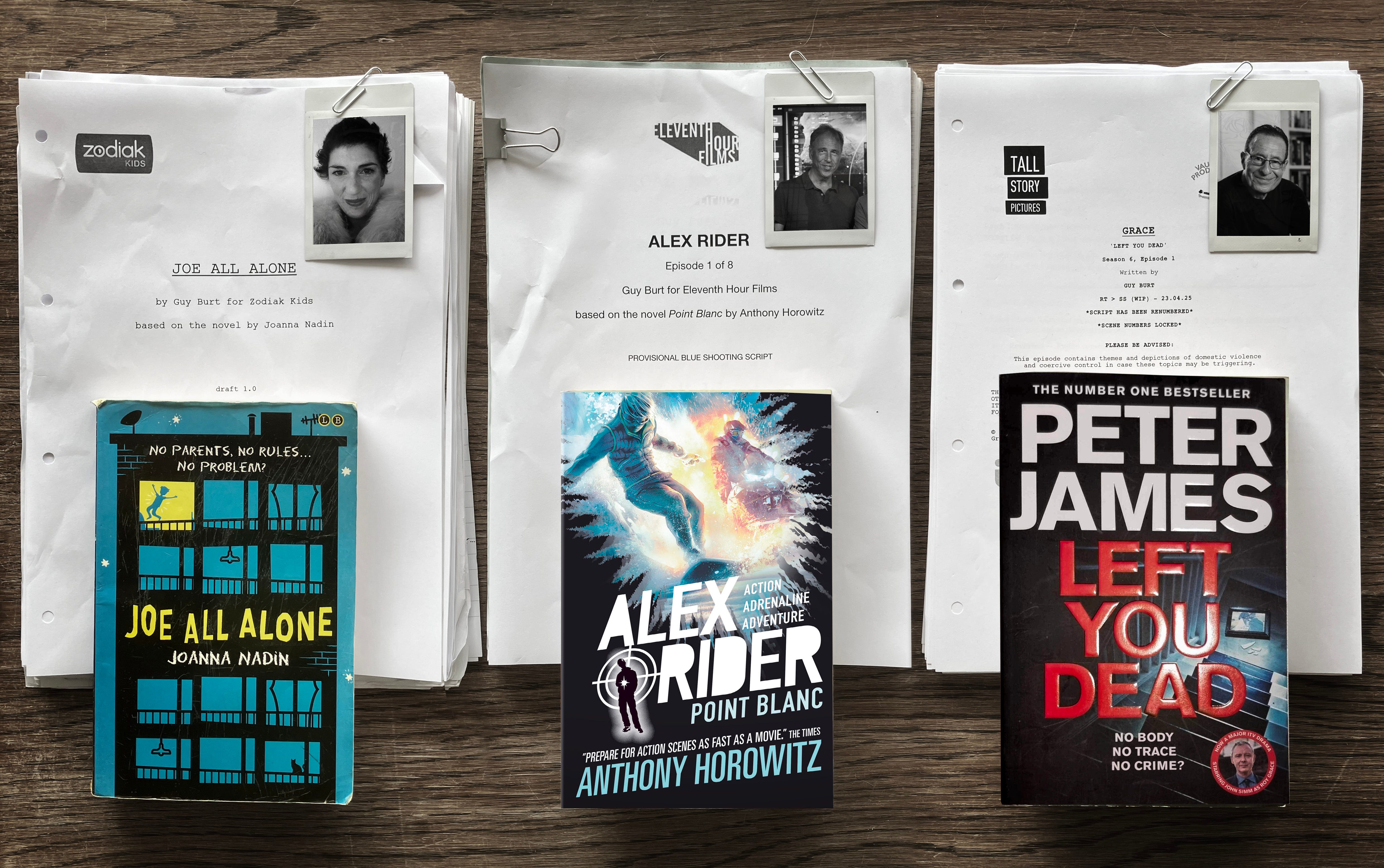
The result is supposed to be a different engine carrying the same emotional cargo; but for anyone who’s seen a beloved book butchered in adaptation, the risk of failure is obvious. This is a process that can be genuinely magical when it works, but there are an awful lot of ways it can go wrong.
I’m more than a little obsessed by this risk, not just because navigating it is part of my livelihood, but because I’ve seen the machine from both sides, and I know exactly how it feels when what lands on the screen is not what was in the author’s head. In fact, I owe my screenwriting career to a novel adaptation I failed to write.
Down a Hole
The book in question was my debut, After the Hole, a dark psychological story which I had largely written during my gap year, about a group of teenagers locked in an underground cellar. A young director called Nick Hamm read it, liked it, and asked me if I wanted to have a stab at adapting it.
I was, at this point, hopelessly unaware of what a screenplay looked like. My first draft was 250 pages long and read a lot like a novel. Nick gently suggested that this was perhaps a stretch—it would have made the film more than four hours long—and gave me some actual film scripts to read, for pointers. (I remember one of them was an early version of Four Weddings and a Funeral.)
I wrote perhaps half a dozen further (shorter) versions of the screenplay while I was at university. It was fascinating and fun, and the world of film was heady and exciting: We went to New York! We workshopped it with real actors! A huge man called Harvey Weinstein said it was too British! The whole experience was faintly unreal but also pretty cool for a bookish, rather nerdy Eng Lit student who really just wanted to write stories.
Eventually, though, I had to make a decision between another redraft and concentrating on my university exams. I chose the exams; the job of adapting my novel was handed to someone else; years went by.
Finally, the film—now titled The Hole—was released in 2001, with Keira Knightley and Thora Birch in lead roles. I was at the first private screening. I remember the lights going down and the audience settling and the film starting. And then, for two hours, the strangest mix of emotions: because what I was seeing on screen was really nothing like my book.
The characters weren’t as I knew them. The claustrophobic cellar room was now a huge, expansive set full of visual interest. And, perhaps most strikingly, the film had committed to decisions—about the ending, about the characters, about tone—that were very different to my own.
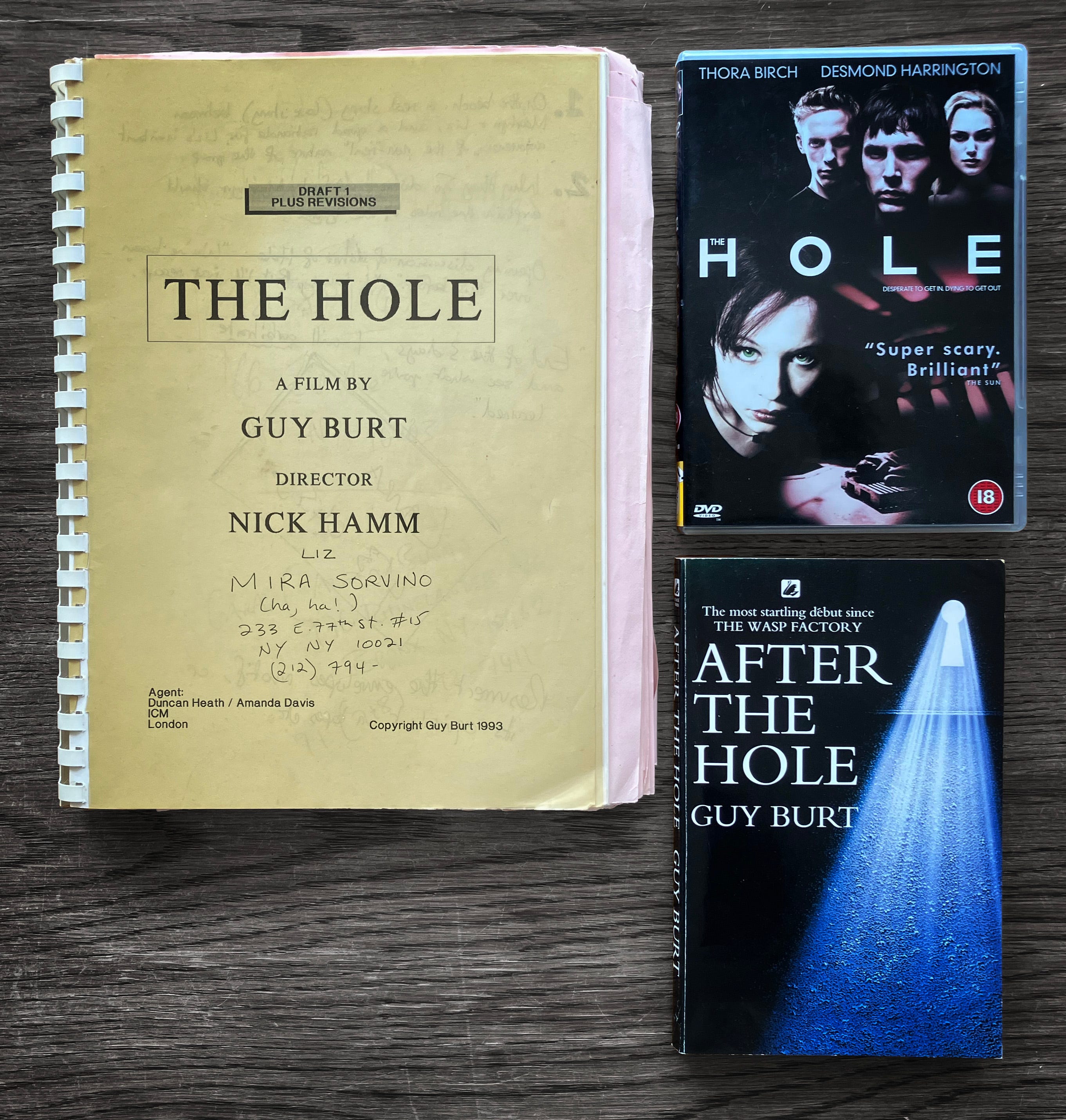
It was abruptly clear to me just how much this was no longer my story. A psychological drama about teenagers had become a horror story for teenagers, and it left me a bit perplexed: I could see that the film was actually very good at what it was doing. It just wasn’t doing what I felt the book had done.
Do the Authors Count?
Anthony Horowitz is a hugely prolific novelist and screenwriter, author of the phenomenally successful Alex Rider books and creator of Foyle’s War and Midsomer Murders—and a host of others. He told me recently, “I remember the advice given to me by an older writer many years ago. You have a book. It is yours. You love it and you treasure it. It is perfect. But the moment you hand it over, it belongs to someone else. It has nothing to do with you. If you don’t like the sound of this, don’t sell the option.”
But no one had mentioned any of that when I was nineteen.
In a lot of ways, The Hole was great for me. Although in the end the film didn’t feel much like my book, and my name wasn’t on the screenplay, the fact that it was actually a project in development based on a novel I’d written helped me get my foot in a few production office doors. My first television drama, The Visitor, starring a very young Daniel Craig, came out in 1999, and it was the start of a career.
Since then, my approach to every book I’ve adapted has been shaped by the experience of having my own first novel adapted, because I know how it feels. I’m acutely conscious of the responsibility I take on when embarking on an adaptation—not just to the production company or the network or the audience, but to the author of the book itself.
But—should it matter what the author thinks? To what extent can an adaptation really be faithful to the book? How far are we entitled to change things—plot, characters, tone—on the journey to the screen? And is there anything a screen adaptation can’t do, or shouldn’t do, that a book can?
These are the kinds of questions that excite and torture screenwriters, but rather than just offer up my own answers, I thought it would be more interesting by far to excite and torture some of the writers whose books I’ve adapted.
Like what you’re reading? Subscribe, and new posts will ride an electron rollercoaster directly to your inbox twice a week. Free subscribers get two-week open access to every post; paid subscribers get the run of the archive, plus bonus content.
Essence and Betrayal
Anthony Horowitz, Peter James, and Joanna Nadin are all bestselling authors in their fields—award-winning writers whose books have delighted readers across the world. I’ve had the privilege of adapting Joanna’s Joe All Alone for children, four of Peter’s Grace novels for adults, and three of Anthony’s Alex Rider novels for family audiences.
I asked them, to start with, how they felt about handing their book over—that moment when, as Anthony put it to me, “it belongs to someone else” and the potential pitfalls of adaptation become starkly visible.
Anthony’s take on this was down-to-earth. “So far, every book of mine has been adapted by me . . . with the exception of the Alex Rider series, which, of course, you adapted. I had already adapted the feature film of Stormbreaker, which, for one reason or another, hadn’t gone well (Harvey Weinstein was largely to blame) so I was happy to hand over the reins and take a back seat. I think I’d have been fairly relaxed even if you hadn’t been the writer.”
Anthony and I first met back in 2002, when I wrote three macabre little dramas for his television series Murder in Mind. Fifteen years later I was delighted to be asked to adapt Alex Rider, not least because by then I had two kids of my own who had devoured the books.
But given the novels’ tremendous, worldwide appeal, there was a definite sense while writing the scripts that the fans of the books were peering over my shoulder. We were “aging up” the stories, making Alex older, and generally aiming for a grittier take on the novels, and I remember being nervous about how Anthony might take these changes. Thankfully—perhaps because he’s a screenwriter himself—he was remarkably sanguine.
“Adapting a book is not a labor of love and certainly not one of obeisance,” he said. “You are taking one thing and turning it into another and that often means major reconstruction, new thinking, even desecration. Look at what the Bond films have done to the original Ian Fleming novels. Outrageous? Well, the result has been a ten-billion-dollar franchise so I don’t think anyone’s complaining.”
Hopefully we kept the desecration to a minimum, but there’s a grayscale between obeisance and being entirely too cavalier with the material. I wondered what Anthony felt most protective about in the books—if there was anything he felt wasn’t up for being altered along the way.
“That’s an interesting question. I think I was only protective of the character of Alex Rider himself—and for a good reason. I’ve been writing about him for twenty-five years. He changed my life. I’m told that over twenty million copies of the books have been sold and children—the next generation—are still reading them. Alex, partly based on my own kids, is almost like a son to me, and I would have been upset if he had been radically altered. I feel that it’s his spirit, his essence, that has made the books successful and that to change that would be a betrayal.”
Attuned to the Spirit
For me, this goes straight to the heart of the screenwriter’s job when adapting a work. Spirit or essence might sound like a nebulous quality, when every screenwriting guide talks about plot points and character arcs and pinches and hinges; but to my mind this is the absolute foundation.
Before I can start imagining what an adaptation would look like, I need to know how the book makes me feel. Everything else can take a back seat: I need to find the tone, the atmosphere, the spirit of the thing, because that is going to inform every single decision from that point forward.
Putting myself on the couch for just a moment: it was the spirit of After the Hole which changed most in its translation to film, and it was that change which I felt most acutely. So it’s perhaps no surprise that I’m attuned to this.
I would agree completely, then, that changing the spirit of the source novel would be a betrayal. But I still wondered if Anthony had any misgivings about allowing someone else to take on the Alex Rider books.
“As I remained an executive producer on the show and was married to the CEO of the company that made it, I had no worries at all. If you are less fortunate than me, you might worry that the film or TV series will be a turkey. But you don’t need to. The book will still be there long after the film is forgotten.”
Peter James isn’t so sure. Peter knows his way around a story: his novels have topped the Sunday Times bestseller lists twenty-one times; his stage shows have taken more than £20 million at the box office; and he’s a successful film producer in his own right. Still, his own experience shows just how badly things can actually go wrong when someone else gets their hands on your book.
“My Grace novels were too precious for me to want to take the risk of them being adapted badly, and for a long time I resisted many offers. Thank God I did. I learned the hard way that whilst a good screen adaptation can have a significant impact on your profile and sales, a bad adaptation can actually damage you.”
Damage Done
I asked him what had happened to bring that point home so hard.
“I was at a party in Brighton in the late 1990s and my novel Host had just been turned into a TV movie by ABC television in the US. It had a (for then) stellar budget of $11 million, and a stellar cast including Mimi Rogers, who used to be married to Tom Cruise, and Robert Vaughn. But it was a terrible interpretation of the novel, missing so much of the essence of the book that had made it a success.
“At the party, I was talking to a builder, having one of those ‘What do you do . . . what do you do?’ conversations. ‘Ah, you’re a writer!’ he said. ‘Anything I might have seen on telly?’ I told him Host (the title had been changed, for some unfathomable reason, to Virtual Obsession) had aired a few days previously. His face fell off a cliff. ‘Look,’ he said, ‘don’t take this the wrong way. The wife and I watched that and we thought it was such crap we would never bother to read you as an author.’”
Ouch. As an example of the wheels coming off, this takes some beating. What strikes me hardest here is that the quality Peter says was missing in this interpretation was the “essence” of the book: exactly the same quality Anthony named, and which is the first thing I’m looking for when I consider adapting a novel.
Not surprisingly, Peter was burned by this experience to the extent that he refused to sell the options for the Grace novels for nearly a decade. When he finally agreed, it was only because he was nudged by someone he trusted implicitly.
“I randomly bumped into an old friend, producer Andrew O’Connor, at the Los Angeles book fair. Andrew and I had worked together on a couple of television series some fifteen years before and he is a man of absolute integrity. Over a game of tennis, he asked what was happening with Grace coming to television, and I told him that nothing was happening. He said he would love to make it. I told him I would love to work with him again.”
Peter and Andrew took the project to Polly Hill, head of drama at ITV. When Peter told me her reaction, I was astonished and impressed.
“She was very keen but said the one writer she felt we should use for the first season was Russ Lewis, but he was tied up for the next two years on Endeavour. Would we be willing to wait? I said we would, and it turned out to be a fine decision. Along with Russ producing brilliant scripts, with Andrew I’ve had a very high level of control both in terms of script and casting, and it has been a very happy and creative relationship that looks like continuing for a long time yet.”
Thanks for reading! If you’re finding this post worthwhile, please restack it, hit the ❤️ below, and share.
Grace is now one of ITV’s flagship dramas: I joined it in its fifth season when it was already hugely popular, and it’s clear that Russ’s work was instrumental in propelling that success. The decision to hold off on bringing something so attractive to screen for two whole years, just to get the right person in place for the adaptation, might seem like madness.
Personally, I think it’s inspired, and completely justified: as Peter had already found out, the wrong person in the role might have damaged the show irreparably. And yes, of course as a fellow writer I’d say that. But that doesn’t make it any the less true.
Interpretation, Not Reinvention
Anthony and Peter both went into the adaptation process of their novels with some screen background—as writers, or producers, or both—which gave them a significant degree of control over the scripting and casting choices. By contrast, Joanna Nadin’s initial reactions to having her work adapted were perhaps more in line with what I remember feeling when After the Hole was optioned: the responses of someone coming to all this new.
Joanna’s background encompasses broadcast journalism and being special adviser to the prime minister before she turned to fiction. She has now written over ninety books for children, teenagers, and adults, including the bestselling Rachel Riley series. But Joe All Alone was the first of her novels to be developed for television. The series was nominated for an Emmy and went on to win a BAFTA for Best Children’s Drama.
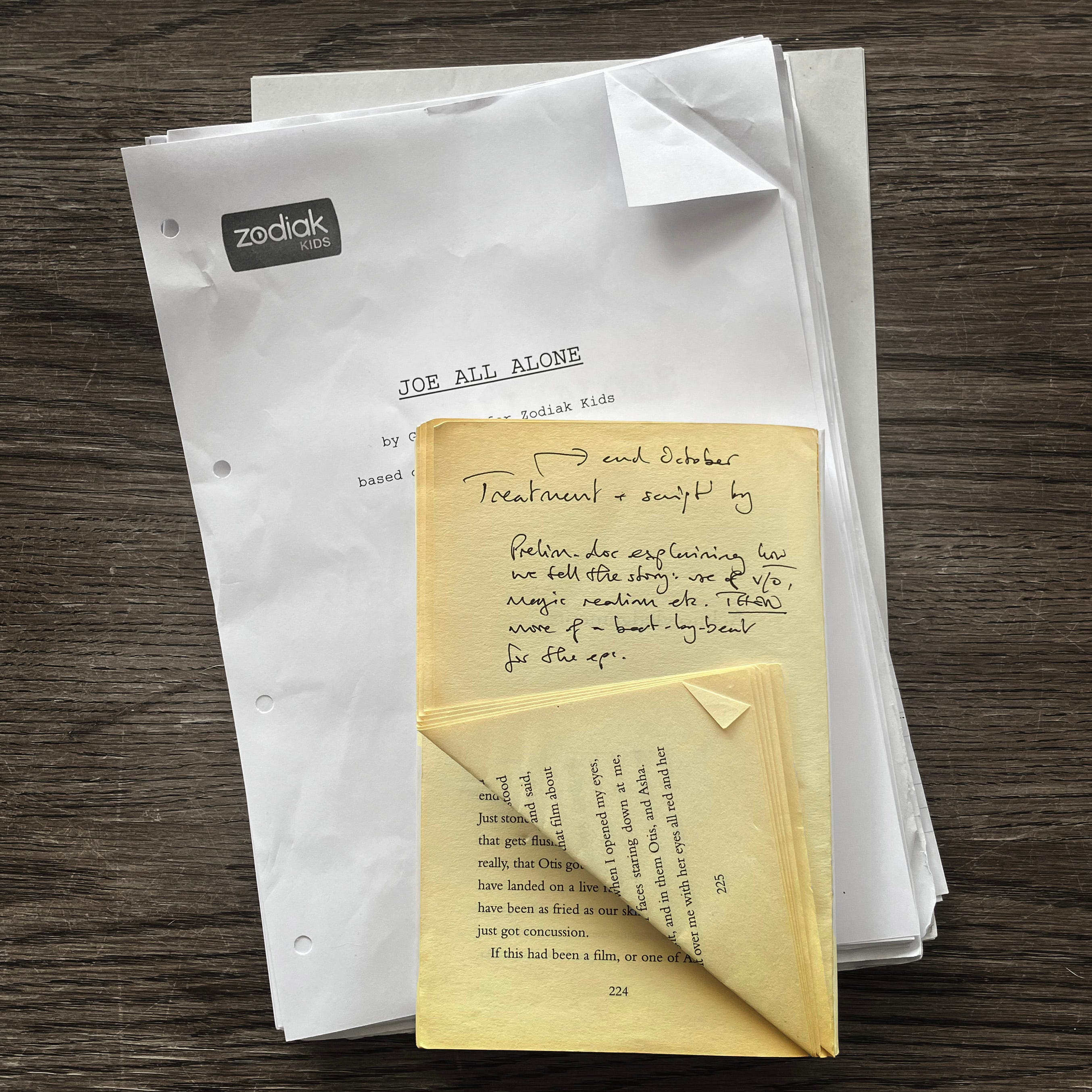
“I was mostly just thrilled that Joe was getting an adaptation at all,” she told me. “But if I had a worry it was that the series would be too ‘light’—shying away from the serious message about poverty and coercive control.”
I knew exactly what she meant, because these were in fact the aspects of the novel that had attracted me to it most and which I was keenest to preserve—and which I felt were most at risk of being diluted or lost.
Joe All Alone is a children’s book, and its beginning looks like an adventure story: Joe, a thirteen-year-old boy, is left alone in his London flat by his mum and her boyfriend while they fly off to Spain. Joe has £10 for food and electricity and is told they’ll be back in a few days, and the initial atmosphere is one of liberty and adventure.
All that changes when Joe’s mum doesn’t come back when she should. I was immediately struck by how the book smuggled social issues in under the radar. It felt essential to make sure those were emphasized in the adaptation, and in particular that we didn’t soften Joanna’s realistic ending (in which Joe is taken into care by social services). I asked her how she’d felt when she first looked at the screenplay’s version of Joe’s life.
“When the script landed I had a lightbulb moment of ‘Ohhhh’—it had gone to places I hadn’t imagined in the book (it felt much darker reading someone else’s version) and had made the most of visual devices that I would never have been able to come up with. It was more than a sigh of relief—it was a real moment of excitement.”
I wondered if it still felt like her book.
“Walking into the table read and seeing the scripts set out for all of us with your name on was a moment I will never forget. But even then it didn’t feel like it wasn’t my book at all—it was your version of it, your interpretation.”
In a lot of ways this is the best response I can hope for: that an adaptation is both fresh and exciting to the author, taking their work off in directions they hadn’t imagined, yet also feels like it is still, firmly and essentially, theirs at heart—an interpretation rather than a reinvention.
No Harm, No Fear
Over the years, my approach to adaptation has become almost Hippocratic: First do no harm. Beyond that, and more than that, it is to let the spirit of the novel determine the spirit of the screenplay: to be open to the book’s possibility, to allow the novel to suggest rather than dictate, to be alert to its suggestions, and to follow them where they lead.
Anthony added this: “An adaptor should never be afraid of anything. The producer has hired you because of your vision, your experience, your past successes (hopefully), and your originality. Why hide them?”
First do no harm. Never be afraid.
Those two instructions pull in different directions, and I would argue that the work lives somewhere in the space between them. A book can be taken apart and bolted back together into something its author barely recognizes and still make a very good film—The Hole did that, and as Anthony points out, Bond has done it to the tune of ten billion dollars. But I’ve also sat in the dark and watched my novel vanish; that’s not something you forget easily, and it’s not something I’d wish on another writer.
For me, then, the goal is to find the interpretation that lets an author see their book in the adaptation, the way Joanna did at the table read, even as it moves in a fresh direction. It may not be your book anymore, but if I’ve done my job properly, it’s still your character, your story, your world, right there on the screen.
This is the first of a three-part series. In the second installment, “Killing Someone Else’s Darlings,” Guy Burt will be talking to Nadin, Horowitz, and James about the tough decisions that get made when adapting for the screen. Subscribe for free to Guy Burt’s Substack to read the rest of the series. And if you want to read a novel that should be made into a film, try Burt’s latest, The Glass Field. I’m reading it now. —JJM


