
Serious Reading Was Always a Minority Sport
Rumors of the Book’s Demise Misunderstand Who Really Reads to Begin With

More than half of Americans think their life warrants a book deal, which is funny because it seems most Americans barely read books at all. You probably know the statistics.
Forty percent of American adults read nary a single book in 2025, according to a YouGov survey, not in any format. The median American read just two; the average American managed eight. While variable on the particulars, other surveys paint a similarly grim portrait. We are, as we often hear, postliterate.

Dwelling on such numbers and pronouncements prompts anxieties about cultural decline at best and social collapse at worst. And maybe that’s true to one degree or another. But people have been announcing the death of reading for ages.
In her 1932 book Fiction and the Reading Public, critic Q.D. Leavis bemoaned the state of literary affairs. The general public had no knowledge of serious writers, reading only, she said, “shallow” novels. Meanwhile, she forecast an apocalypse for those who favored the deep stuff. “The small group of serious readers who still follow modern literature is,” she said, “isolated, disowned by the general public, and threatened with extinction.” It’s been nice knowing ya.
How should we think about this?
Once a Reading Country
At the tail end of 2024, the National Center for Education Statistics released the 2023 findings of its Program for the International Assessment of Adult Competencies. It’s not a pretty picture. Average literacy scores in the U.S. dropped by twelve points since 2017, and the share of adults performing at Level 1 or below rose from 19 percent in 2017 to 28 percent in 2023.
For context, PIAAC’s five literacy levels describe escalating reader skill:
Level 1: locating explicit information in a short text
Level 2: paraphrasing and inferring from a longer text with distractors
Level 3: constructing meaning across dense, multi-source passages
Level 4: drawing knowledge-based inferences from long, unfamiliar texts
Level 5: integrating and evaluating across multiple complex texts
Based on those definitions, serious reading of most any type requires functioning at Level 3 or higher, yet only 44 percent of the adult population can manage that. So most of us can navigate our way down our X feeds but can’t navigate our way through Charles Dickens.1 The numbers, such as they are, were better just a handful of years ago.
With reading skills receding, it’s no surprise we’re spending less time reading for pleasure. The share of Americans aged fifteen and older who read more than twenty minutes a day fell from 22 percent in 2003 to just shy of 15 percent in 2023, according to time-use data from the Bureau of Labor Statistics. Pleasure reading of any duration fell by 40 percent in the same period, according to a 2025 study using the same dataset.
The surveys, literacy stats, and time-use numbers all circle the same reality like vultures: We’re reading less than we used to and fewer of us seem capable of—or interested in—reading more. While the historical data is sketchier and more anecdotal, this seems like a curious reversal, especially in the American context.
Early Americans were famously literate. Male literacy in Colonial New England climbed from about 60 percent in the middle seventeenth century to around 90 percent by the end of the eighteenth, according to scholarly estimates. Historians peg male literacy at roughly 70 percent for the thirteen colonies as a whole—vastly outstripping their peers; consider Britain at 40 percent and France at 29 percent.
America’s founding generation represented, as historian Forrest McDonald observes, “a remarkably literate people” whose knowledge of the world was “informed by untold gallons of ink.” As I detail in The Idea Machine, newspapers proliferated throughout the period, and a vibrant literary ecosystem evolved across the colonies. The 1766 New York Gazette saluted, for instance, “the rapid progress of knowledge in this once howling wilderness, occasioned by the vast importation of books; the many public and private libraries in all parts of the country; the great taste for reading which prevails among people of every rank.” In 1771 Boston supported ten printer-booksellers, eight bookbinders, seven book importers, four printers, two stationers, and seven men listed as “arms in the book trade.” And lending libraries patterned after Benjamin Franklin’s Library Company in Philadelphia mushroomed across the colonies and (later) states.2
Books might have been sparse outside the cities, but reading was nonetheless pervasive. The Bible was everywhere present, as were Shakespeare and select classics. When Alexis de Tocqueville toured the country in the early 1830s, he reported finding the Bard in the huts of frontiersmen. “I remember reading the feudal drama Henry V for the first time in a log cabin,” he said in Democracy in America. In one frontier cabin he saw “a shelf of rough-hewn lumber” on which sat “several volumes . . . a Bible, the first six cantos of Milton, and two plays by Shakespeare.”
Anthony Trollope, who toured the U.S. a generation later, found American literacy impressively widespread and classless; coachmen and laborers read as well as their employers. Traveling by train, he noted the presence of book and magazine vendors. “A young man enters during the journey,” he said, “firstly with a pile of magazines or of novels bound like magazines” and then “flings one at every passenger. . . . I do not doubt that I had fully fifteen copies of The Silver Cord thrown at my head in different railway cars on the continent of America.”
Trollope estimated popular English novelists such as Thackeray, Dickens, and Wilkie Collins sold ten times as many copies in America as they did back home. There was no reading crisis in America in 1862; we hurled books at strangers on trains.
But today? With all those slumping statistics rattling around in our minds, we forecast the end of the book and a new Dark Age. Are we justified in that assumption?
The Literary vs. the Unliterary
In Paul Auster’s detective novel, City of Glass, an author named Quinn waits in a train station and realizes the woman to his right is perusing a book he’d written, “casually skimming the pages that had cost him so much effort.” He suppresses his irritation at her dismissive manner and asks her how she likes the book.
“I’ve read better and I’ve read worse,” she answers. Against his better judgment, Quinn presses for details. She tells him the main character talks too much and the book lacks action.
“If you don’t like it,” he asks, “why do you go on reading?”
“I don’t know,” she answers. “It passes the time, I guess. Anyway, it’s no big deal. It’s just a book.” And that’s when Quinn realizes she is, as the narrator says, “beyond hope.”
When I first read this passage I was reminded of C.S. Lewis’s 1961 book, An Experiment in Criticism. Venturing a new model for criticism, Lewis divides readers into the literary and unliterary. For the former, reading is the very source of life. Not so the latter, for whom reading is reserved for “railway journeys, illnesses, odd moments of enforced solitude, or for the process called ‘reading oneself to sleep.’” They turn to it “as a last resource” and “abandon it with alacrity as soon as any alternative pastime turns up.”
This distinction would seem to apply to the current situation. Ever since printers began powering rotary presses with steam engines in the nineteenth century, we’ve been living in a world of cheap, accessible literature. Steam did more than power Trollope’s train as he traveled the U.S.; it provided boys gobs of affordable books and magazines to toss at him and his fellow passengers.3
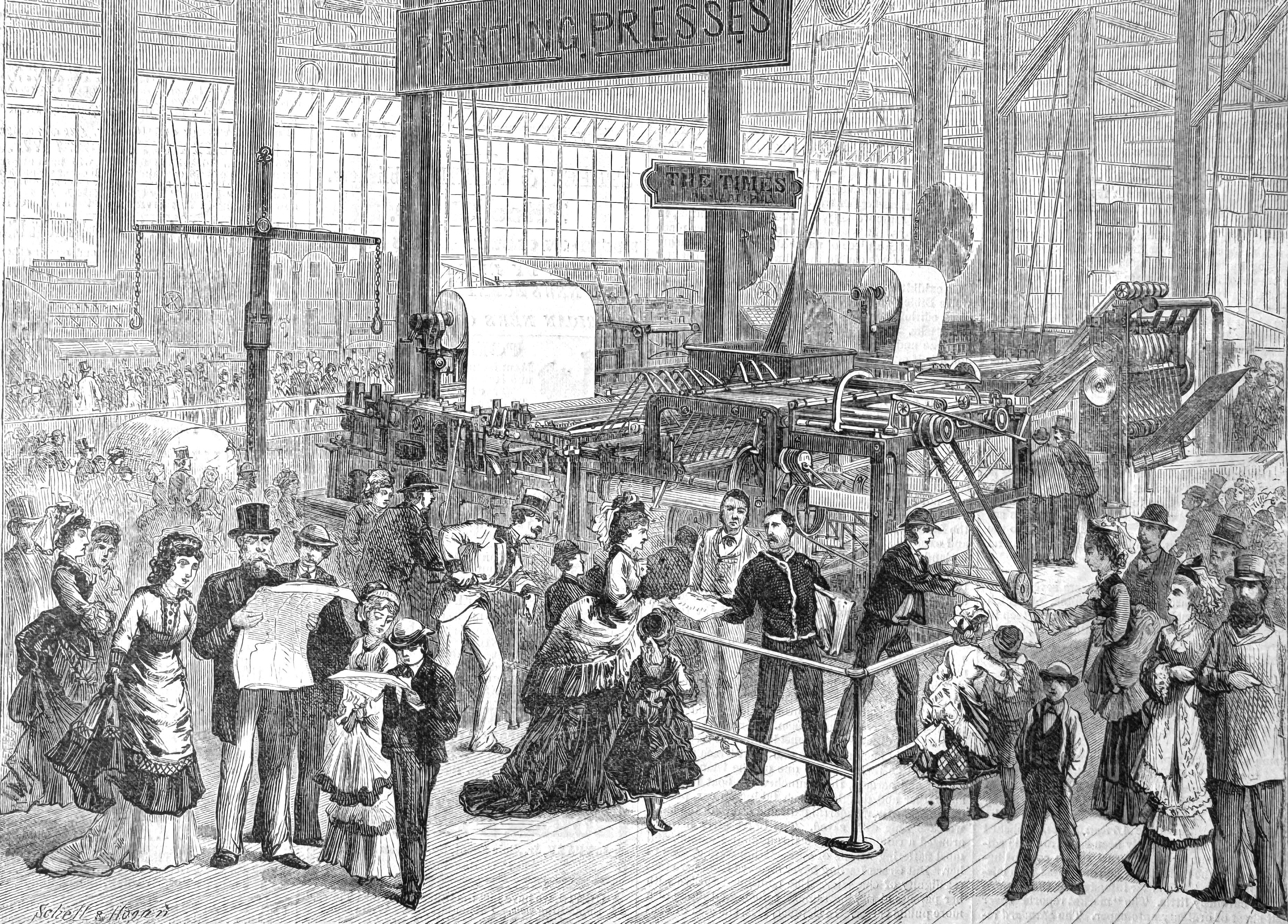
The relative affordability of newspapers, magazines, and books transformed reading into a ubiquitous pastime for all sorts of people. Waiting for a train? Read a book. Riding on the train? Keep reading the book.
Entranced by their reading, the literary will look for ways to maximize their book time. But using the book to kill time, the unliterary will put it down when something more interesting arises. That said, who’s to judge?
Lewis was careful not to make this distinction sound like a moral hierarchy. The literary, he said, include their share of fools, and the unliterary often include folks of superior virtue, prudence, and common sense. Some people are literary, others aren’t, and people may move in and out of those camps over the course of their lives depending on countless variables.
The hitch is that the term reading describes essentially two different activities masquerading as the same thing: The literary are being transported and prioritize it; the unliterary are killing time and books serve the purpose unless something better comes along.
When cheap reading material offered the best option for both the literary and unliterary, mass readership prevailed—contingent on the interplay of cultural, economic, and technological forces. Nothing demonstrates the trend as well as mass-market paperbacks. Pioneered by publishers like Penguin and Pocket Books, mass-markets were once both omnipresent and dirt cheap: John Grisham at the gas station, Stephen King at the supermarket, Louis L’Amour at all points in between.
In 1995, annual unit sales in the U.S. hit 532 million.4 But the wave has since crested and ebbed. By 2024, mass market sales were down to a fraction of that figure, just 21 million, a 96 percent drop. And last year, ReaderLink, the country’s largest paperback distributor, stopped selling them. The forces that once dropped books in the shopping bags of everyone who wouldn’t have otherwise bought them have essentially played out; the unliterary now have better things to do.
Smartphones deliver near infinite options that appeal to unliterary people more than books. They have music, podcasts, streaming, short videos, long videos, social feeds, and AI to generate whatever else they want. I’ve spent the last two weeks in a hospital caring for my mom. I’ve seen a hundred people waiting for one thing or another—all of them with their phones, not one with a book. (I’ve been looking.) But can you blame an unliterary person if they prefer TikTok to Cormac McCarthy and YouTube to Toni Morrison? That’s like blaming someone for liking tacos more than pho.
All of this points us to an interesting and perhaps uncomfortable reality: The mass of unliterary readers has been padding the reading statistics for a century. After all, “it’s no big deal. It’s just a book.” The unliterary are now abandoning reading because, for them, they’ve got better alternatives for passing time.5
“Although contemporary commentators deplore the decline of ‘the reading habit’ or ‘literary reading,’” say a trio of Northwestern sociologists in a 2005 study on reading practices, “historically the era of mass reading, which lasted from the mid-nineteenth through the mid-twentieth century in northwestern Europe and North America, was the anomaly. We are now seeing such reading return to its former social base: a self-perpetuating minority that we shall call the reading class.” Thanks to Lewis, we already know them as the literary.
Serious, devoted reading was always a selective activity, even when the surface numbers suggested otherwise. That doesn’t mean we should fatalistically shrug our shoulders about the turn. But Lewis’s literary vs. unliterary distinction can also help us avoid pointless remedies to the decline.
What’s in It for Me?
Most defenses of reading—and related pleas for people to do more of it—make an instrumental case. Reading makes you smarter, longer lived, healthier, more empathetic, more attractive, better at your job. It’s not that these points are fundamentally wrong; there’s decent enough evidence behind most of them to at least be interesting. The problem? These arguments crumble in a substitution test.
Books are great for transmitting information, but a good summary can deliver the goods quicker. “I would never read a book,” said Sam Bankman-Fried, the felonious founder of cryptocurrency exchange FTX, when speaking with journalist Adam Fisher in 2022.
“Reading books is the highest-bandwidth way I know to get quality information into my brain, which just craves the stimulation,” said Fisher in the exchange. Bankman-Fried pushed back.
“I’m very skeptical of books. I don’t want to say no book is ever worth reading, but I actually do believe something pretty close to that,” said Bankman-Fried. “I think, if you wrote a book, you f—d up, and it should have been a six-paragraph blog post.” And so we get services like this one, the so-called Living Library, created by David Strolder, who tells us to “stop reading books” and instead, using an AI platform, “start talking to them.”
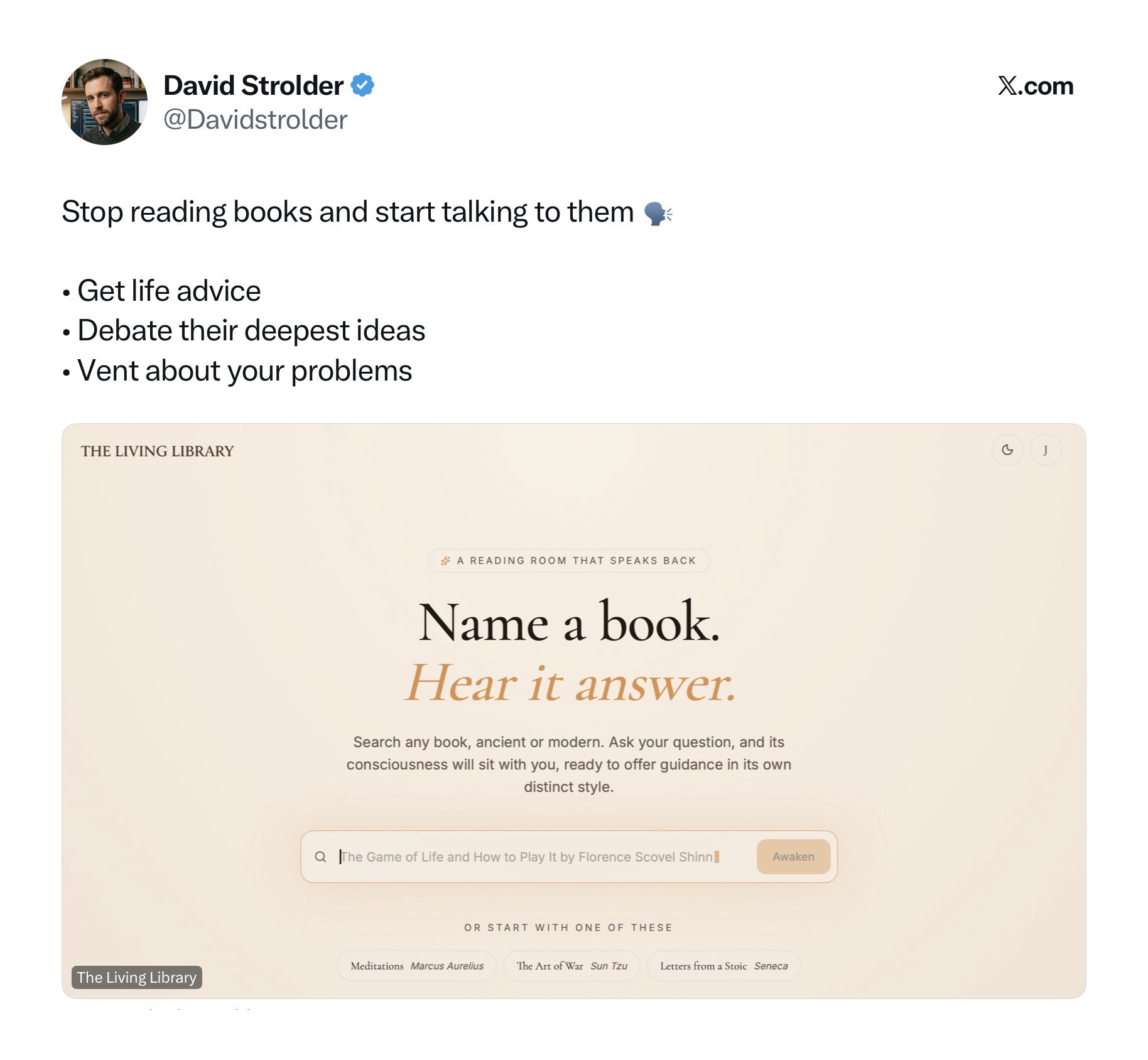
Forget the boring pages! No more ponderous passages. With a question and click you can instantaneously get the goods from Marcus Aurelius, Sun Tzu, Seneca, or hundreds more catnip authors favored by those who mistake reading for a shortcut to self-improvement. AI lets you shortcut the shortcut and—having instrumentalized reading—why not? If another instrument can better serve what you want, it’s hard to object. “Vent about your problems”: Because Seneca’s digital revenant can’t wait to answer.
I’m bullish on AI and think reading in concert with an LLM can be very helpful. I do it all the time and recommend it. But the Living Library is exactly the sort of thing only the unliterary would desire—precisely because it saves them the trouble of reading. The same is true for pretty much any other supposed, vaunted takeaway from reading. Cognitive exercise? Stress reduction? Name what you like. In most any place we offer a book as a means, something else can produce the same end better, faster, cheaper.
If we want to convert the unliterary, these sorts of tactics are a thrilling adventure in missing the point.
Books are not, contra Fisher, “the highest-bandwidth way . . . to get quality information into [our] brain[s].” That’s close but was easily rebuffed by SBF because it misses something essential. Books convey information, but they don’t confer knowledge. That requires thinking. A plate can hold food, but it can’t digest your dinner. Fisher tried getting there by praising books for stimulating his mind. That’s at least moving in the right direction. The allure of books for the literary involves their near magical powers to provoke thought, awaken the imagination, and stir the heart.
When the literary approach a book, we “seek an enlargement of our being,” says Lewis. “We want to be more than ourselves. . . . We want to see with other eyes, to imagine with other imaginations, to feel with other hearts, as well as with our own.”
If there is an instrumental case for reading that does pass the substitution test, it rests upon the one thing books can do better than any other medium or activity. Books represent the only technology our species has devised for spending immersive, extended time inside another mind. AI, movies, music, social media, games, and sports are great. I enjoy them all. But none serve as “a technology for perspective-taking” in Steven Pinker’s phrase, certainly not to the same extent; they lack the immersive, expressive, time-consuming qualities required.

SBF was not wrong about the cost-benefit; books are stairs, not an elevator. Rather, he was wrong about what books are for. Lewis said a primary feature of unliterary reading was reading for the use of the book. If you reduce reading to the utility it provides, you will eventually find other things to do. If you read because you love the adventure of taking up temporary residence in the mind and heart of another human being, you’ll never stop.
Big Problem? No Problem?
Back to those worrisome PIAAC numbers. Our literary muscles atrophied between 2017 and 2023, average literacy scores fell, and the number of adults who can’t tell the difference between a paragraph and a brick wall climbed.
There are grim societal implications for this kind of practical illiteracy begging for attention, starting with parents and teachers remembering that exposing their kids to literature is all about awakening a passion for what Lewis described: “to see with other eyes, to imagine with other imaginations, to feel with other hearts, as well as with our own.”
What’s not particularly helpful is the panic that literary life is going under because the broader population is reading less. That assumption teeters on a category error: Literary people—who can’t quite imagine what the unliterary are thinking by passing up a book—assume everyone ought to read like us. We picture a frustrated literary reader inside every distracted phone-scroller, waiting to be liberated and coaxed back to the book. But it’s not so; ask Quinn. Some folks just want something to do while they wait for the train.
“The Western world is continuing to move away from a very special enlightenment period when book reading and literary modes of thinking were paramount,” says Tyler Cowen, looking at the trends and describing a society shifting “from a literary culture to an oral culture.” Yes, there are pluses, but consider the minuses:
Fewer fixed texts that welcome scrutiny and testing.
Less analytical distance between a thought and its thinker.
An absence of shared language on which people can build cohesion and argue their truths.
Along with that, we get a society where claims are harder to verify, rumors and conspiracies spread through the very devices replacing books, and objective and analytic thought finds little welcome. Cowen’s not typically pessimistic, and he shows restraint where others don’t. But is the future so bleak?
Adam Mastroianni says no and offers several reasons. First, he says, “there are signs that the digital invasion of our attention is beginning to stall.” Second, “reading has already survived several major incursions, which suggests it’s more appealing than we thought.” (Can confirm.) He also takes issue with the magnitude of the numbers and argues they’re less catastrophic than we’re being led to believe.
Beyond that, there are cultural and psychological dynamics at play. “All serious intellectual work happens on the page,” says Mastroianni. Despite the forces arrayed against it, reading wins because nothing else can do what text can do. “Videos can titillate, podcasts can inform, but there’s only one way to get that feeling of your brain folds stretching and your soul expanding, and it is to drag your eyes across text.”
Lewis would probably say Cowen and Mastroianni are closer than it might at first appear. Cowen is watching the unliterary leave, and Mastroianni is watching the literary stay. Both observations are correct. The mistake we keep making—the one Q.D. Leavis made nearly a century ago, the one we make today—is to interpret the disinterest of the unliterary as the death of the literary. Books will persist precisely because they do what no other technology can.
Serious reading has always been a minority sport. Most Americans who think their lives warrant a book deal will never write one, the way most would never read it if they did. They’ve got other things to do. Meanwhile, the literary will go on doing what we always have: reading, arguing about reading, and recruiting the next generation to see with other eyes.
Thanks for reading! If you enjoyed this post, please hit the ❤️ below, restack, and share it with your friends (especially if they consider themselves literary).
Not a subscriber? Take a moment and sign up. It’s free for now, and I’ll send you my top-fifteen quotes about books and reading. Thanks again!
While you’re here, check out 👇


.jpg)

Literally, as it happens. When researchers asked 85 English majors at two Kansas universities to read the opening of Bleak House and render the passage into plain English, 58 percent couldn’t do it, not even when given the aid of dictionaries and their phones. But no worries. All 85 students said they could finish the novel; they’d just skim and check SparkNotes.
I devote a chapter in The Idea Machine to the effects of literacy in early America, especially in justifying the Revolution and the subsequent debates on the U.S. Constitution.
It’s hard to overstate how important industrialized printing and related developments proved for expanding literary culture. Now-classic authors like Jane Austen and William Wordsworth had tiny readerships in their own day. Early novelists and Romantic poets had to wait decades for rotary presses, inexpensive paper, and outlets like railway bookstalls for mass readership.
Calculated from taking the 1998 numbers and the reported 9 percent drop since 1995.
It’s easy to romanticize life before smartphones. But it’s not like everyone pre-iPhone sat around reading Ernest Hemingway and James Baldwin. When bored, people mindlessly flipped through “newspapers, magazines, or catalogs,” as Ian Bogost points out. “Free alt-weeklies and classified rags were godsends when no other options were on offer.” Before phones, people took solace in “junk mail, subway ads, the backs of cereal boxes, the story on the restaurant placemat, the labels on the condiments.” If you were among the literary and knew you’d be waiting, you brought a book to the dentist’s office or the mechanic’s; if you were unliterary, you hoped the stack of People magazines was current. How is that different from scrolling social media?
The unliterary who read to pass the time reminds me of a story told to me by a WWII veteran, of waiting in a long line of other young men for their physical. Someone in the line had a racy paperback, and when he had read a number of pages, he tore then off and handed them to the next guy to read, and so on, so the book was passed along, in pieces, through the line.
Those who read only a less than ten books in the year would include both my parents, who are older baby boomers. Eyesight problems are partly responsible (a serious accident left my father with blind spots in his vision that interfered with his ability to scan a printed page, and my mother is slowly going blind), but neither of them ever read as much as I do. Yet they are both intelligent and wise, and they both inspired me to read as much as I do. Reading was, after all, a luxury to the previous generations of my working-class ancestors.
Poor Kansas! Ha. Thanks, Joel.