

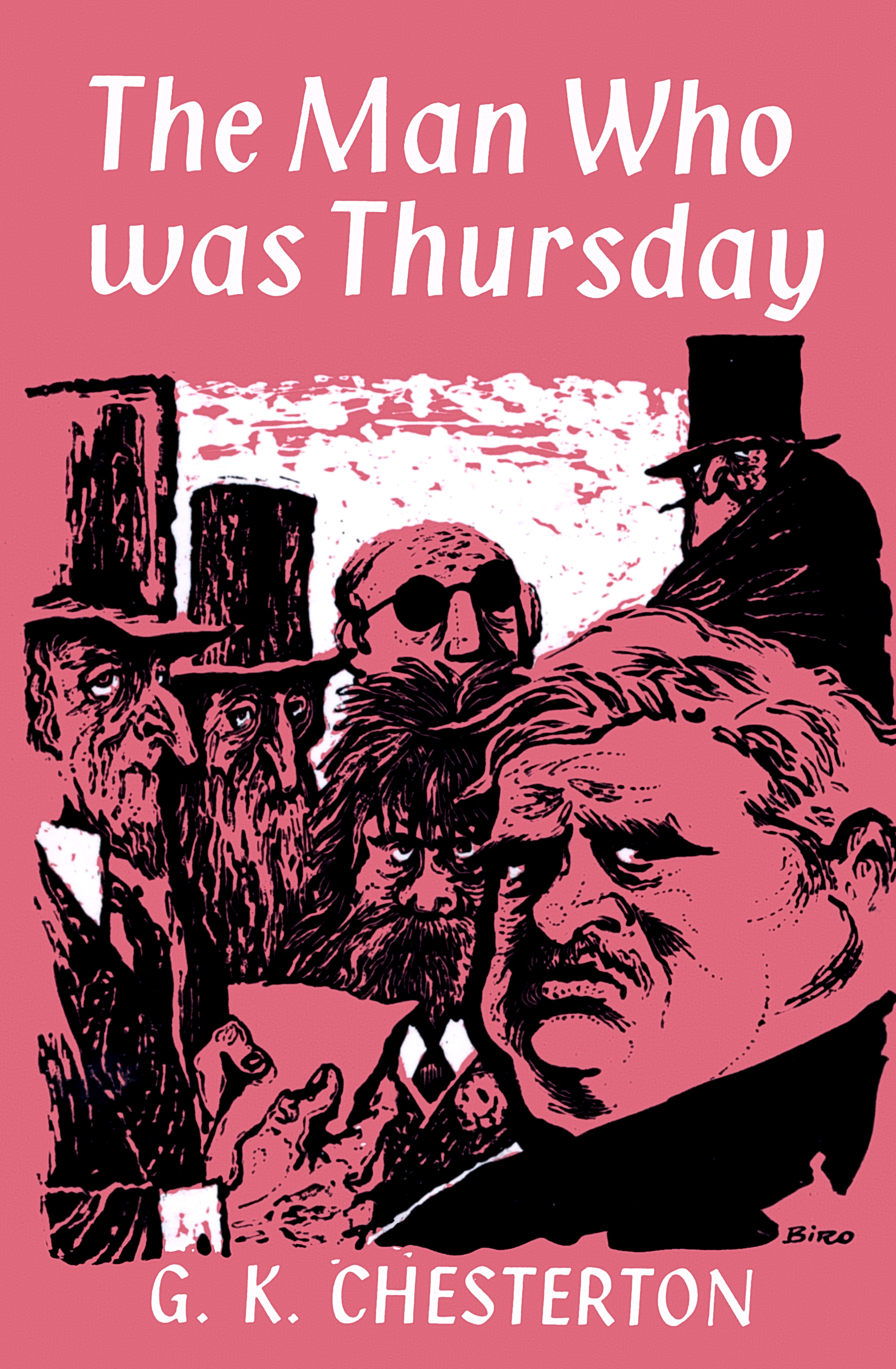
In one of her many sharp asides in “Writing Short Stories,” Flannery O’Connor notes that “A story is good when you continue to see more and more in it, and when it continues to escape you.” Reflecting on that line, I find that one of the few books that come to mind, vividly, specifically, and every time, is G.K. Chesterton’s century-old thriller The Man Who Was Thursday: A Nightmare.
A Dare in Saffron Park
The Man Who Was Thursday is Gabriel Syme, an English poet who, when the novel begins, is at a garden party in a fashionable suburb of Edwardian London. There he finds himself in conversation with the beautiful Rosamond and her testy brother Lucian, who, like Syme, is a poet.
Lucian takes himself dreadfully seriously, and the puckish Syme can’t resist goading him. Finally, dared to prove that he really means what he says in his nihilistic modernist poetry, Lucian reveals that he is an anarchist. He invites Syme to a meeting of his anarchist terrorist cell that very night.
“Your offer,” Syme says, “is far too idiotic to be declined.”
Syme and Lucian arrive early and, just before the others enter, Syme repays Lucian for his dangerous revelation with one of his own: he is an undercover cop.
In a masterfully suspenseful scene, Lucian, who is nominated for a position on the supreme anarchist council under the code name Thursday, attempts to downplay the violence of their group. Syme denounces him—the path to success among radicals—and is elected the new Thursday, at which point he is whisked downriver to Westminster. There, at a luxurious breakfast on a balcony overlooking Leicester Square, Syme meets the five other members of the council and the man behind them all, Sunday.
The other members—Monday, Tuesday, Wednesday, Friday, and Saturday—are all grotesques. One is a cadaverous German professor named de Worms, another a crooked French aristocrat, another, one Dr. Bull, a man who grins ominously from behind opaque sunglasses. But their leader is the most frightening of all.
Sunday, an enormous man, a giant who fills Syme’s senses with his overpowering presence, announces that he has uncovered a spy among their number. Syme thinks he has failed just as he’s begun, but it turns out to be one of the other members, a Pole named Gogol who tears off his wig and beard to reveal a Cockney policeman underneath. After threatening Gogol with death, Sunday sends him on his way.
Sunday then reveals the council’s plot: the Tsar is en route to Paris for a meeting with the president of France. Wednesday, the French marquis, is to blow them up with a bomb when they meet in three days. Syme’s goals at this point become clear: stop the assassination and bring down Sunday.
Everyone Is a Policeman
But as Syme leaves Leicester Square he discerns that he is being followed. After failing to elude his tail, he turns and confronts him. It is Friday, the elderly Professor de Worms, who insistently asks whether Syme is a policeman. When Syme finally denies it, the professor is crestfallen: “‘That’s a pity,’ he said, ‘because I am.’”
With astonishment and frustration, Syme and Professor de Worms realize that three of the seven anarchists at the council meeting were actually undercover detectives. Only their ignorance of the fact prevented them from moving against Sunday on the spot. They determine to stop Sunday’s plot together by forcing Saturday, Dr. Bull, to reveal the marquis’s plans for carrying out the bombing. Once they find and interrogate the inscrutable Dr. Bull, a scene in which the hapless Syme and Professor de Worms struggle to break through the man’s defenses, it turns out that he, too, is a policeman.
From this point on, the three race to cross the Channel and find and stop the marquis—who also turns out to be a policeman.
One by one, every member of the supreme anarchist council, the organization working to overthrow the entire world, except Sunday, has been revealed to be an undercover agent of the forces of law and order. And one by one, each reveals that he was recruited by the same man—a Scotland Yard official who questioned them in a completely darkened room in which, despite their inability to see him, they felt awed and overpowered by his presence. Each has derived an extra measure of strength for his work from remembering that interview. Each wants to please his unseen boss by defeating Sunday.
After cheating death in a duel against an expert swordsman and fleeing a zombie-like mob in northern France, Syme and his allies decide to turn the tables on Sunday. They will return to England and confront him.
“This is more cheerful,” said Dr. Bull; “we are six men going to ask one man what he means.”
“I think it is a bit queerer than that,” said Syme. “I think it is six men going to ask one man what they mean.”
What they discover defies expectations or explanation, just as the novel defies easy summary or explanation. It’s hard to describe the plot without giving too much away, but I’ve tried to avoid spoiling important episodes, specific surprises, major plot points, and most especially the ending. It’s also hard to describe, period. See again that quotation from Flannery O’Connor.
Like what you’re reading? Subscribe, and new posts will ride an electron rollercoaster directly to your inbox twice a week. Free subscribers get two-week open access to every post; paid subscribers get the run of the archive, plus bonus content.
Take the Subtitle Seriously
A good place to begin is that subtitle: A Nightmare. The subtitle is easy to overlook, especially once one has started reading, but proves important for both stylistic and thematic reasons.
Artistically, Chesterton’s most effective tool in establishing a nightmare feeling, and the one that most clearly sets The Man Who Was Thursday, his most famous novel, apart from all of his other fiction, is pacing. This novel maintains a breakneck speed that creates a sense of barely controlled panic as crisis flows into crisis and surprise piles upon surprise.
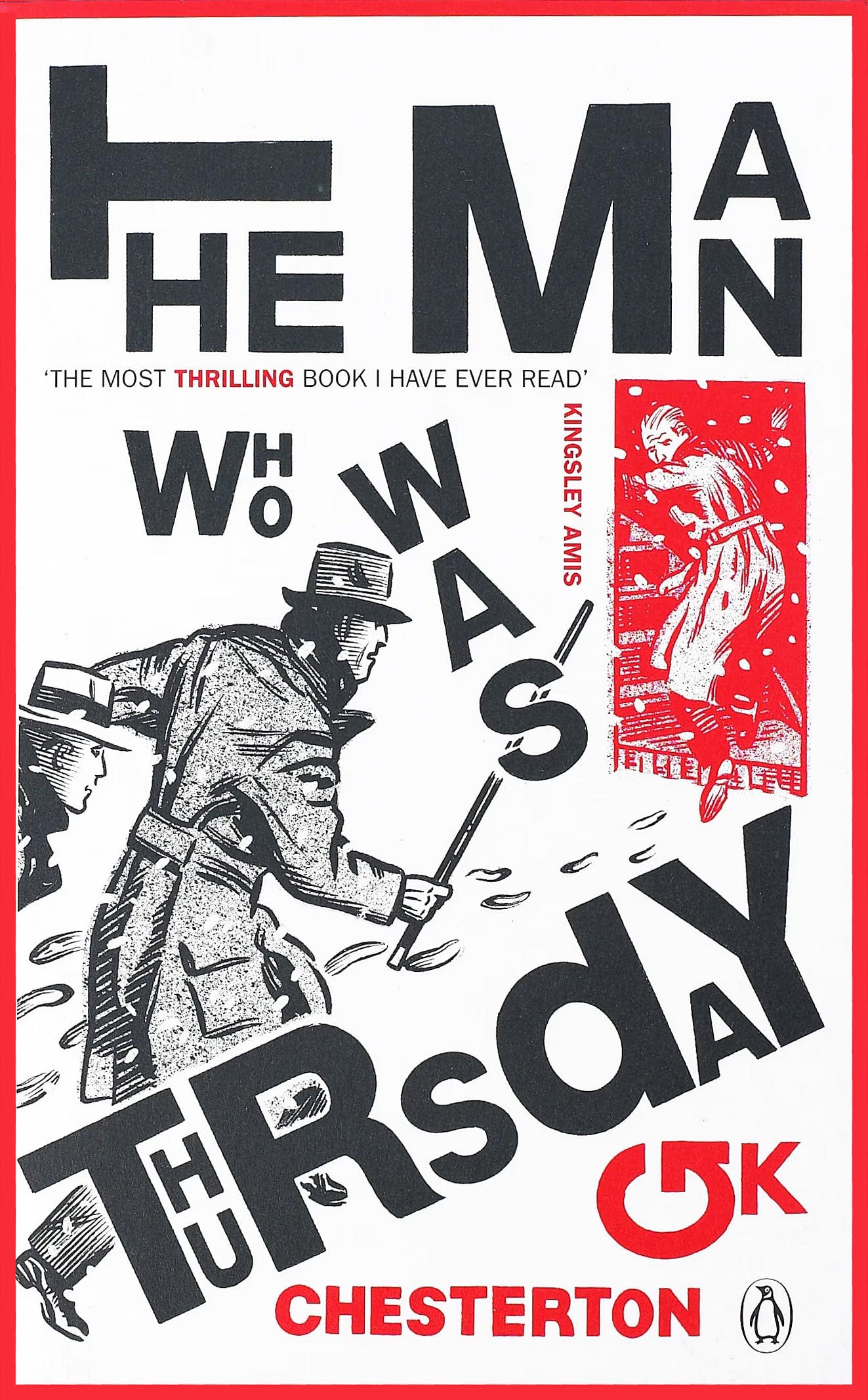
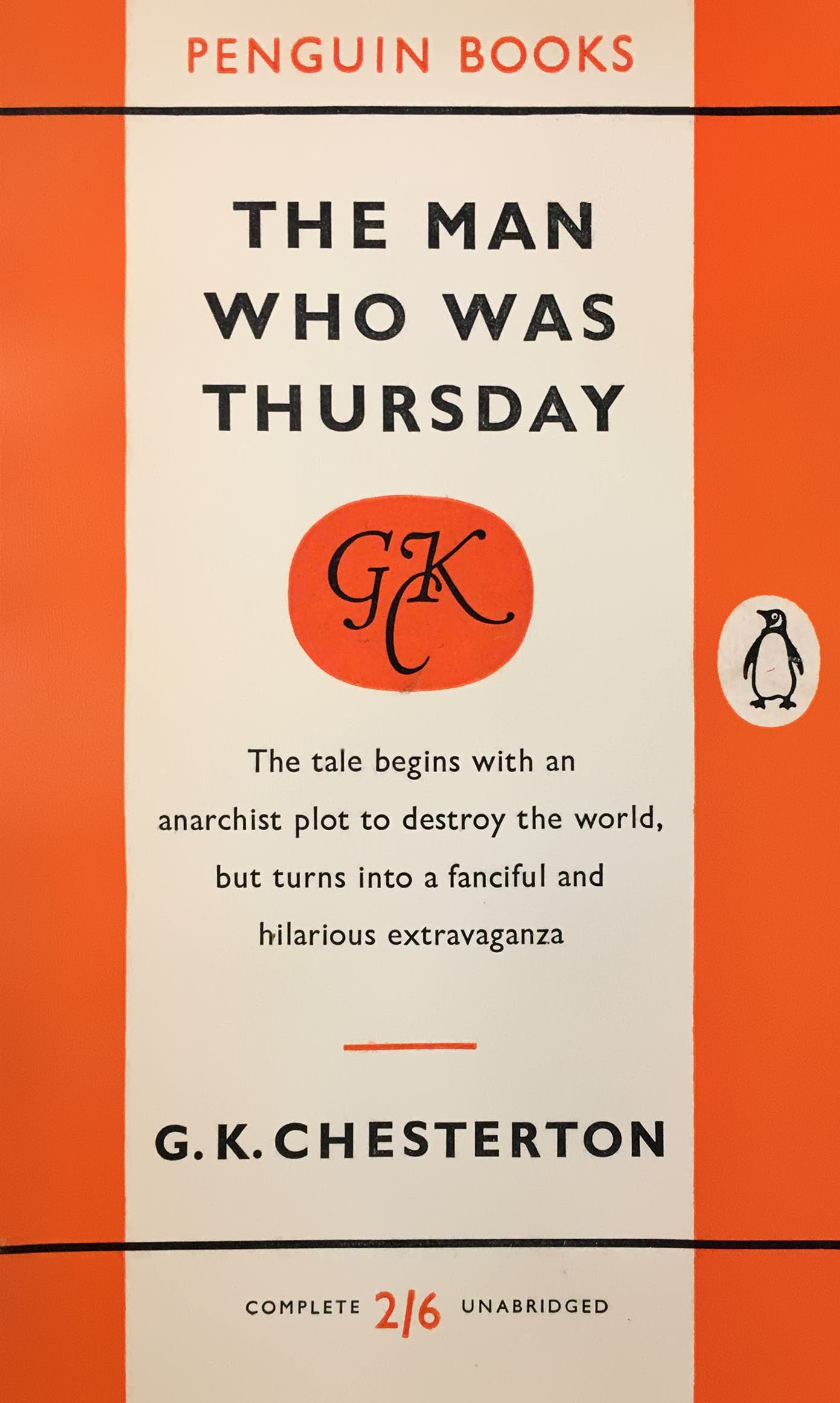
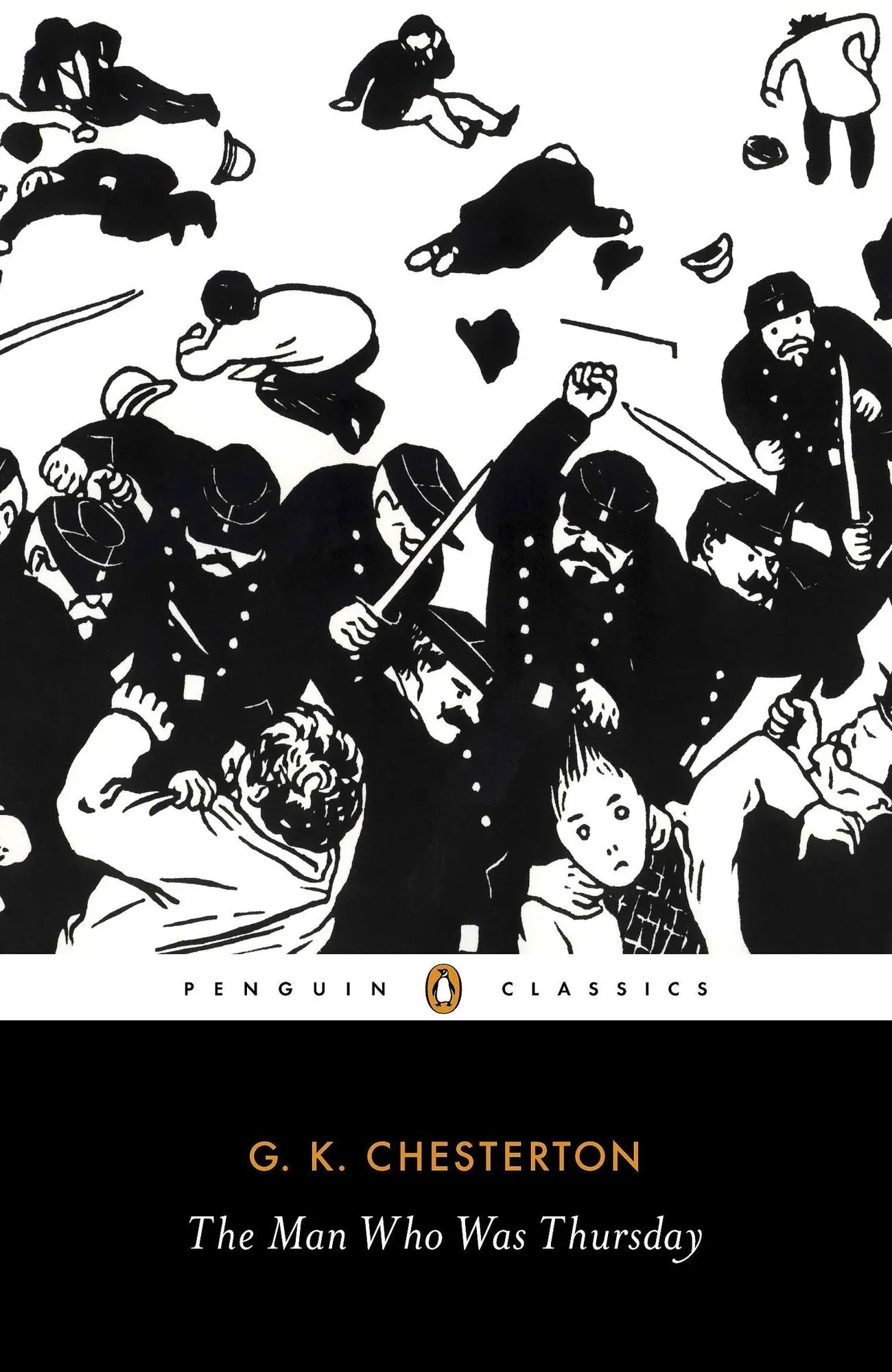
There is no lag or dull spot, and Chesterton metes out his surprises and twists expertly. Kingsley Amis, in a line commonly reprinted as a blurb on paperback copies (as with the one above), called The Man Who Was Thursday “the most thrilling book I have ever read.” High praise, and well earned.
The book’s atmosphere and tone are also crucial. Chesterton evokes better and more subtly than any other writer the feeling of being in a nightmare. Anyone who has dreamt of being chased will know the feeling. Over and over again, Syme is followed or chased by enemies of obscure purpose who always keep up with him no matter how hard he strives to get away.
And, as in a dream, the familiar—Chesterton, a lifelong Cockney, sets the first half of the book in a believable and realistic London—mutates almost imperceptibly. Under the influence of this paranoia, which prefigures that of the political thrillers of John Buchan and his successors, home becomes a foreign battlefield, nothing appears quite right, and the human face and form both prove horrifyingly changeable.
Thanks for reading! If you’re finding this post worthwhile, please restack it, hit the ❤️ below, and share.
The World on Its Head
But alongside the pursuit and paranoia of the nightmare is the reversal. Enemies turn out to be allies, being chased turns into chasing, disguises do not conceal, and, in the climax, the villain flees his accusers only to welcome them. The reversal, the inversion, the topsy-turvy turning of the world on its head—this is one of Chesterton’s recurring motifs and the great load-bearing structure of this novel.
It also turns out to be the key to Sunday, who is both a threat and the solution to the threat, both feared and trusted, both hated and loved, both a destroyer of the world and its creator and preserver.
I can say little more without revealing too much. The Man Who Was Thursday can be described, even spoiled, but must be read. It has to be dreamt.
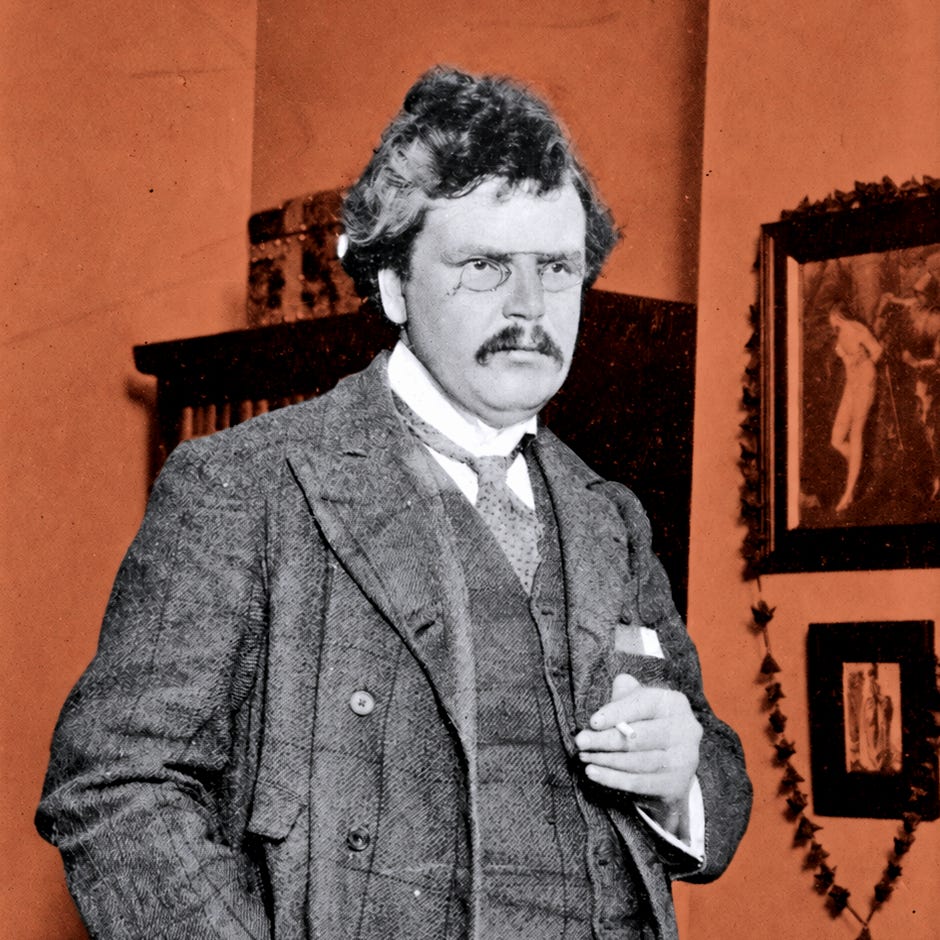
When Chesterton published this book in 1908, he had taken a live issue—the waves of anarchist terrorism and assassination that, in the ten preceding years, had claimed the lives of an Austro-Hungarian Empress, an American President, the King of Italy, and, the same month the novel was published, the King of Portugal—and leapt from these current events to explore doubt and despair and madness. The plot, in a way that feels intuitively right while reading but impossible to explain afterward, provides an answer by rejecting the question.
In my most recent read-through, during the novel’s concluding scenes, with Sunday and the six policemen of his council reunited, I thought of a passage from Chesterton’s “Introduction to the Book of Job.” Here Chesterton describes how Job, after all his questions, finds himself
suddenly satisfied with the mere presentation of something impenetrable. Verbally speaking the enigmas of Jehovah seem darker and more desolate than the enigmas of Job; yet Job was comfortless before the speech of Jehovah and is comforted after it. He has been told nothing, but he feels the terrible and tingling atmosphere of something which is too good to be told. The refusal of God to explain His design is itself a burning hint of His design. The riddles of God are more satisfying than the solutions of man.
Chesterton’s message is all the more powerful because, unlike the messages of many other novels—including some of Chesterton’s—that have attempted to plumb spiritual questions, it is never made explicit, much less preached.
The Nightmare You Need
Over the years after its publication, readers wrote to Chesterton to tell him that The Man Who Was Thursday had saved them from despair. I can believe it. As I concluded my fourth or fifth reading in about fifteen years, I set the book down feeling steadied and content, something I had not expected to get out of a thriller.
I finally understood. The Man Who Was Thursday is not just witty, surrealist fun and genuinely thrilling espionage action; it is an allegory that strikes to the heart through the imagination.
Our world is no more settled or peaceful than it was in Chesterton’s time. If you’re feeling that, especially if you’re feeling that right now because of the forces at work to destroy civilization—whichever forces you think those might be—The Man Who Was Thursday may be the nightmare you need. A paradox worthy of its author.


I thank God I was born and raised in the Christ Haunted South.....
....God bless GKC and Flannery O!
This is such a fantastic novel. I’m excited to see you feature it here because it is highly under-appreciated in the main, but its influence can be spotted everywhere (Spy vs Spy, Lemony Snicket, and on and on). I recorded it in full last year and enjoyed every turn of the page: https://classicsreadaloud.substack.com/p/the-man-who-was-thursday