
The Beautiful Mess of Steinbeck’s ‘East of Eden’
When a Novelist Attempts to Write Scripture

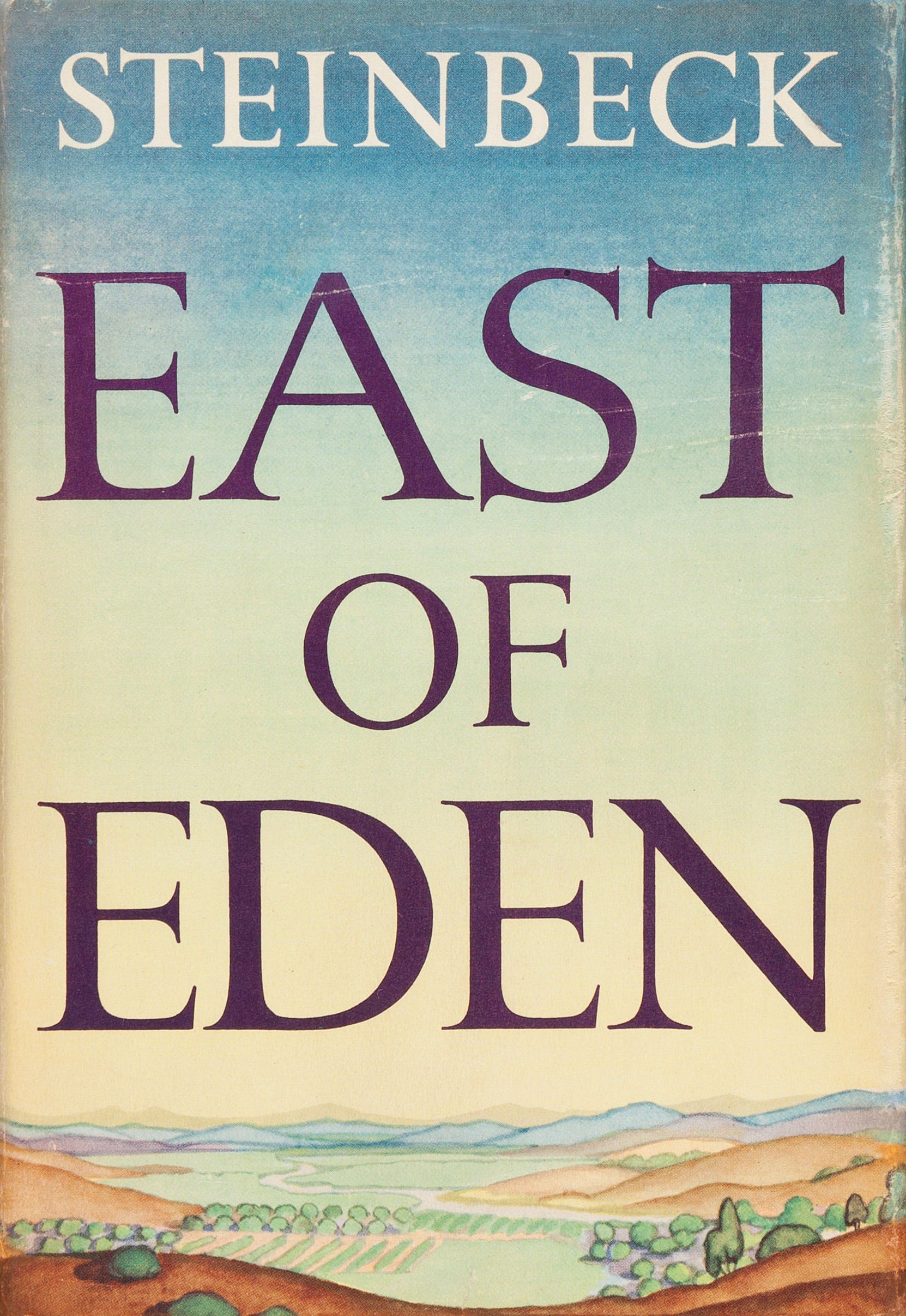
I had high hopes for John Steinbeck’s East of Eden as I cracked the cover and began laddering down the opening lines. “The Salinas Valley is in Northern California. It is a long and narrow swale. . . .” Everyone I know who has read it tells me it’s one of their favorite novels, maybe their very favorite. Having now read it, I get why. And yet, in some ways the novel shouldn’t work.
The story meanders with little discipline. We get, for instance, a lengthy aside about the narrator’s mother, terrified as she loop-de-loops through the air in a biplane. The vignette is hilarious by itself—well worth reading—but the woman never enters the story in any meaningful way, and the story serves no purpose. Even the placement makes no sense. Why is this here? Steinbeck doesn’t seem overly bothered about flummoxing his readers.
And that first-person narrator presents deeper problems. He shares gobs of impossible details: events well beyond his knowing, private thoughts of people he’s never met, conversations he couldn’t have heard. You might cut Steinbeck slack and concoct a justification for it; maybe it was all family gossip? But no, it’s all too finely drawn for that. Steinbeck wants an omniscient narrator—and supplies one—but then pretends he’s not.
Then there’s the moralizing. Steinbeck can’t resist telling us what to think—over and over again. Before the villainous Cathy Ames has done one thing to merit the adjective, the narrator more or less announces she’s a “psychic monster . . . born without a conscience.” What ever happened to show, don’t tell? Why not describe her deeds and let us figure it out? She kills her parents. She sleeps with her husband’s brother. Pretty sure that’s bad. We’re not daft! No need to spell it out.
An MFA professor would send a student back to work on revisions with this sort of thing. But they would be wrong.
A novel should wrangle its digressions into thematic relevance, obey the conventions concerning point of view, and earn its judgments through dramatic depiction and accumulation. By those standards, Steinbeck flunks the final. But do those standards apply to the Bible? I ask because Steinbeck isn’t following the norms of realism; he’s writing a new kind of scripture.
Others have said as much, so this isn’t new. (What could I add to the torrent of takes the novel has garnered since its 1952 publication anyway? It’s in the title for Pete’s sake.) Consider the detailed description of the Salinas Valley that opens the novel. The bookending mountains, the river, the cycles of drought and abundance—it deliberately echoes Genesis 2: “A river flows out of Eden to water the garden, and from there it divides and becomes four branches. The name of the first is Pishon. . . .”
And when he tells us Cathy is a monster before she’s done anything monstrous? He’s introducing the serpent. My friend Hannah pointed this out when I mentioned Cathy in a text. “Cathy Ames is a broken and dangerous woman,” I said. Her answer? “She might be more (or less) than that. Reread the scene where she’s introduced and see how many serpentine references you can tally.” The slender, hipless woman garners more than a few by my count, all the way down to sharp teeth and a flicking tongue.
I think this reframes the narrator problem too. A voice that conjures up more knowledge than any single person could isn’t a problem if you’re recounting a myth. Genesis doesn’t fret about point of view. Steinbeck’s impossibly omniscient narrator represents a refusal to let novelistic conventions cramp the scriptural register he’s shooting for.
Even the digressions start to make sense. The aside about the narrator’s daredevil mother, the unruly brood of Hamiltons who drift in and out of relevance, the bits that go nowhere in particular—the tangents provide the texture of the tale, as others have said, full of people whose significance to the story have less to do with narrative logic than conveying the mystery of human life in all its tragic and comic reality.
Steinbeck trades realism for myth in East of Eden. It’s an American Genesis, specifically a Californian Genesis. For most novelists that would fail miserably. Hence the sour look on the MFA prof’s face. But Steinbeck makes it work, masterfully so. Once you start, he pulls you along, not by the force of plot, but by power and range of personalities he brings into the tale and the resonances he finds in the original, Hebrew Genesis.
Cain and Abel appear in the form of Charles and Adam Trask and again in Adam’s sons, Caleb and Aron. Adam thinks he’s found his Eve in Cathy, but she’s the snake, a woman so restless in her marriage she shoots him in a doorway to walk out of his life.
If these characters form the center of the novel—to the extent the sprawl has a center—it’s ringed and riddled by a colorful cast:
Charles and Adam’s father Cyrus, who dupes the world into not only believing he’s a war hero but trades on his bogus reputation all the way to Washington, D.C., and leaves an inheritance of dubious provenance;
the entire Hamilton clan, whose Irish ancestry confers no luck except love, whose head Samuel hides his whiskey and shares his wisdom, and whose big-hearted son Tom can never quite find his worth, while his brother Will makes money as easily as eating lunch;
the Chinese house servant Lee, who plays to every terrible stereotype out of self-protection but cultivates a rich and magnanimous spirit, studies Hebrew(!) with Chinese elders(!!) in San Francisco(!!!), reads Marcus Aurelius, and becomes the novel’s moral compass—more father to Cal and Aron than Adam can manage;
Abra Bacon, who becomes Aron’s childhood sweetheart and stays close the family but who realizes there’s no satisfaction in being the figment of a man’s imagination.
And that’s to say nothing of the madam Faye, who treats Cathy like a doting auntie, never suspecting lethal response; Sheriff’s deputy Horace Quinn, who gives Cathy a pass after she shoots Adam, recognizing peace sometimes beats justice; and the whorehouse bouncer Joe, who’s loyal to Cathy—until he isn’t.
All these people and more ricochet off the walls of the novel in ways that echo the narrator’s contention that every story amounts to the contest of vice and virtue, explicitly grounded in an exegesis of the story of Cain and Abel.
Was Cain required to master sin, was he fated to fail, or did he have a say in the matter? The analysis comes down to the translation of the Hebrew word timshel—“thou mayest”—which reverberates until the final page, as the drama plays and replays the old story in new ways: sibling rivalry, rejected gifts, parental scorn, vindictive reprisal, the piercing gouge of shame.
If Steinbeck had attempted all of that in a purely realist key with disciplined plotting, the saga would have buckled under its own weight, which is already considerable. But the biblical register allows for narrative shortcuts that develop their own discipline as the story evolves—not tidily or neatly but, then, a tighter book wouldn’t have accomplished half as much. Instead, effect is an overpowering story that sweeps you along in the swell. It’s easy to see why people find themselves entranced.
I did. There are moments where I found the digressions tedious, but then the story takes a sudden turn and I was back in the swirl. And while Steinbeck’s impossibly omniscient narrator can sometimes annoy or puzzle with his interjections, most of the time the moralizing and philosophizing works. Steinbeck has something to say—a lot of somethings—and launders those observations through his narrator. I don’t hold it against him. I just nod and underline the bits that resonate; many do.
The book of Genesis ends with Jacob on his deathbed blessing his many sons, pronouncing over them what they are and will become. There’s a certain fate to the pronouncements, a verdict. At the end of the novel, Steinbeck recapitulates the scene but changes the content. Adam, dying, doesn’t pronounce Cal’s fate; he announces his freedom. Instead of a verdict, he offers a challenge—one suffused with hope. Timshel! Thou mayest.
Jacob’s blessings are prophetic and fixed—”you will be this.” Adam’s single word is the opposite: “you may.” Like all of us, for better or worse, Cal is free to chart his own course. And this is the destination the unruly narrative has been pushing toward all along, not a tidy resolution but a blessed release—an existential permission slip to grow and become the person you want to become, responsible for whatever you choose.
I’m reading twelve big-ass classic novels this year. Steinbeck’s East of Eden is the first. Here’s the full schedule for 2026.
January: John Steinbeck, East of Eden
February: Wilkie Collins, The Woman in White
March: Fyodor Dostoevsky, Crime and Punishment
April: Charles Dickens, David Copperfield
May: Henry Fielding, Tom Jones
June: Laurence Sterne, Tristram Shandy
July: Miguel de Cervantes, Don Quixote
August: Herman Melville, Moby-Dick
September: Leo Tolstoy, War and Peace
October: Vasily Grossman, Life and Fate
November: Denis Johnson, Tree of Smoke
December: George Eliot, Daniel Deronda
Thanks for reading! If you enjoyed this post, please hit the ❤️ below and share it with your friends (or enemies, I’m not picky).
Not a subscriber? Take a moment and sign up. I’ll send you my top-fifteen quotes about books and reading. Thanks again!
And check out my new book, The Idea Machine: How Books Built Our World and Shape Our Future, one of Big Think’s favorite books in 2025. I spend a whole chapter on the transformative power of fiction.


Steinbeck also wrote EoE as a family mythology of his own extended family in California. So he attempted to ground a 'Californian Genesis' as you say within a deeply personal set of characters whom he knew well or knew family lore about (hence the mother in an airplane aside).
Steinbeck wrote to his editor and friend, Pat Covici, that EoE was his attempt to put 'everything' into a book, meaning everything he knew and understood of the world, all of his personal history, the essence of America and California, and by hyperlocalising amd specifying it, he managed the difficult task of showing us the universal through the particular.
Your excellent review suggested an interesting future topic: what are some really good works of fiction that retell Biblical stories?