


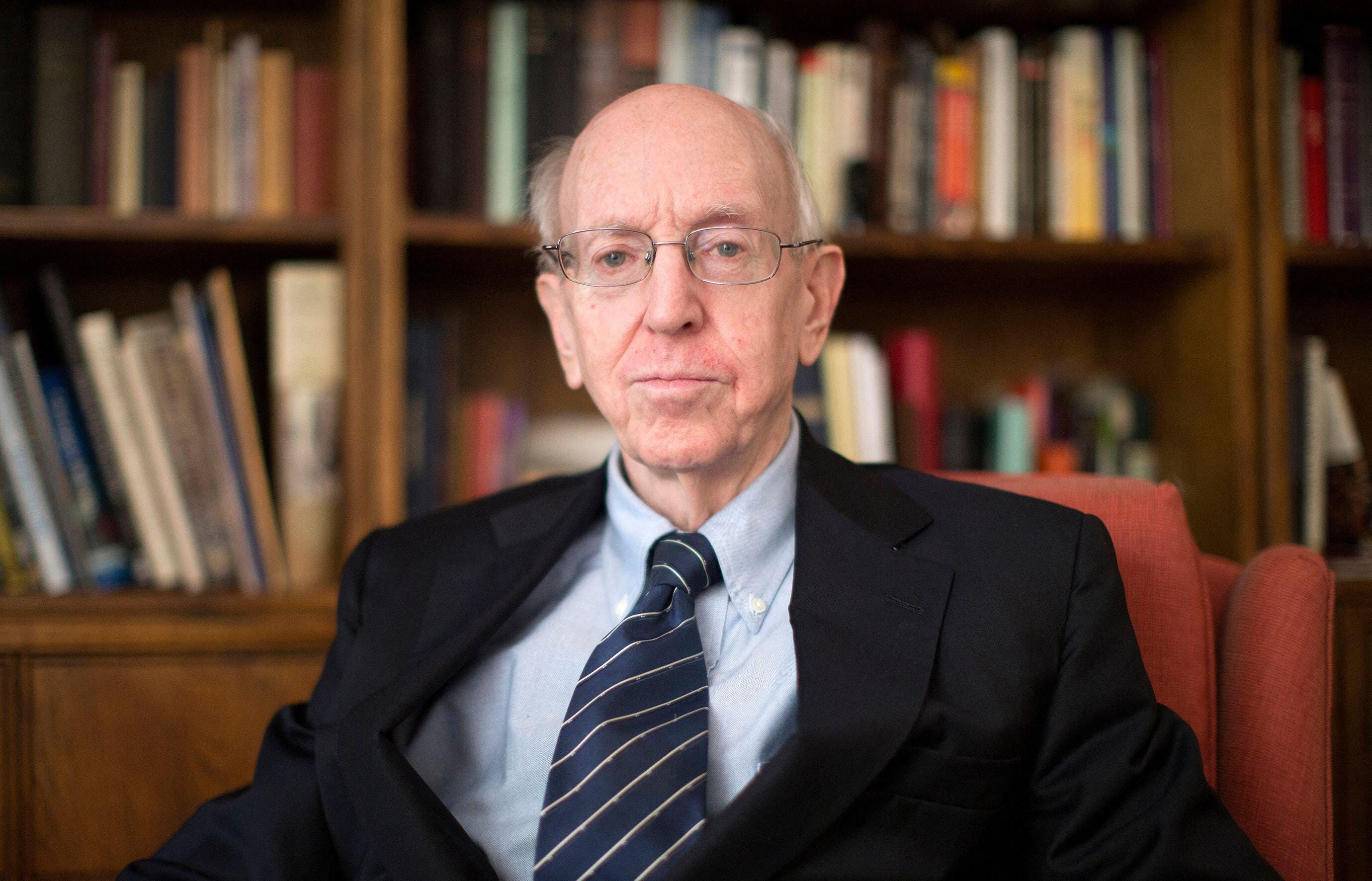
Richard Posner, who died earlier this month at 87, was, in the words of his Washington Post obituary, “an iconoclastic federal appellate judge and prolific author.” Prolific? Posner’s output embarrasses the adjective.
While serving three and a half decades on the 7th Circuit, he penned more than 3,300 judicial opinions. Along the way, as the Post recounts, he wrote or cowrote more than 40 books, over 65 volumes if you toss in revised editions, not to mention, as the New York Times does, 500 articles.
Legal scholar Cass Sunstein recalled one of those articles. Fellow scholar Ronald Dworkin gunned for both Posner and Sunstein in a paper. “He thought that we were full of nonsense,” said Sunstein. So Posner and Sunstein decided to return fire.
The original plan, cooked up over lunch on a Friday, was to coauthor a response. Sunstein had an idea of how the piece should go and thought it would play better for him if he initiated. “I worked really hard over the weekend and managed to produce a full text (without footnotes) by Monday morning,” he recalled. “It was about 20 single-spaced pages—rough, but a draft.”
Apparently, Posner had the same idea because, when Sunstein arrived at his desk, Posner had already deposited his own draft on Sunstein’s chair. “It was about 30 single-spaced pages, fully footnoted—not rough at all,” he said. “I was fast, but Dick was the fastest gun in the West.”
That kind of turnaround was typical for Posner. He, as Adam Liptak put it when Posner retired in 2017, “blurts out books at a comic pace.” What a verb!
Many of those books seem utterly predictable coming from the pen of a judge. They bear such titles as The Problems of Jurisprudence; Law, Pragmatism, and Democracy; Frontiers of Legal Theory; and The Problematics of Moral and Legal Theory. But there are some surprises in his bibliography, too, including Law and Literature, a nearly 600-page treatise on the overlap between the two fields.
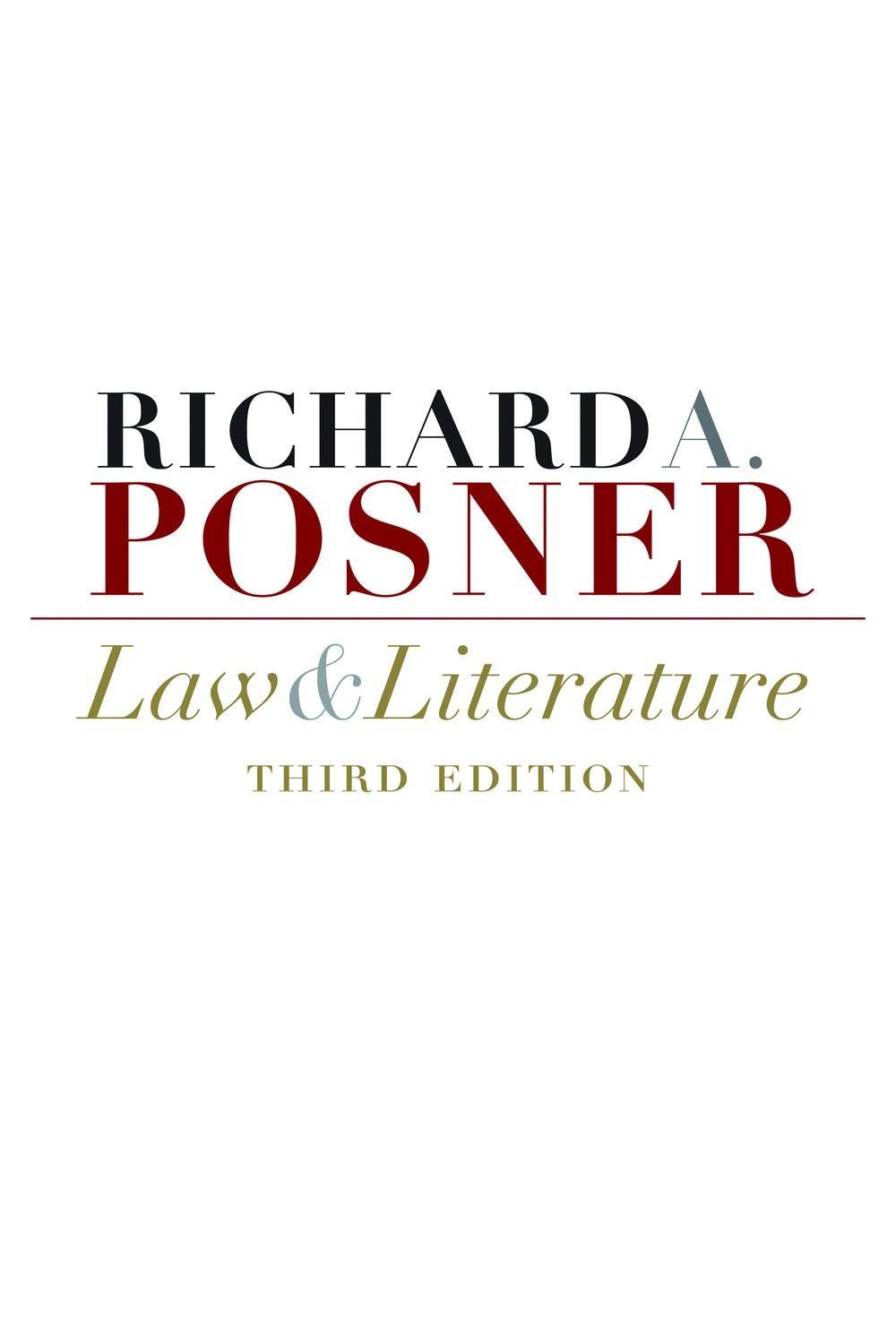
“Law’s techniques and imagery have permeated Western culture,” he says in the introduction, “popular as well as high, from its earliest days.” As such, it’s no surprise to see it manifest in plays and novels—and not only courtroom scenes.
Posner opens with an analysis of E.M. Forster’s Howards End where he dissects the argument between Henry and Margaret about whether her sister Helen, pregnant out of wedlock, may stay a single night at his estate before she goes abroad to have her child. Henry refuses, and Posner uses the moment to reveal how legal reasoning works in a character’s mind.
His verdict? “Henry is a very poor legal reasoner, but the interesting thing is that in a novelistic setting remote from law we catch an echo of legal reasoning.” He brings up the example to “suggest the ubiquity of law as a literary theme” and then goes on for hundreds more pages to detail the point in such writers as Shakespeare, Milton, Dickens, Kafka, Camus, Melville, and Dostoevsky.
Like what you’re reading? Subscribe, and new posts will ride an electron rollercoaster directly to your inbox twice a week. Free subscribers get two-week open access to every post; paid subscribers get the run of the archive, plus bonus content.
This preoccupation with literature went back to the beginning for Posner. “His mother was a high-school English teacher in the New York City public schools and started reading Homer and Shakespeare to him when he was three,” Lincoln Caplan wrote in a retrospective for Harvard Magazine.
He attended Yale (at sixteen!) for undergrad, where he studied English under the literary critic Cleanth Brooks. Yeats’s poetry provided the subject for his senior thesis, and, reported Larissa MacFarquhar in a 2001 profile for the New Yorker, “He still knows many of Yeats’s poems by heart and uses them as templates for ‘sizing’ his own reactions to life’s events.”
After graduating summa cum laude in English, Posner considered further studies in literature, pivoting instead to law. It was strictly a career move, likely inspired by his father who was an attorney. But while you can take the boy out of the English department, you can’t always take the English department out of the boy.
His literary fixation persisted throughout his career, showing up in memorable displays—maybe most notably the informal Greenberg seminars he co-led with his friend, philosopher Martha Nussbaum, at the University of Chicago. Nussbaum described how the seminars went, held in her living room:
He would sit on the couch . . . and we would read books and talk about them with students. Typically Posner liked to talk about form and style. And I would like to talk about the political issues in the books and the ethical issues. So of course Posner would have none of that and he would typically say to the students, “Well, what Professor Nussbaum has said is just utter nonsense.” Now of course being Dick Posner, he said it in a gentle and funny way, and we all felt happy, and we loved it . . . [O]ne student wrote on her evaluation that what she liked about the Greenberg seminar was the wonderful entertainment of watching the professors fight.
The law school would also put on theatrical performances. Posner loved playing roles where he’d meet a violent end. “I was killed and dragged off the stage, and that was fun,” Posner said of playing Polonius in Hamlet. “I’m a villain or some old guy who’s going to be knocked off. My death scenes are well regarded.”
Thanks for reading! If you’re finding this post worthwhile, please restack it, hit the ❤️ below, and share.
Nussbaum agreed. “He liked especially to be stabbed,” she said. “In a scene from Aeschylus, he would play Agamemnon who was stabbed by the murderous Clytemnestra, which was me, and fell flat on his back. So, that was what he really loved, and he was so good as an actor.”
Nussbaum thought Posner’s love of literature lent an important weight to his work as a jurist, and not only because of his prose:
He hated the way most judges wrote—or didn’t write—and he wrote with beautiful prose, but also with a biting wit and sarcasm that’s wonderful. But he also had the kind of imagination that I think you have if you read a lot of literature, the capacity to see a human situation from all different sides.
Posner himself might have pushed back, just as he did on that living-room couch. He rejected the notion that the humanities humanize us. “I resist the idea that literature can tell us how to live,” he wrote in Law and Literature. “Literature is not in the advice business.” But the humanities can, he believed, clarify what we cherish.
“Literature,” he said, “helps us to become what we are.”

