


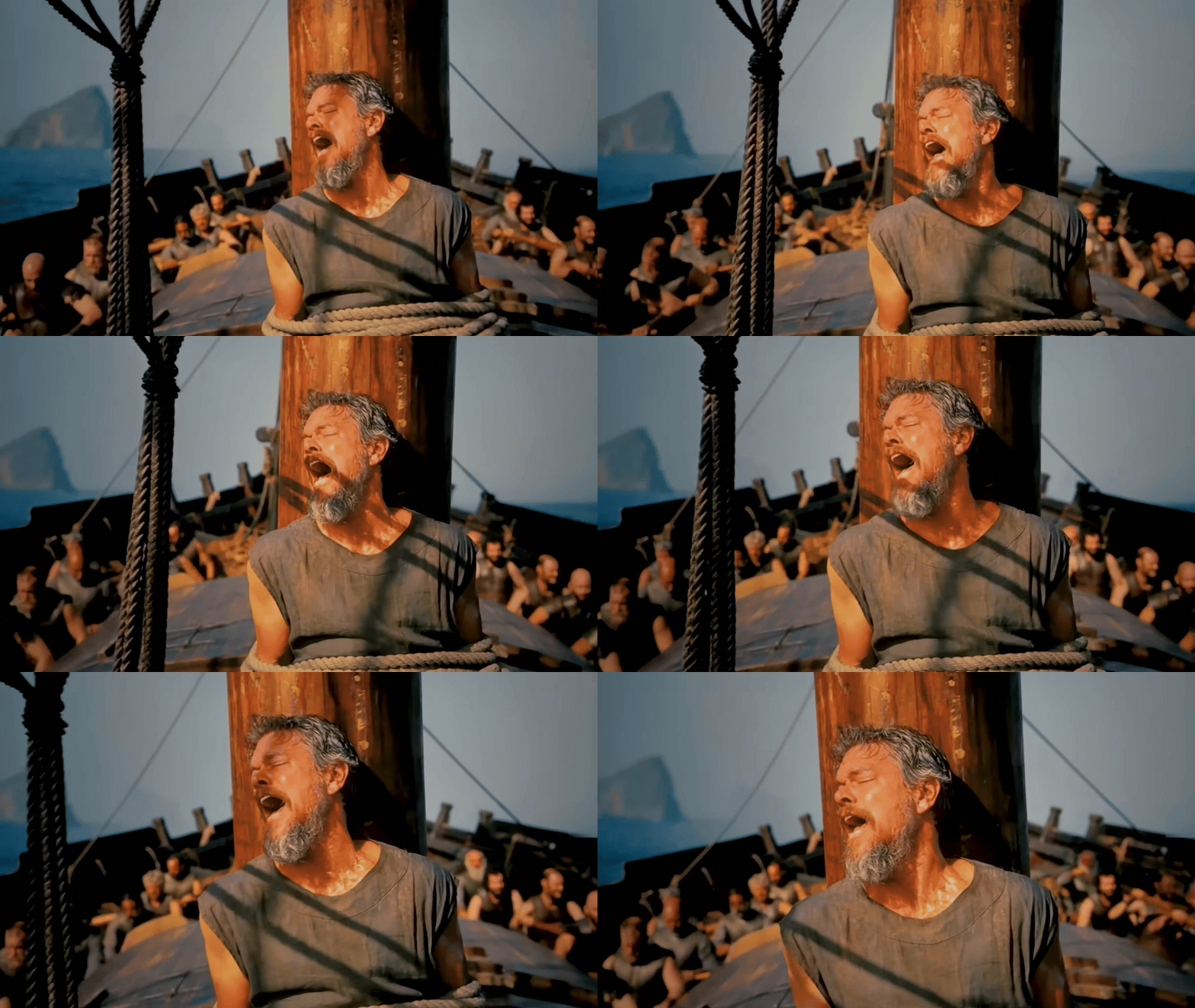
In Book 12 of Homer’s Odyssey, the Achaean hero Odysseus and his crew must row past the island of the Sirens, whose enchanting voices drive sailors mad. “The high, thrilling song of the Sirens will transfix him,” says the witch Circe of any man whose ear catches the alluring chorus. “Race straight past that coast!” she counsels.
But how to muffle the melody during the passage? “Soften some beeswax and stop your shipmates’ ears so none can hear.” Then, should Odysseus want to hear their song for himself, he can, provided he and his men take precautions:
Have them tie you hand and foot in the swift ship,
erect at the mast-block, lashed by ropes to the mast
so you can hear the Sirens’ song to your heart’s content.
But if you plead, commanding your men to set you free,
then they must lash you faster, rope on rope.
Odysseus relays the message to his men. “I informed my shipmates point by point,” he says, preparing wax to stuff in their ears and commanding them to bind him to the mast before they pass the treacherous island. While Odysseus listens to the Sirens’ “honeyed . . . ravishing voices” and his “heart throbbed to listen longer,” his deafened men row past the island to safety, and none are harmed.
Psychologist Angela Duckworth would approve.
More Than Grit
Duckworth is famous for her study of what she terms grit, a character trait combining self-determination, persistence, and tenacity that—to one degree or another—enables us to pursue and achieve our goals, such as, say, resisting the alluring voices of supernatural temptresses bent on our destruction. Duckworth’s 2013 TED Talk on the subject has been viewed 18 million times, and her 2016 book Grit has sold north of 5 million copies.
But in Duckworth’s new book, Situated, she upsets her own model of achievement by saying successful people probably rely less on grit than we assume; instead, she draws on her own research and others’ to show people have better outcomes if they behave like Odysseus and prearrange circumstances to favor success, instead of relying on grit alone.
“After investigating what goes on inside the heads of successful strivers, I began to wonder what might be special on the outside, too,” she says. “How you think about your goals and what you’re willing to do to achieve them depends on both you and your situation.” Odysseus didn’t depend on internal fortitude alone to foil the Sirens; he changed his situation.

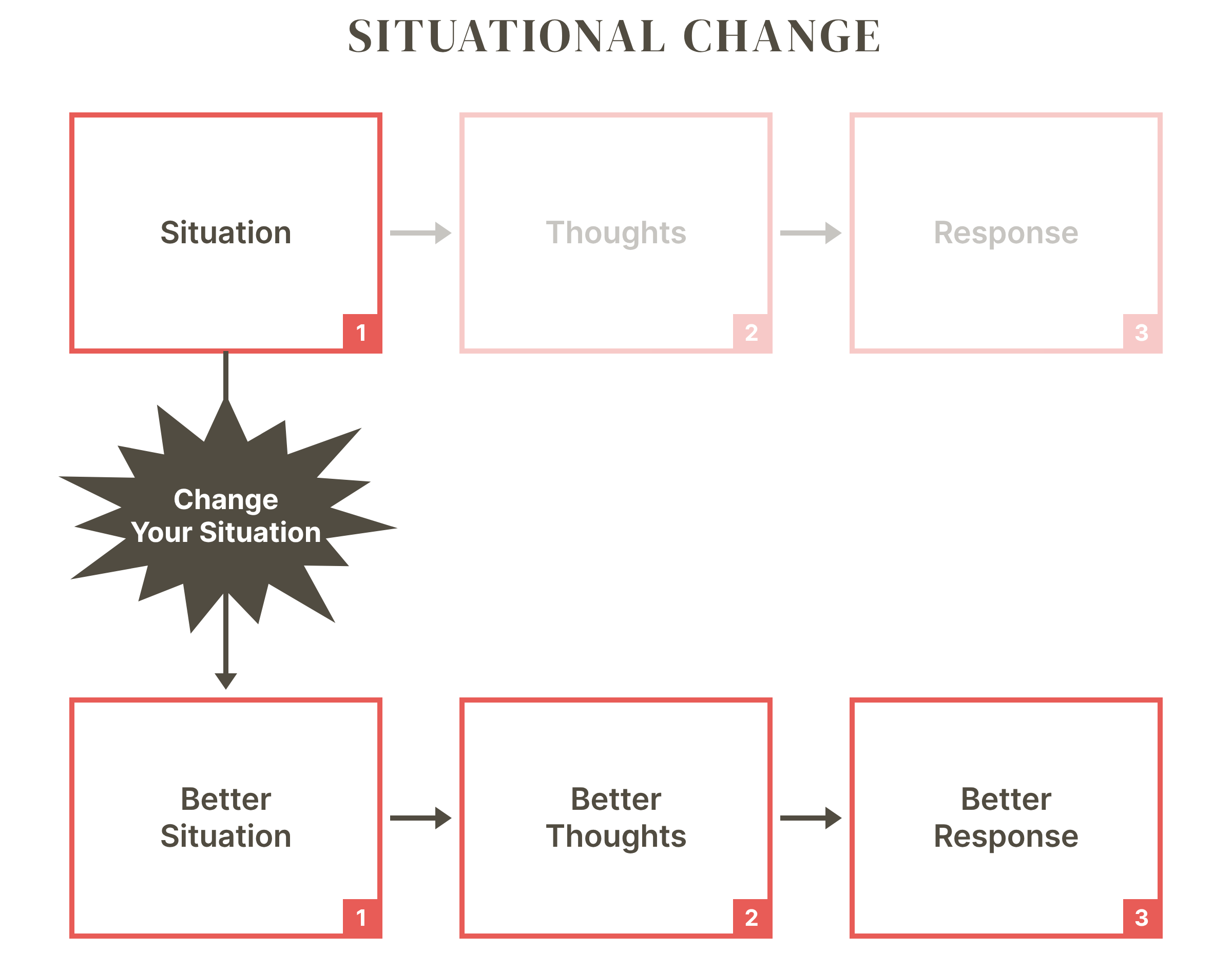
Duckworth shares a reductive but helpful three-box model for thinking about the subject, taken from her colleague James Gross. We (1) find ourselves in a situation, (2) have thoughts about it, and (3) respond.
In this model, the most direct way to effect a change in our response is to think differently. After all, the synapses are right there in our own heads. Cognitive behavioral therapy relies on this sort of direct intervention; unhelpful thoughts lead to unhelpful outcomes, so CBT seeks to help us change our thoughts and produce different responses and, thus, better outcomes. You self-coach your way to more favorable results. Come on, brain. Get with the program!

But direct and effective are two different considerations. When we determine to change our thoughts, we’re relying on willpower. And willpower often—in case you haven’t noticed—disappoints. Odysseus free on the deck of his ship sailing past the island of the Sirens is a dead man; he’s overboard the moment he hears their song, no matter how much he determines not to. We’re no different.
“In national surveys of American adults,” says Duckworth, “lack of willpower is ‘the most commonly cited barrier to making lifestyle and behavior changes.’” Does she have cameras in my house?
Instead, Change the Situation
A more effective intervention, says Duckworth, is to change the situation. Different circumstances provoke different thoughts and, thus, a different response. “A change would do you good,” as Sheryl Crow has been trying to tell us for all these years.
Duckworth shares the results of a study that asked a hundred people to describe major changes in their lives, such as career advancement, educational attainment, better relationships, and kicking bad habits. Half the group was instructed to write about positive change they’d experienced, the other half about change that had eluded them.
The failure stories tended to describe thwarted change in terms of insufficient willpower (Box Three territory), whereas the success stories tended to describe “mastery of the environment,” that is, intentional improvement of circumstances, including support and accountability from friends and family (Box One). Says Duckworth, “Attempts at making big life changes were more successful when aimed at the Box One situation rather than the downstream Box Three response.”
At some level this seems intuitive. If you want to lose weight, you don’t keep ice cream in the freezer. If you want to get out and jog in the morning, you set your shoes out the night before. If you want to curb your social media habits, you delete the apps from your phone or get a Brick. If you want to up your odds further, you enroll someone to hold you accountable.
And yet there’s cultural and moral heft attached to the idea of self-mastery, as if environmental change is somehow cheating. But is it?
Like what you’re reading? Subscribe, and new posts will ride an electron rollercoaster directly to your inbox twice a week. Free subscribers get two-week open access to every post; paid subscribers get the run of the archive, plus bonus content.
Two Types of Agency
I’m reminded of St. Benedict, living as a hermit and, alone in the wilds with only his thoughts for company, finding himself tempted by lustful memories of a woman. He could have determined to think different thoughts, but how well would that work? (Don’t think of an elephant.) Instead he stripped naked and tossed himself into a briar patch, and the resultant pain took his mind right off her.
Benedict couldn’t change his mind with willpower alone, so he changed his circumstances. However we think of going to such extremes, it hardly seems like cheating. In that case, self-mastery took the shape of situational mastery, which amounts to an indirect version of the same thing.
The problem is that we think of willpower as the only legitimate form of agency. There are obvious reasons for this. Grit, as I mentioned earlier, involves determination, persistence, and tenacity, all of which express self-agency, the internal power to make change happen. With that in mind, we tend to think of circumstantial assistance as something external, as a crutch.
And that might be true if we passively accept external circumstances as they come, making do with whatever they afford us. But Duckworth isn’t really interested in that. Her focus is what she calls “situational agency,” that is, the power to alter circumstances to assist the changes we desire. This is also a form of self-mastery, knowing yourself enough to intervene where you’re most effective. Odysseus took command of himself before the encounter with the Sirens when he instructed his men to bind him to the mast.
Thanks for reading! If you’re finding this post worthwhile, please re-stack it, hit the ❤️ below, and share.
Duckworth calls this “controlling the controllables” and quotes psychologist Roger Barker, saying, “When people understand behavior settings and learn to create and operate them, they greatly increase their power by managing the environment that has so coercive an influence over them.” That might not sound like self-mastery to some, but to me it seems to represent something equally, if not more, important: wisdom.
Four Levers to Pull
Duckworth suggests four primary ways to express our situational agency, all of which reflect various ways our situations are formed:
Our spaces
Our peers
Our mentors
Our culture
These four areas often overlap and might extend into others, depending on how we frame them up. For instance, I was born in Northern California but moved in my early twenties to Oregon for a job. That changed not only my space and my peers, but also my mentors and culture. I moved again from Oregon to Tennessee for another job. Once again, I changed spaces, peers, mentors, and culture—all in one fell swoop and all for the good. Migrants of all sorts are betting on similar outcomes.
But we don’t have to go to extremes like moving (though I recommend it) to benefit from situational change, any more than a naked leap into the thorns is the only way to beat distraction (still, it pays to keep your options open). Depending on what we’re trying to do, we can nudge situational changes.
When it comes to our spaces, says Duckworth, simply lowering the friction on stuff we want to do and raising it on the stuff we don’t want to do can help. Similarly with peers, if we find someone who’s willing to keep tabs on our progress, we’re more likely to keep plugging away. Book clubs? Great for reading goals. A personal trainer? Great for exercise goals. And these small effects can compound over time.

The Feedback Loop
A couple of decades ago the economist Bryan Caplan proposed what he called the Idea Trap, and I think it’s interesting that it more or less maps to Gross and Duckworth’s three-box model. Caplan was trying to explain why some countries stay poor. His answer? Bad growth (the situation) breeds bad ideas about economics (thoughts), which produce bad policy (response), which yields more bad growth, and then around and around the merry-go-round we spin, worse with every turn.
You can theoretically reverse it by injecting new and improved ideas, but we’re not typically open to those—or able to implement them—when we’re trapped in the cycle. Instead, it takes some shock to the system to shake things loose; in other words, a situational change.
I think this is true for individuals as well. As Duckworth points out in her conclusion, the three boxes aren’t a straight line; they’re a loop. Our response and its consequences feed back into our situation, which then shapes our next set of thoughts, and so on. If you get it wrong, it’s a vicious cycle. But if you interrupt the cycle at the situational level, you can create a virtuous circle: a better situation prompts better thoughts, which prompt a better response, which improves the situation, and so on. My move to Tennessee is, for me, a case in point.
Without situational support, implementing new ideas through willpower alone is likely to fail us. Odysseus was a famous talker and clever on his feet; Athena said he was “among mortal men . . . far the best at tactics.” She called him “foxy” and “ingenious.” But Odysseus knew he was no match for the Sirens, and so he didn’t trust himself.
Instead, he tied himself to the mast. Wise man.
Footnote: Situated for Reading
I read quite a bit. Not as much as some, but far more than the average. And people sometimes ask me how I manage to do it. For anyone who wants to fill their life with more reading, Duckworth’s model offers some valuable assistance. In fact, she recently discussed it on EconTalk with host Russ Roberts. So, here’s an exploration for paid subscribers of how to get better situated for more reading. Let’s start with the problem.


Thanks, Joel! I hadn’t heard of Duckworth’s new book, and I appreciate your interaction with it here.
Actually, inspired by Ulysses, in the fields of mental health and addiction there is growing interest in what are called 'Ulysses contracts'. Basically, these are contracts instructing others to force one to do or refrain from doing something regardless of one’s anticipated resistance. For instance, you might sign a contract agreeing to institutionalisation if you go off your meds, or you might sign a contract barring you from entry to a casino. They're a fascinating - if extremely legally fraught - area, primarily because they are very difficult to legally enforce.
The core problem is actually illustrated by Thomas De Quincey's *Confessions of An Opium Eater*, when he describes the efforts of his contemporary, Samuel Taylor Coleridge (De Quincey's core frenemy), to overcome his 'vassalage to opium' through precisely this type of self-binding. According to De Quincey:
"Coleridge hired porters for the express purpose of barring his entrance to any drug store
in order to procure opium, which would lead to the following rather extraordinary scenes:
‘Oh, sir,’ would plead the suppliant porter – suppliant, yet semi-imperative (for
equally if he did, and if he did not, show fight, the poor man’s daily 5s. seemed
endangered) – ‘really you must not; consider, sir, your wife, and—
Transcendental Philosopher: ‘Wife! what wife? I have no wife’.
Porter: ‘But, really now, you must not, sir. Didn’t you say no longer ago than
yesterday—’
Transcend. Philos.: ‘Pooh, pooh! Yesterday is a long time ago. Are you aware,
my man, that people are known to have dropped down dead from timely want of
opium?’
Porter: ‘Ay, but you tell’t me not to hearken—’
Transcend. Philos.: ‘Oh, nonsense. An emergency, a shocking emergency, has
arisen—quite unlooked for. No matter what I told you in times long past. That
which I now tell you, is—that, if you don’t remove that arm of yours from the
doorway of this most respectable druggist, I shall have a good ground of action
against you for assault and battery".