
How to Win a Billion Dollars and Ruin Your Life
The Perfect Bet: A Review of A. Natasha Joukovsky’s Satire ‘Medium Rare’

The great myths are always with us. “The ‘Iliad’ is only great because all life is a battle, the ‘Odyssey’ because all life is a journey, the Book of Job because all life is a riddle,” said G.K. Chesterton in his essay “A Defence of Nonsense.” We still draw water from these wells because, while the world has changed a million ways, we remain much the same as those who heard such stories with virgin ears.
Chesterton’s essay ricocheted around my head after I read a. natasha joukovsky’s latest, Medium Rare. Her first novel, The Portrait of a Mirror, gave readers Narcissus for the Instagram era. In Medium Rare, she retells the myths of Icarus and Phaethon, as narrated by another famous voice from the legendarium, Cassandra, who informs us at the start, “I always tell the truth; I am never believed.”
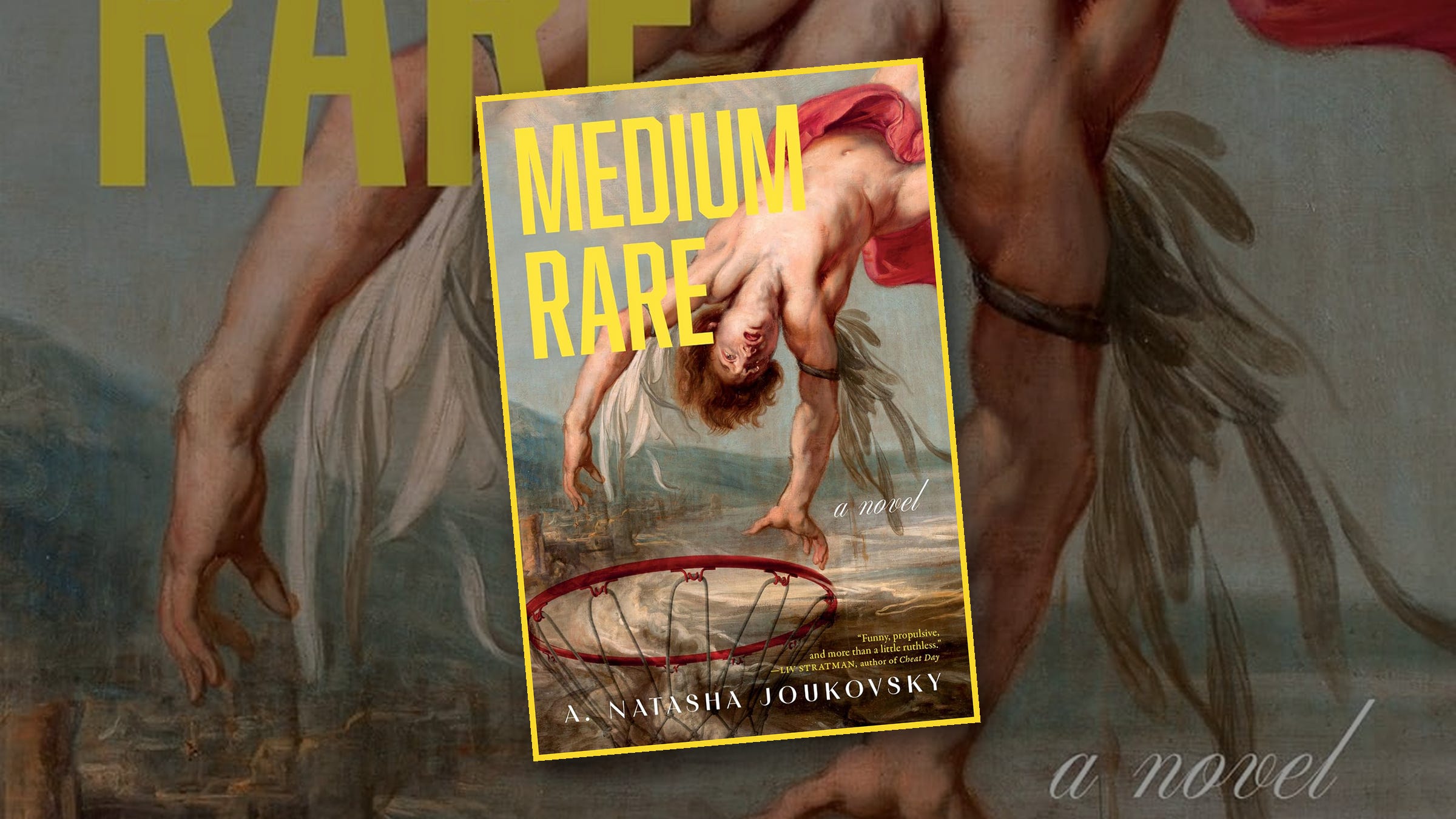
Despite the source material, we’re far from ancient Greece the minute Joukovsky’s satire begins. Phil Fayeton, a lowly Washington lobbyist for the American Association of Stone, Sand, and Shale (AASSS, unfortunately), pursues an impossible prize: filling out a perfect bracket for March Madness, the NCAA’s annual college basketball tournament.
Well . . . not exactly impossible, but the odds are loooong—roughly in the neighborhood of one in nine quintillion sort of long—so improbably, ludicrously, mind-bogglingly long that, as a publicity stunt, the founder and CEO of tech giant Daedalus (think Google) offers a billion-dollar prize for anyone who can do it.
Oops: Phil does it.
The Rise
Our narrator, Cassandra, a political fundraiser who sees herself writing novels someday, has known Phil and his wife Raleigh since college. Before the two marry, Cassandra warns Raleigh. “I see inconstancy and fitfulness—success portending pain,” she says. “Better steer clear.”
Raleigh doesn’t, and the two plow ahead into a life of middle-class mediocrity, complete with “a synthetically weathered home-decor sign reading ‘Love Is Never Having to Say You’re Sorry,’” suspended over the flatscreen.
In status-conscious Washington, Cassandra stands a cut above the couple but finds herself pulled back into their orbit as Phil ascends, one correct pick at a time. Throughout Part 1, Joukovsky charts the journey, using Phil’s winning bracket like a map.
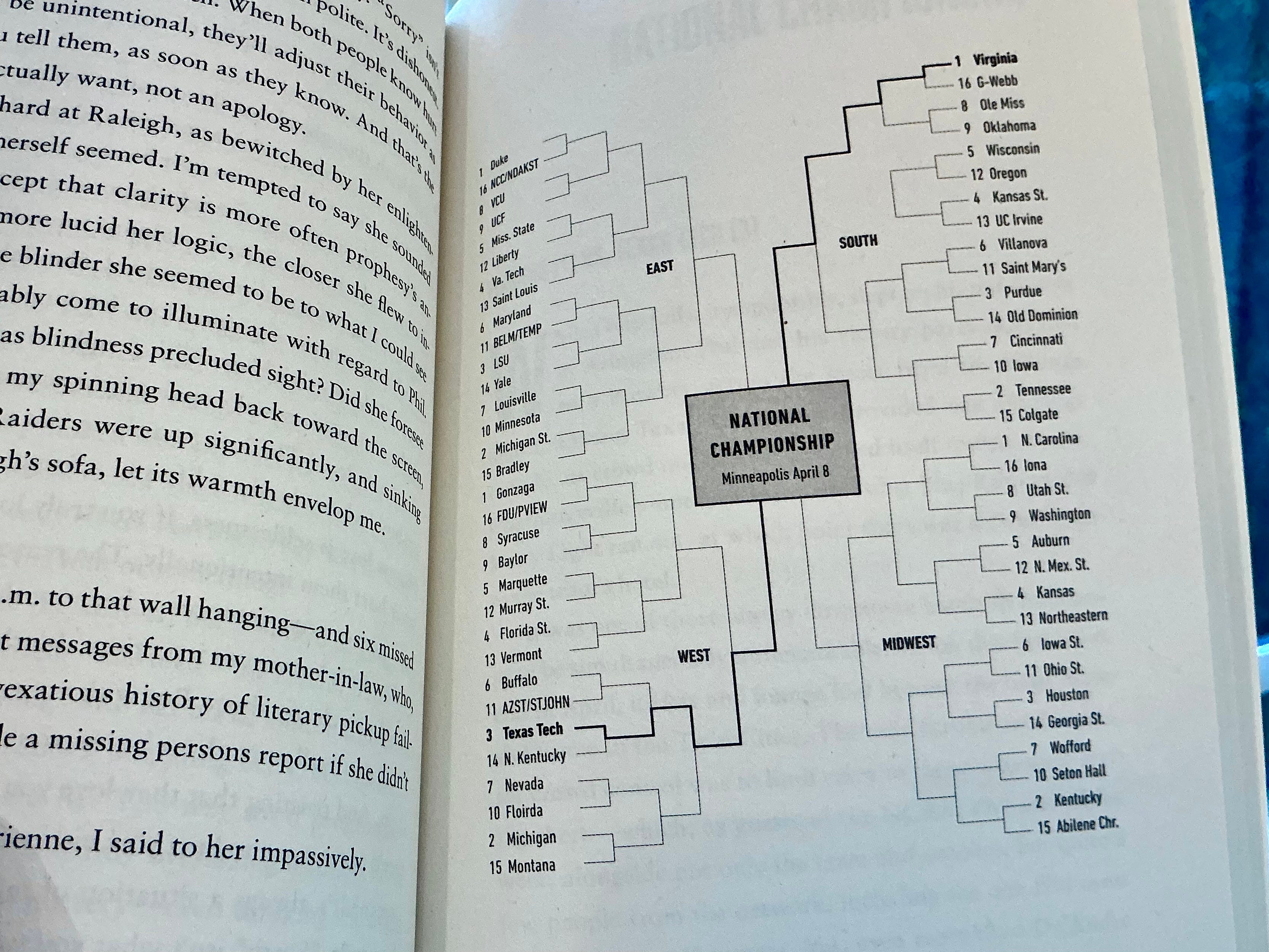
Raleigh joins Phil early on, but, far along in her pregnancy, must watch most of the action from their humble home on the television, where buxom sportscaster Sunny Sanders visibly takes a shine to her husband, a shine that Phil (no, Phil! you dolt!) returns.
Cassandra’s husband, Miles, keeps Phil company on the road, while Cassandra supports Raleigh at home, even through the premature birth of Phil’s daughter, an event he misses because he doesn’t believe—no one ever does, do they?—Cassandra when she tells him over the phone that Raleigh’s going into labor.
Phil faces moments of temptation beyond his entanglement with Sunny, as when Daedalus CEO Arun Patil offers to buy him out before the competition ends. It’s far less than a billion, though nothing to sneeze at. Raleigh is mystified her husband doesn’t take the offer, but Phil believes in his bracket, believes in his singular genius for picking the winner of every game. He refuses the offer, and when the final buzzer sounds, Patil ponies up the full billion.
Phil is stratospheric, a modern Midas who has gotten exactly what he wished for. The trouble is, to quote Anthony Bourdain at the start of his own lamentably Icarian arc, “You’ll never know the consequences of getting what you want until you get what you want.”
And Fall
As Part 2 begins, Raleigh remains loyal, even submissive, to Phil and goes along with his schemes to further his newfound fame and fortune. She doesn’t know about Sunny. Cassandra knows, or thinks she does, but she can’t prove it. Nor can she bring herself to tell her friend, to whom she’s grown very close over the prior months.
While buying up primo real estate around the country and yachting around the Mediterranean, Phil sees reality television as the best way to extend his moment in the sun. When that doesn’t pan out, he turns back to his more natural environs: politics. He had been a lobbyist, after all, and Cassandra is a fundraiser. Who better to pitch in? What could be more obvious?
Cassandra hesitates. Sunny is still out there, and Cassandra knows better. But not even Cassandra listens to Cassandra. She agrees.
The trick is that as a moderate Republican, Phil doesn’t stand a chance of winning anything. But as a moderate Democrat, he could possibly steer a state like California in a more productive direction than the progressive candidate. He decides to switch parties and run for Senate. The polls look favorable, better than favorable, and high-dollar donors line up behind him, including Arun Patil.
But there, at the apex of the rise, where can he go but down?
As confirmation of his affair tumbles out, Phil finds himself at his big fundraiser, dunked in Patil’s pool—a dress rehearsal for an even greater, more fateful descent. Joukovsky is drawing, after all, from more than the tale of Icarus. Phil Fayeton’s mythic namesake did not fly too close to the sun. To prove divine parentage, Phaethon demanded the reins of the sun god’s chariot, lost control, scorched the earth, and was struck down by Zeus, falling dead into a river. Watch out, Phil!
Capering Around a Truth
Medium Rare is satire, which takes me back to Chesterton’s essay. Referring to the nonsense of satirists, he says, “It was a kind of exuberant capering round a discovered truth. . . . Nothing sublimely artistic has ever arisen out of mere art, any more than anything essentially reasonable has ever arisen out of the pure reason. There must always be a rich moral soil for any great aesthetic growth.”
Joukovsky’s satire capers around a particularly American truth: we launder luck into merit, wealth into worth, and visibility into authority. Phil owes his fame to blind chance, but swallows the media mythology that he is practically clairvoyant. In his telling, he didn’t get lucky; he saw it all from the start. He even promises to do it again.
Like Cassandra, we can see the disaster looming: “Inconstancy and fitfulness—success portending pain.” The odds against a perfect bracket are, give or take, one in nine quintillion. The odds against a man wrecking his life once he can afford to are quite a bit shorter.
Thank you for reading! If you enjoyed this post, please hit the ❤️ below, 💬 discuss, and share it with your friends—or anyone you know who loves Greek mythology.
Not a subscriber? Take a moment and sign up. Free subscribers get two-week access to all new posts. Paid subscribers get access to the full archive, going back to 2022, plus an exclusive member chat and monthly member calls.
Before you go, check out these👇

