

There’s a paradox at the center of Don Quixote, Miguel de Cervantes’s beloved classic and the first modern European novel. The titular hero rides throughout Spain as a knight errant, pledged to righting wrongs while mostly making them worse, accompanied by his gullible squire Sancho Panza.
By the time we discover him gallivanting across the countryside, the world of knight errantry had been long dead. So where does this unhinged but earnest codger get the idea to don armor (such as he has) and mount his trusty steed (such as it is) and embrace a life of saddle-weary chivalry prone to endless abuse and reversals?
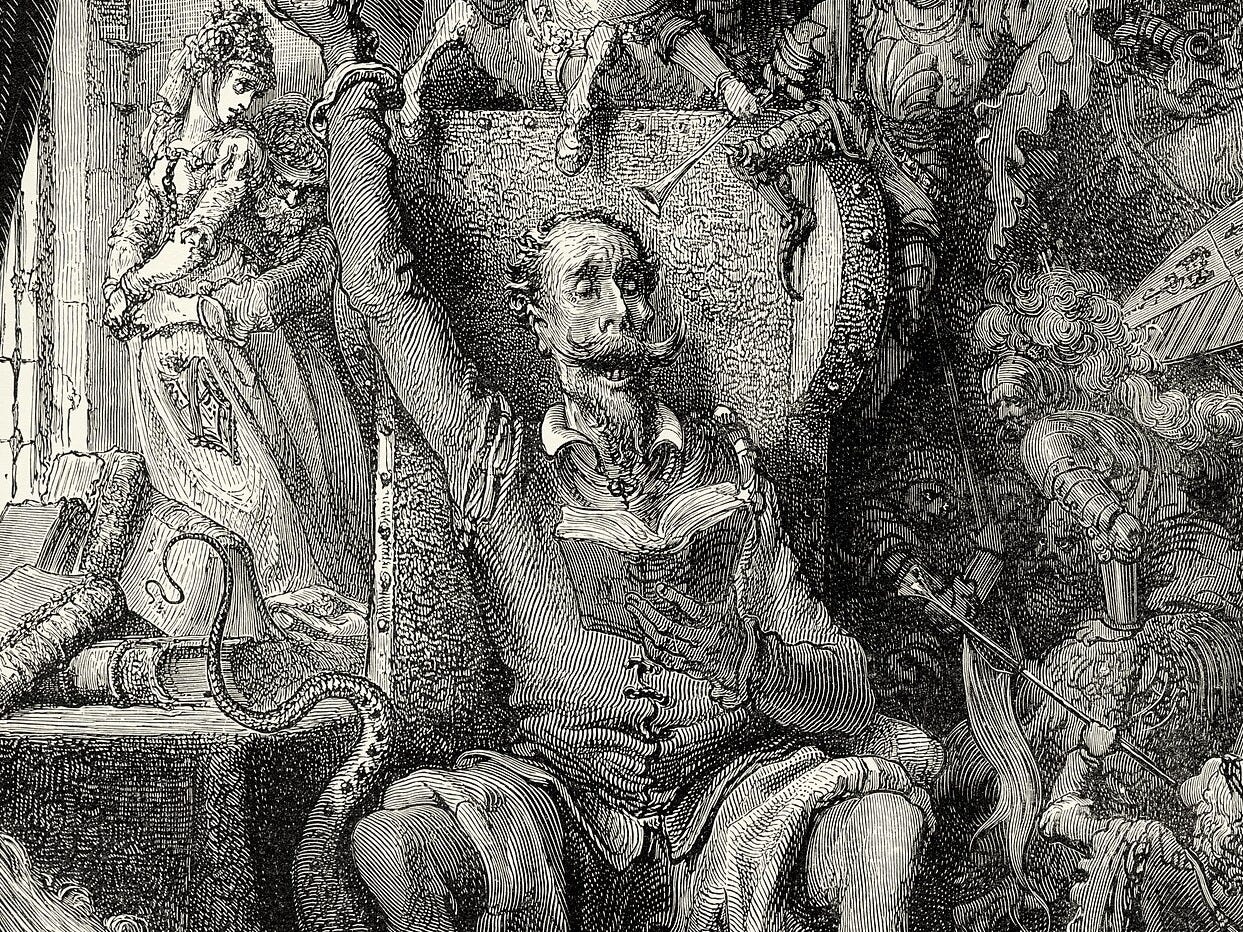
He reads it all in books! Gobs of them. Don Quixote, a hidalgo, or member of the lower gentry, acquires all the chivalric tales he can find, selling off acres of farmland to buy more volumes, which he reads nonstop—until, says the narrator,
the lack of sleep and the excess of reading withered his brain, and he went mad. Everything he read in his books took possession of his imagination: enchantments, fights, battles, challenges, wounds, sweet nothings, love affairs, storms, and impossible absurdities.1
Don Quixote takes these tales of courageous knights rescuing damsels, avenging wrongs, slaying giants (“with just one back-stroke” splitting “two fierce and enormous giants clean down the middle”) as genuine events, actual histories, and argues with the village priest about which knights in all these tales were the bravest and truest, compared to all others.
“And so, by now quite insane,” says the narrator, “he conceived the strangest notion that ever took shape in a madman’s head, considering it desirable and necessary, both for the increase of honour and for the common good, to become a knight errant.”
The paradox? Reading can drive you crazy and drive you to do crazy things (there’s a reason we have the word quixotic—about which more in the bonus below). And Cervantes warns us of the danger by giving us . . . another book.
Birth of a Novel
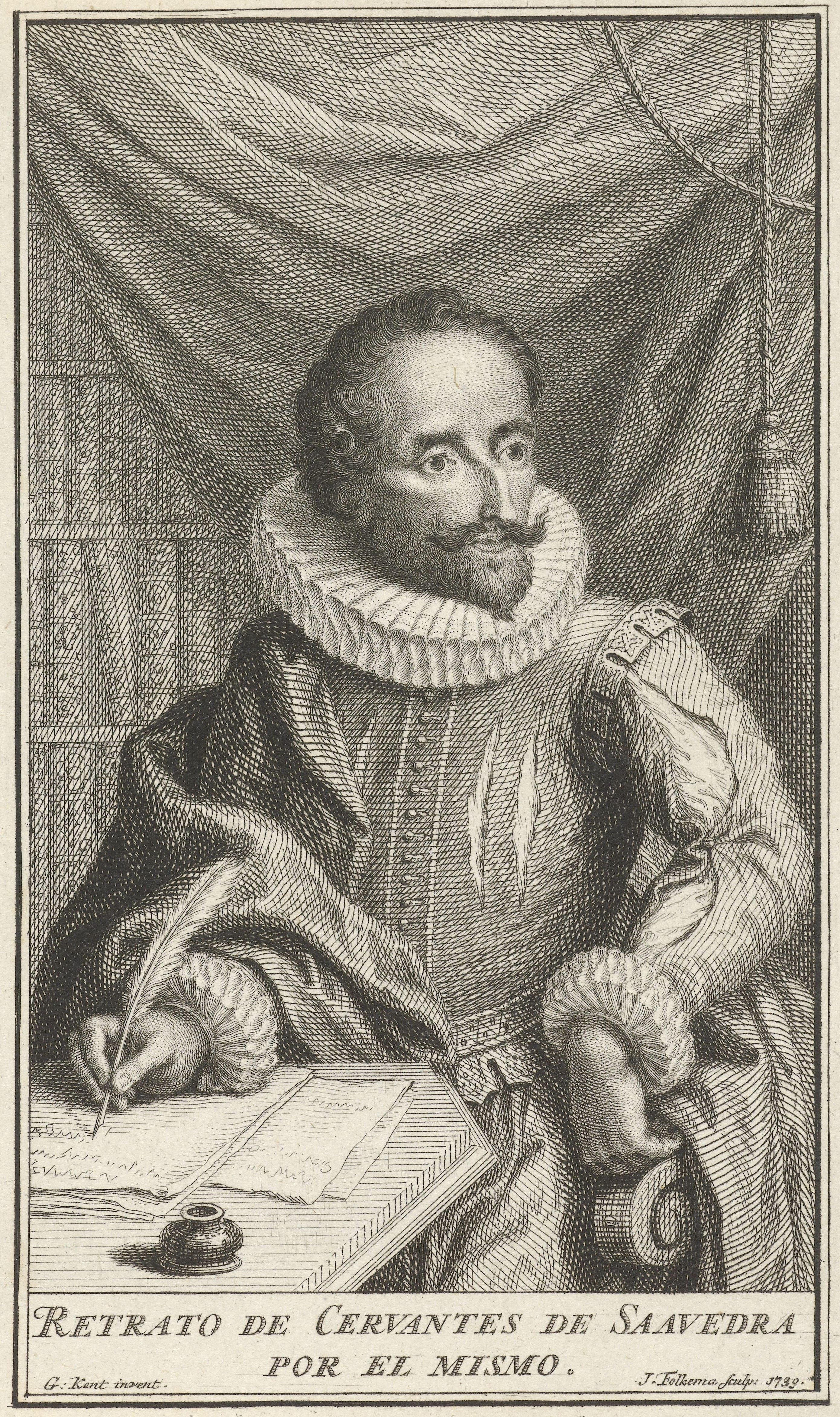
Cervantes was a soldier and bureaucrat with a talent for writing—but not very much if early fame is an indicator. He’d written some plays and novellas. His first drama, possibly his play El trato de Argel (Life in Algiers), came around 1581 or 1582, though the specifics are hard to nail down. He wrote it immediately after his own five-year imprisonment by Barbary pirates in Algiers and subsequent ransom. The best that can be said for it, according to Cervantes himself, was that it wasn’t booed or hissed off the stage.
Despite marginal success, Cervantes kept on writing while angling for other opportunities, ultimately landing a position in 1587 as a royal commissioner of provisions for the Spanish Armada. The role entailed purchasing—or seizing—goods to supply the navy. He kept lousy accounts and, accompanied by complaints about his activities, found himself imprisoned for unauthorized sale of wheat in 1592. Following his release, he became a tax collector, which led to (thanks to more shoddy bookkeeping) three months’ imprisonment in 1597.
Instead of getting used to his bars, however, Cervantes—possibly while still confined—cooked up something big. In the prologue, he refers to his book as “a child born . . . in prison, where every discomfort has its seat and every dismal sound its habitation.” With debts to settle and a literary axe to grind, he started writing, motivated in part by lampooning “books of chivalry, despised by so many and praised by many more . . .”
From the outset Cervantes conceived his novel as a book about books, offering a narrative that plays with other forms of narrative from within the narrative itself. The chivalric books he targets, for instance, often claimed to be true accounts, and Don Quixote takes them as such. So Cervantes spoofs the whole enterprise by claiming the same for his story, claiming to have found the true account of the knight Don Quixote. But the humor arrives immediately since there’s no agreement in the supposed histories about Quixote’s name. But the narrator plows ahead, promising not to “stray one inch from the truth.”
What’s more, as the story progresses the narrator’s principal source runs dry right in the middle of a fight. It takes him some time to find the rest of the story, written by an Arab historian. He has the book translated but then immediately tells us it’s untrustworthy. And yet that’s the story we get.
Tilting at Bookcases
With all the literary pomp and style usually attached to the valiant, the narrator gives us the exploits of this lowly, lunatic hidalgo, decked in fake armor, saddled atop his broken-down nag Rocinante, and trailed by the enabling Sancho, who can’t think his way out of a paper bag but who loves his master wholeheartedly and sticks with him on the promise of receiving the governorship of an island once Don Quixote has won his fame through deeds of virtue and valor—something that proves more than a little difficult because the hero has lost all grip on reality, beginning with his transformation of a local peasant woman into his lady-love and muse Dulcinea del Toboso without a hint of her awareness.
On his first foray, sans Sancho, Don Quixote mistakes an inn for a castle and convinces the innkeeper to knight him, to the amusement of all the guests. Emboldened by his commission, he then rides out to right grievous wrongs beginning by intervening as a farmer is beating his servant. His meddling causes the boy worse harm after his savior departs for further adventures, ending when Don Quixote gets beaten half to death while trying to defend Dulcinea’s impugned but imaginary honor, which he jeopardized in the first place.
When he returns home to recover, his friends and his local priest try to rescue him from his madness by burning the books that seeded his delusions. Once they begin sorting the library, however, the purge dissolves into a comic picture of literary criticism: this book is important, another one beautifully written, still another worth saving for a special virtue (“its author is a friend of mine”).
The chapter works as Cervantes’s soft poke at the idea that the books themselves are Don Quixote’s problem or that censorship can serve its purported purposes; the men who entered the library to destroy the books can’t stop arguing about their merits. How could you possibly judge? Don Quixote’s problem is that he can’t read fiction as fiction, a problem Cervantes mocks by presenting an impossible fiction as literal history.
Don Quixote’s friends resolve the issue by—a pattern for nearly every character in the story—making things worse: The housekeeper burns the condemned books, and they plaster over the library door, telling Don Quixote an enchanter has spirited it all away. Cue sad trombone. The scheme flops; for the rest of the book the lunatic believes an unseen enchanter is foiling his plans. Hardly dissuaded, he rides forth yet again, this time with Sancho in tow to serve his ever-mounting needs (and play comic foil).
Now for the Windmills
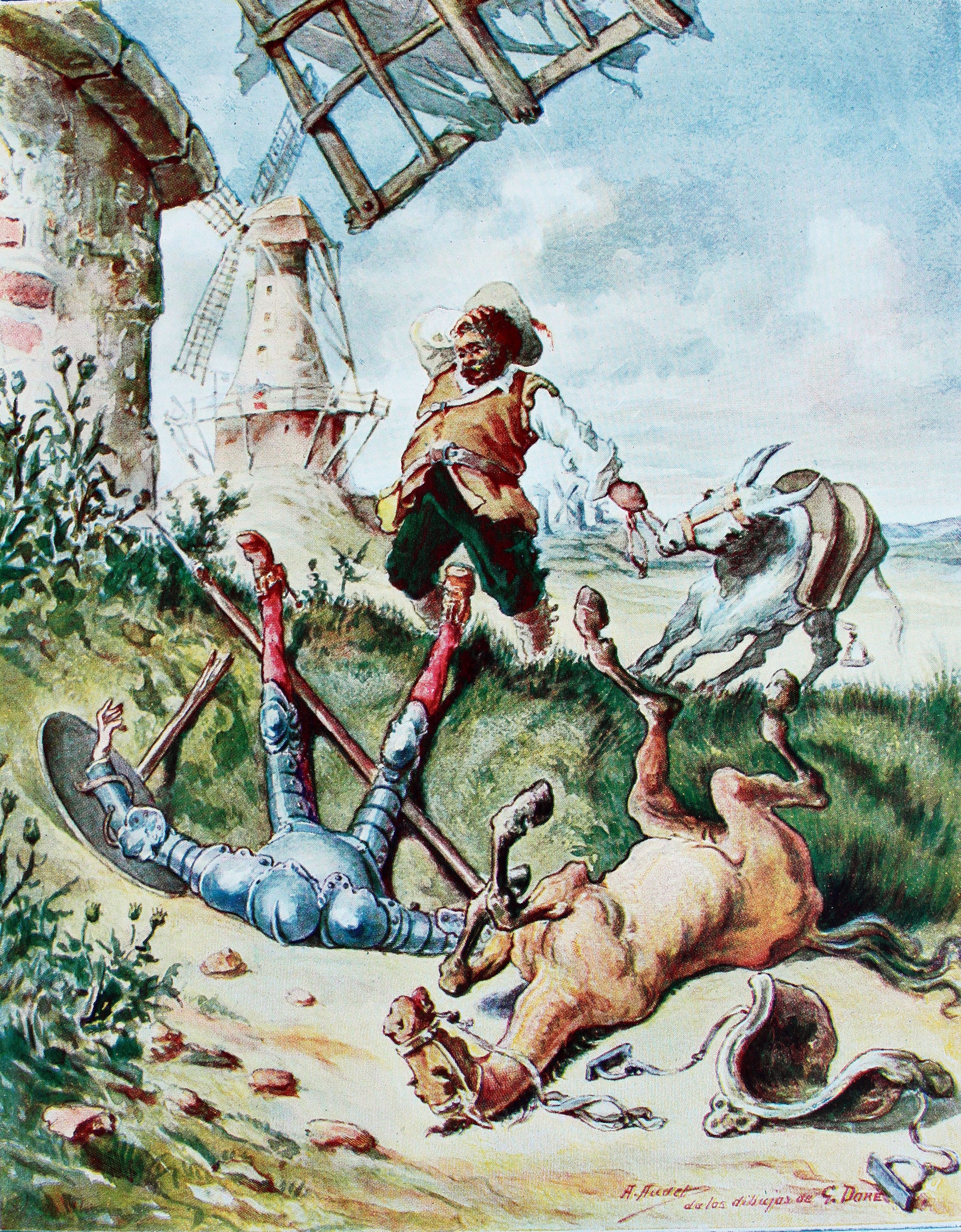
On the second foray, Don Quixote commences the most famous of all the episodes, jousting with windmills, which he takes in his delusion to be giants. “You can see over there, good friend Sancho Panza, a place where stand thirty or more monstrous giants with whom I intend to fight a battle and whose lives I intend to take; and with their booty we shall begin to prosper.”
Sancho tries to correct him, which Don Quixote rebuffs. “It is perfectly clear,” he says, “that you are but a raw novice in this matter of adventure . . .” Then off he flies on Rocinante and straight into one of the whirling arms of the nearest mill, which dashes him to the ground. When he gets up and realizes his foes are indeed windmills, he chalks it up to the enchanter who “turned these giants into windmills, to deprive me of the glory of my victory . . .” And so it goes, with, for instance, a flock of sheep he takes for an army, a chain gang of felons he takes for the oppressed, and a barber’s basin he takes for the enchanted helmet of Mambrino.
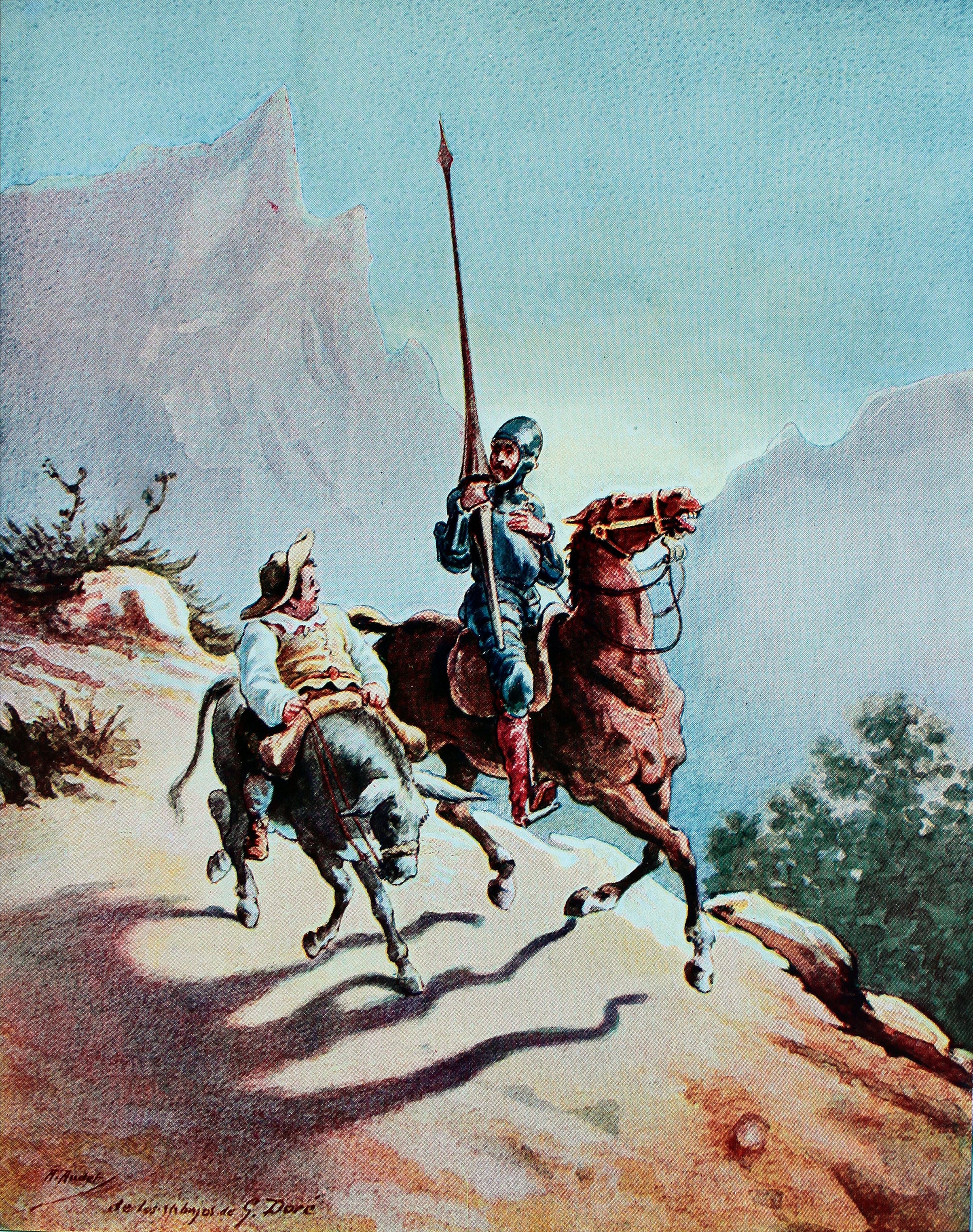
In these mixups, Don Quixote gets mixed up with a pair of unlucky lovers whose crises he inadvertently helps resolve while his friends try bamboozling him into returning home. They finally succeed in binding him hand and foot and tossing him in a cage on an oxcart. On his way home in that sorry state, he’s introduced to a goatherd by one of the friends, who calls him “the famous Don Quixote de la Mancha, the redresser of injuries, the righter of wrongs, the protector of damsels, the terror of giants and the victor in battles.”
“That sounds to me,” says the goatherd, “like what you read in books about knights errant, who used to do all those things you said this man does, but it’s my opinion that either you’re joking or some of the rooms in this character’s upper storey are empty.” Indeed. Wink, wink. Chuckle, chuckle. But the story’s not over.
The Phony Quixote!
Don Quixote went to press in late 1604 and was published in early 1605. The response was instantaneous. Readers loved the comic nature of the story, and Cervantes and his printer produced a second edition within months. Meanwhile, pirated editions took advantage of demand while Cervantes struggled to extend his publication privileges, which were regionally controlled by authorities vainly hoping to control the print market.
Within a decade the book was translated into both English (1612) and French (1614), and Cervantes’s fame spread across the ocean. Copies were shipped to the Spanish Americas—400 copies in the publication year alone. Soon, anticipating the cosplayers of Comic-Con, people were dressing as Don Quixote and Sancho in festivals in Spain and the New World as well (Peru in 1607 and Salamanca in 1610).
Meanwhile, Cervantes busied himself with other projects, though they went unpublished for several years and finally came in a rush: Exemplary Novels (1613), Journey to Parnassus (1614), Eight Comedies and Eight Interludes (1615), and Persiles and Sigismunda, published posthumously (1617). Most important was Part Two of Don Quixote; that came in 1615.
Another writer forced his hand. In 1614, the pseudonymous Alonso Fernández de Avellaneda published Second Volume of the Ingenious Gentleman Don Quixote of La Mancha. So we’ve got cosplayers and fan fiction here in the early seventeenth century, and we’ve also got metafiction, which Cervantes embraces in Part One and aggressively exploits in Part Two.
Cervantes was already working on his own sequel when the counterfeit emerged. He now felt not only compelled to finish his own version to set the story right, but also denounce his competition in print and have fun doing so. He published his Part Two in 1615; what we now think of as Don Quixote is both books together, all thousand or so pages.
In Part Two, Don Quixote discovers that his earlier escapades have been published (Part One); the bookworm has become a book! What’s more, he finds many of the people he meets in his journeys have read it. They know his habits, play to his delusions, and begin using what they’ve read on the page to manipulate the man in front of them. Having read the book, for instance, a bored Duke and Duchess are well equipped to bend Don Quixote and Sancho to their amusement for days.
In Part One, Don Quixote tries to bend the world to the books he’s read; now a book tries telling the world who he is and what he’ll do. Finally, Don Quixote revolts. In one episode the narrator places Don Quixote and Sancho in an inn where someone asks a friend to read aloud from Avellaneda’s knockoff version of Part Two in which the imposter says Don Quixote has abandoned his love for Dulcinea.
When Don Quixote hears this, he explodes with indignation and sets the men right. After a conversation they ask where he intends to go next. “Saragossa to take part in the jousts for the suit of armor that are held in that city each year.” No surprise, really; that’s exactly what the phony book said he’d do! So Don Quixote changes his plans. “Well, for that very reason,” Don Quixote says, “I shall not set foot in Saragossa, and thus I shall announce that novice historian’s lie to the whole world. People will be made aware that I am not the Don Quixote about whom he writes.”
The Book Folds on Top of Itself
Pushing the metafictional angle even further, the narrator brings Don Quixote to a print shop where the fraudulent book is being printed. He declares it fit for fire and stalks out. By the end, the book has folded on top of itself.
The chivalric romances at which Cervantes rolls his eyes claimed to be history, and Don Quixote believed every word. But Cervantes borrows the devices they use to pass as history and makes each one fail: the sources disagree, his primary witness runs out in mid-fight, the new source is suspect, and a rival version turns up in print.
In Don Quixote’s world there’s no gap between “it’s written” and “it’s true”; it’s like the worst version of that one person in your family and all the Youtube videos and Facebook posts they send you. (See, we’ve been dealing with that a long time too.) But Cervantes’s narrator keeps prying open the gap, which lets us do what Don Quixote can’t: enjoy the story while judging what it asks us to believe.
Even when Don Quixote confronts a version of his own life he rejects, he calls its author a liar—that is, a bad historian. Then he changes his itinerary when he should have changed his epistemology. The only thing that finally breaks the spell for him is utter defeat.
Books are a powerful technology. We’ve known that at least since people began trying to control readers by burning what they read. Books can furnish the categories by which we interpret everything we encounter: our friends, enemies, obligations, hopes, disappointments, even ourselves. Contrary evidence needn’t break the spell. Once a book teaches you how to explain away the evidence against it, there’s no getting out. Just talk to a conspiracist; there might be a powerful enchanter on the loose.
The cure isn’t censorship and bonfires. Don Quixote’s friends burn his offending books and only strengthen his delusion. Cervantes exemplifies a better remedy: He writes a book capacious enough to expose the faulty books’ absurdities, absorb their virtues, and then eclipse them. He answers bad literature with better literature and bad reading by making the novel’s central claim—”this really happened”—fall apart in our hands while leaving the adventure whole, in one glimmering piece.
Like what you’re reading? Please hit the ❤️ below, restack, discuss, and share.
And consider subscribing: Free subscribers get two-week access to all new posts. Paid subscribers get the run of the complete archive, plus bonus content.
Bonus: The Global Reach of Quixotic
If you want to say something is idealistic but a little (or a lot) unhinged and likely to end in failure, there’s a word for it: quixotic. The etymology, naturally, runs back to our hero, but the word traveled much further afield than our daffy knight errant ever managed in Spain. The word, like the novel, went global. Here’s an etymological world tour for paid subscribers.
Before You Go👇


_%22%C2%A1V%C3%A1leme_Dios!_dijo_Sancho..._(5789387761).jpg)
_%22Mire_vuestra_merced,_se%C3%B1or_caballero_andante,_que_no_se_le_olvide_lo_que_de_la_%C3%ADnsula_me_tiene_prometido...%22_(5789386773).jpg)
All quotes from John Rutherford’s translation.
When any fictional characters in any media set off to do good and write wrongs and end up mostly not doing either, they are clearly walking in the footsteps of Don Quixote and Sancho Panza. I'm convinced you can find their comic DNA in a wide variety of different fictional comic duos, from Laurel and Hardy to Rocky and Bullwinkle...
As far as I can tell, we are all conspiracists- divided and certain the “ other side” is all bad intention and terrible action. Maybe considering ourselves as Quixotes might grant us some humility.