
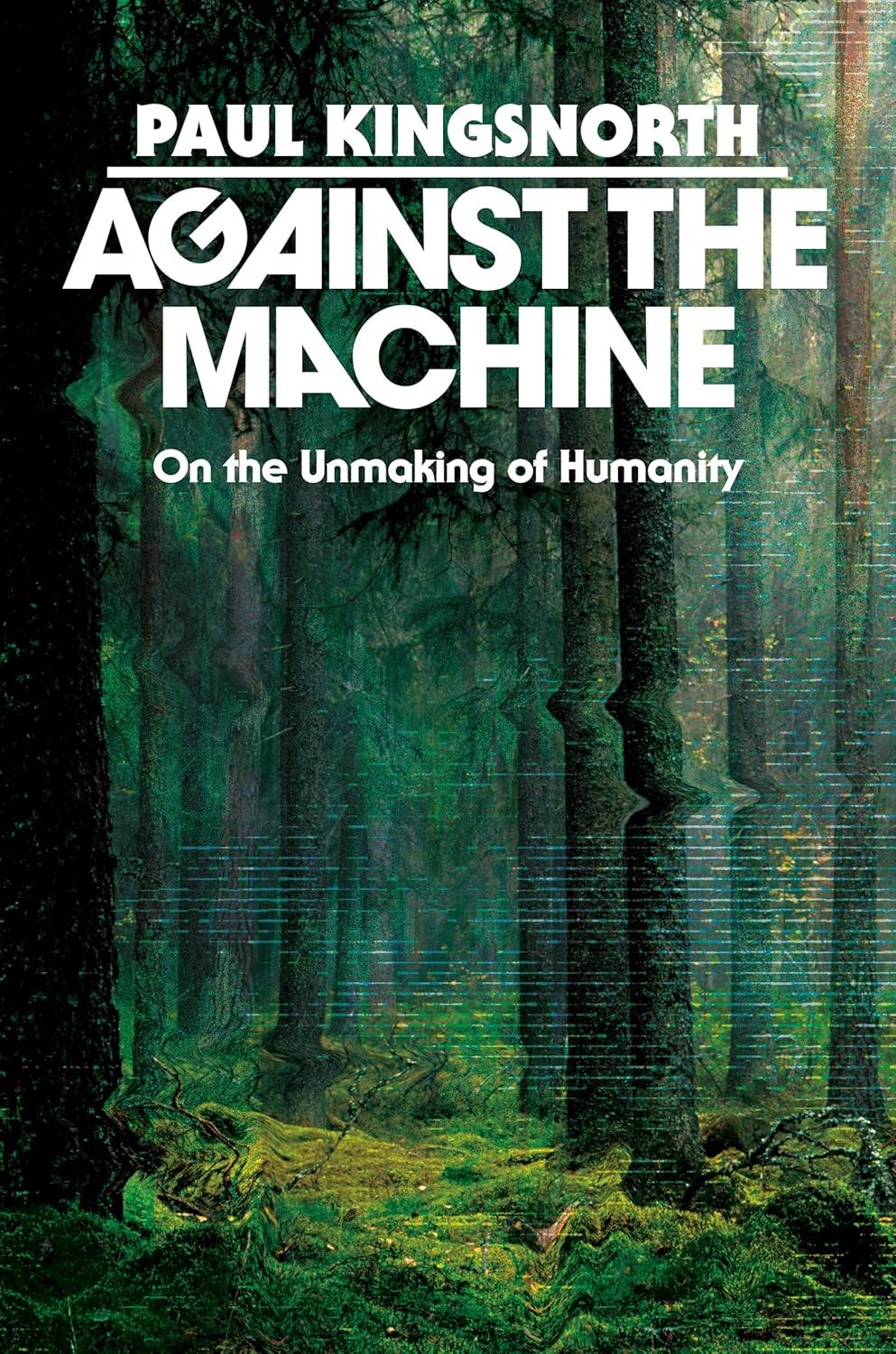
Against Paul Kingsnorth’s ‘Against the Machine’
A Charitable (I Hope) Critique

Toward the end of Paul Kingsnorth’s Against the Machine, he paints an attractive picture of people free to pursue value and meaning in small pockets of community and industry. He highlights “a politics which embraces family and home and place, loving the particular without excluding the outsider, and which looks on all great agglomerations of power with suspicion.”
My inner anarchist cartwheeled at his description of “a system built around community bonds, local economics, and human-scale systems,” where the reach of the totalitarian state gains little purchase, populated by—in James C. Scott’s descriptor—“barbarians by design.”
But! And you can’t even imagine all the contrariness I’m cramming into that humble coordinating conjunction. But! The barbarian stands outside civilization, and I reject Kingsnorth’s description of the civilization he urges us to exit.
Let me start with a caveat and show some cards; the rest of my hand will be revealed as I go. I don’t read books to dismantle them and don’t review books as takedowns; that can be useful, but I find it distasteful and get no joy from it. When I read disagreeable books, I do so with self-imposed criteria you can find here.
More important than that, however, books are written by authors, by people. I have no relationship with Kingsnorth; he lives an ocean away, and I don’t believe I’ve ever had one exchange with him online. But he’s an Orthodox Christian, as am I. He’s a brother, and however we differ, we have more in common than not. I’ve read some of his work—I’ve been, for instance, fascinated by his posts about sacred wells. I suspect I’d enjoy his company for hours on end. If opportunity ever presents, and I hope it does, I’d jump on it.
I say that to underscore the spirit in which I offer this critique. Take it as you will, but there is no malice in what follows. There is, however, considerable disagreement. I scribbled my way through the entire thing.
From where I sit, the whole project gets off on the wrong foot.
The Wrong Story
Kingsnorth begins by describing what he sees as a complete break in the West’s self-understanding as it shifted from a Christian culture to a secular society. He describes this shift as a death, “leaving only ruins.” But this bungles the story.
Secularism is the product of Christianity, as were both earlier and subsequent developments Kingsnorth derides: capitalism, individualism, liberalism, and so on. They are all part of how the West interpreted and applied its Christian heritage to meet various societal needs.
Secularism was, as Kingsnorth acknowledges, an answer to warring Christian groups after the Reformation. Agreeing to disagree—that is, allowing for some sort of common ground if only as a practical concession—beat endless bloodshed over who had the “correct” set of beliefs. I, for one, am grateful to sip coffee with my Catholic neighbor instead of lancing him on a muddy field somewhere. But contra Kingsnorth, the intent wasn’t to replace religion with Christless secularism; that may have been an effect—it’s at least worth debating—but it was not by design as he claims.
This sort of mischaracterization runs all through the book. Kingsnorth approvingly quotes G.K. Chesterton damning capitalism as “a monster that grows in deserts.” Chesterton was clearsighted about many things, but he overlooks his own tradition’s role in capitalism’s emergence and what that origin might tell us about the thing itself. Rodney Stark’s The Victory of Reason shows how, for instance, capitalism arose from European monastic communities where agricultural produce was cultivated, traded, and managed with the development of cash, credit, interest, and investment. Widespread technological innovation folds into this story as well, as detailed by scholars such as Lynn White Jr.1 The industrial revolution? Read French medievalist Jean Gimpel and it’s clear its trajectory began in the Middle Ages.2
Pointing to medieval origins doesn’t cancel Kingsnorth’s criticisms. Monks trading grain and wool and building windmills operated at a different scale than Amazon’s global logistics empire, and size can transform the nature of a thing. The question is whether modern capitalism represents a continuous development or a qualitative break. I lean toward the former.
What about the negatives that populate Kingsnorth’s narrative? The fact that various players have historically coopted political power and used it to direct ill-gotten riches to themselves says less about capitalism and industry than it does about human failings: arrogance, greed, and the like. Perhaps other systems offer different checks on those sins; it’s harder to play monopoly in, say, Communist Cuba—unless, of course, you rule the island. Even then, I suspect the Cubans aren’t noticeably more virtuous than their North American neighbors.
Along with capitalism, monasteries also helped foster individualism and liberalism. Through both theological and social innovation, Christianity challenged the Greco-Roman dominance of the family and carved out a pocket for personal autonomy and conscience to flourish. In Inventing the Individual, Larry Siedentop follows this trajectory from St. Paul through medieval monasticism and into the modern era. “Christian moral beliefs emerge as the ultimate source of the social revolution that has made the West what it is,” says Siedentop.
We can add to this recital, but I think it’s sufficient to say that where Kingsnorth beholds rupture and ruin there’s actually surprising continuity and fruit with deep, if underappreciated, roots. The problem? In missing these and other continuities, he misconstrues the cultural developments he criticizes.
By presenting the Western project—which we might define by several of its features, such as personal autonomy, equality, individual rights, liberal governance, open trade, democracy, and so on—as something alien or, more accurately, cancerous, he can attribute a form of malignancy to the entire enterprise. He then portrays this malignancy as a consuming force that relentlessly grinds against human flourishing: the machine of his title.3
But there’s nothing fundamentally malign about any of these features and their development. They are simply how our culture evolved, given the materials to work with and the situations at hand. To press that point, these features are responsible for much of the human flourishing documented in the last several hundred years: lengthened life expectancy, heightened living standards, economic growth, widespread reductions in poverty, drastically expanded literacy, greater freedom and civil liberties, significant declines in overall violence, and more.4
These gains are real and shouldn’t be dismissed—I won’t trade them in. But Kingsnorth hardly nods in their direction. Instead, we get an unremitting prosecution of the modern West’s many faults: fractured communities, meaningless work, nature treated as mere pantry for our ravenous appetites, the dominance of market logic, technological triumphalism, and an unshakable sense we’ve been reduced to cogs in, well, a machine. (There’s a reason the title resonates.) To the extent these complaints are real and not caricature, Kingsnorth does us a service. But by presenting them as if they are absolute facts of Western life with no benefits in the balance, he actually obscures the picture.
How could, after all, such a malign machine produce the gains outlined above? It didn’t. Because there is no malign machine. Kingsnorth might be describing something real: emergent structures that, whatever their origins, now constrain human freedom and flourishing in ways that feel systematic and mechanical. But that’s not the whole story—nowhere near it.
What does all this reveal? Kingsnorth presents us with a flawed understanding of how cultures actually work and, therefore, what our response to our current predicament should be.
How Culture Works
Kingsnorth treats modern culture like a top-down phenomenon, practically imposed on us. Following Lewis Mumford, he describes the machine as “an entire society ordered from the top down, justified by a mythos employed by its leaders and driven by a desire for order, power, predictability, and above all control.”
Corporations represent an example of this in action, according to Kingsnorth. “Companies like Amazon and Google do not just have phenomenal economic heft, granted to them every time we use their services: they also design the parameters of the culture in which we live” (my emphasis).
Kingsnorth captures something real here about the experience of modern life; it often feels as though we’re subject to forces beyond our control, shaped by institutions whose scale dwarfs our individual agency. Hello, administrative state! But as a description of how culture actually works, Kingsnorth has it backwards. Corporations like Amazon and Google—not to mention governments—don’t set the parameters of our culture. Culture is a bottom-up phenomenon, an emergent system like language and markets.
What is a culture? Kingsnorth says it’s “a story that a people tells itself.” But a culture is not a story; it is a constellation of assumptions and practices. Story is something we layer on those practices after the fact, as a way to make the past intelligible. But that narrative imposition is necessarily reductive, flattening the messy reality of how cultures actually function.
Cultures don’t operate under singular narratives anyway. They contain currents and crosscurrents, internal tensions that affect how people within the culture express themselves at any given moment. There is no monolithic story to which a culture subscribes. There are multiple stories, many of which compete with each other.
By ignoring this dynamic reality, Kingsnorth presents a monolithic, antagonistic vision of the modern Western project. His capitalism, for instance, means one thing, but many of its most ardent proponents wouldn’t recognize the capitalism he describes. He isolates certain features—say, corporatism or technocracy—and treats them as if they constitute the whole, as if they define the system rather than represent particular expressions within it. He also fails to recognize that these strands are opposed by proponents within the same system. (Consider the fight within the Republican Party right now over tariffs.)
Kingsnorth seems to assume that cultures are static, not dynamic. This rules out the ability to see the continuities mentioned above; instead, they represent fractures. But excluding extreme cases, cultures don’t die so much as transform. They have to. They must evolve and change because the people who practice that culture face different circumstances, and cultures arise precisely in response to circumstances. The Reformation created religious and political turmoil; secularism emerged as a practical solution. Economic changes demanded new forms of organization; capitalism developed. Technological possibilities opened; people explored them. None of this was designed or superintended from above, let alone for malign purposes. These were adaptive responses, bottom-up solutions to real problems and opportunities.
This is how cultures work: through constant feedback and adjustment, changing as individuals act upon the exigencies of their day. Every participant plays a role in signaling and responding to countless factors, both internal and external. Changes themselves drive further changes in an open-ended process without a predetermined destination. There are tradeoffs, but the reality of winners and losers doesn’t mean the game is fundamentally rigged. It’s too gargantuan and complicated to rig beyond local effects anyway.
Recognizing the continuities also helps point us to answers for the intolerable aspects of these developments, such as alienation, dislocation, meaninglessness, ecological destruction, and concentrated political and commercial power. “Europe has given birth to monsters,” says French philosopher Pascal Bruckner, “but at the same time it has given birth to theories that make it possible to understand and destroy these monsters . . . like a jailer who throws you into prison and slips you the keys to your cell.” Potential answers come from within a living tradition, not by exiting a supposedly dead culture.
This is what Kingsnorth misses in his call to become “barbarians by design.” As products of Christianity as lived within Christian Europe, secularism, liberalism, individualism, capitalism, and the rest, are not foisted upon us from without or by a cabal of malicious elites. These developments are us; we created them in response to real needs and genuine problems. And their best, most fruitful expressions will come not from rejecting them and wandering off, but from better participating in them.
Kingsnorth emphasizes the importance of roots, rightly so. But these are our roots—every bit as much as those he laments having lost as Western culture has adapted and evolved. Even to the extent we reject certain expressions of the culture, we are its children nonetheless. We are not barbarians outside the gate. We are inhabitants of this city we’ve created with responsibilities to love our neighbors and live our lives within it. That means working to bend it toward human flourishing, using the very resources—moral, intellectual, spiritual, practical, institutional—that the tradition itself provides.
The dynamism that created these problems can also address them, if we participate intentionally rather than passively. So: If there is no malign machine, if culture is an emergent phenomenon that we help shape through our participation, then Kingsnorth’s prescription to exit offers one response—but not the only one, and perhaps not the wisest.
The Irony of Exit
I could say more. I believe, for instance, that Kingsnorth pulls his punch at the end of the book by accepting that people who go for his argument will still need to live and work within the machine, to become “cooked barbarians” as opposed to “raw.” That’s only honest if we downplay the severity of everything that’s come before. I also think he fundamentally misconstrues the role of the city—Christianity is a cosmopolitan religion whose culminating icon is an enormous city, gloriously descending from heaven. But there’s a final and more fundamental irony in Kingsnorth’s call to become barbarians.
The attractive picture he paints at the end of his book—people free to pursue value and meaning in small pockets of community and industry, a politics embracing family, home, and place—is best practiced, perhaps only practiced, within a liberal order that leaves people free to experiment and try new ways of living.
What Kingsnorth describes is possible right now, under the current terms of our culture, thanks to the very liberal, secular order he decries. Want to raise your children outside the industrial education system? Opt out of consumer culture? Slow your pace? Homestead? Start a local farm coop? Build intentional communities organized around shared values? Practice artisanal crafts? The current order permits all of this. It even protects your right to do so.
If this sounds like the right path for you, thank the liberal tradition’s commitment to pluralism and individual conscience—back to those Christian continuities I mentioned.
By all means, push back against what you find dehumanizing. Build alternatives. Create communities that embody superior values. Retrieve and revive ways of life that modernity has marginalized. Follow a monastic rule! But recognize that there’s nothing gained in burning down the platform on which we stand—a platform those same monks helped build.
The very ground that makes such experiments possible is the liberal, pluralistic culture that emerged from our Christian past and still promises hope for the future.
Paul Kingsnorth was generous enough to respond to my critique. Read his response here. I followed up here and here.
As a side note, several months ago, Dylan Pahman (The Cutting Room Floor) of the Acton Institute allowed me to read an advance copy of his book, The Kingdom of God and the Common Good (Ancient Faith, 2025). It’s now out, and it’s the single best book I know for explaining the long, rich history of Christian social thought—across all traditions. If you’re looking to supplement Kingsnorth’s book, or want a corrective to it, I cannot recommend Pahman’s book highly enough.
Thanks for reading! If you enjoyed this post, please hit the ❤️ below and share it with your friends.
Not a subscriber? Take a moment and sign up. It’s free for now, and I’ll send you my top-fifteen quotes about books and reading. Thanks again!
Related post:

And check out my new book, The Idea Machine: How Books Built Our World and Shape Our Future, out now! Interintellect founder Anna Gát calls it “the best Christmas gift you can get for anyone you know who loves books and ideas.” I’m biased, but I agree!

See, for instance, White’s Medieval Technology and Social Change (Oxford University Press, 1964); Dynamo and Virgin Reconsidered (MIT, 1968); and Medieval Religion and Technology (University of California Press, 1978).
See, for instance, Gimpel’s The Medieval Machine (Penguin, 1977).
It’s worth saying that my continuity argument cuts both ways. If modernity’s problems flow from Christianity’s development in the West—and I acknowledge Kingsnorth identifies genuine problems—then perhaps something in that developmental path itself warrants scrutiny. He teases this when pointing to John Duns Scotus’s theological innovations in the thirteenth century. As Orthodox Christians, both Kingsnorth and I recognize divergences in Eastern and Western expressions of the faith that foreclosed certain options as Western Christianity pursued its subsequent trajectories. That’s a conversation worth having, even if I don’t share his conclusions.
See, for instance, the work of Joel Mokyr, Deidre McCloskey, and Johan Norberg. It’s also worth looking at the data tracked by Human Progress.
Thanks for the review. I appreciate the engagement. I don't normally respond to reviews, but in this case I feel the need to, because you characterisations are to my mind both wrong and mistaken, and I am itching to stick my oar in ...
So please accept following the kickback against your review in the spirit in which you offered yours, and from one Orthodox Christian to another. Maybe we will get the chance to have that drink together one day.
Let's start with the notion that 'the Machine' is a product of Christianity. Here are a couple of quotes from your review:
'But contra Kingsnorth, the intent wasn’t to replace religion with Christless secularism; that may have been an effect—it’s at least worth debating—but it was not by design as he claims.'
'Chesterton was clearsighted about many things, but he overlooks his own tradition’s role in capitalism’s emergence and what that origin might tell us about the thing itself. Rodney Stark’s The Victory of Reason shows how, for instance, capitalism arose from European monastic communities where agricultural produce was cultivated, traded, and managed with the development of cash, credit, interest, and investment.'
The first thing to say is that my book makes the explicit argument that the current Western model did indeed emerge from Christianity, quoting Christopher Dawson, among others, to make the point. The first few chapters are taken up with arguing this case. At no point does the book claim that the Reformers and their descendants had an 'intent' to replace Christianity as such. In fact, it quotes Brad Gregory's 'The Unintended Reformation' at some length to argue the opposite.
These reading errors aside, the point you make about Chesterton and the monasteries is, to my mind, just wrong, and it is a wrongness that underpins your whole review. A rather obvious undercurrent throughout is your defence of capitalism, which you seem to bizarrely regard as a system that Christians can get behind. Given the fact that the Gospels are a long blast against wealth, accumulation, greed and inequality this is quite a stretch, though not an uncommon one, I have found, amongst American Christians.
The notion that the monasteries gave birth to this system however, is simply wrong. As the book demonstrates at some length - as did Chesterton - capitalism did not 'evolve' to 'meet needs' but was an enforced system created by land enclosure - or land theft, if we want to be blunt about it. There is a lot of talk in your review about the misery of pre-modern cultures, and there was plenty of it, but you say nothing about the misery of the millions wept into factories during the industrial revolution, or of those currently labouring in China and Africa to dig up the coltan for our phones or sew cheap sweatshirts in endless sweatshops surrounded by dead rivers and dead skies.
As for the monasteries - well, usury was a sin in Christian Europe, and for the simple reason that is was fundamentally unChristian. Only after that notion died was capitalism able to emerge. You say:
'The question is whether modern capitalism represents a continuous development or a qualitative break. I lean toward the former.'
The book leans towards the latter and provides plenty of argument. I might be wrong, but the case is not a flimsy one.
Incidentally, you include an aside about Cuba without mentioning that the book is as harsh on state communism as it is on monopoly capitalism, both of which are manifestations, to my mind, of the same Machine mentality.
Later, you ask:
'How could, after all, such a malign machine produce the gains outlined above? It didn’t. Because there is no malign machine. Kingsnorth might be describing something real: emergent structures that, whatever their origins, now constrain human freedom and flourishing in ways that feel systematic and mechanical. But that’s not the whole story—nowhere near it.'
Well, there certainly is a malign Machine! In my view. But even regardless of that, the book does not deny the gains created by the process. In fact, I repeatedly stated that the gains were real. I also agree with your point that most people like the Machine and its fruits. I am indeed in a minority. Just like the apostles ;-) But then, that's why I wrote the book. If you want a book about the wonders of Western liberal capitalism, they're ten a penny. That's the sea we swim in. This book swims against the tide. I happen to believe that the human soul, and the Earth itself, ultimately does too.
'Corporations like Amazon and Google—not to mention governments—don’t set the parameters of our culture. Culture is a bottom-up phenomenon, an emergent system like language and markets.'
In an ideal world, yes. That would be the 'Four Ps' outlined in the book: people, place, prayer and the past. But it's very naive to imagine that a world dominated by massive corporations and overweening states leaves any air at all for this to happen. When was the last time you wrote a folk song? The Machine commodifies culture and sells it back to us, and this is the enclosure process continuing. My first two books were travelogues exploring this process at work all over the world.
As you correctly say, cultures are dynamic, and ever-changing. This is not at issue. What is at issue is, broadly, 'who we are' in the modern West. The overall impression I get from this review is, I am afraid to say, one of a familiar kind of complacency. 'Cultures evolve, lots of good things happen, and some bad ones too, but we deal with them, and we live in the best system there could be. Don't you like antibiotics and dentists? then stop complaining, whiners!'
Overall, it seems a curious review for an Orthodox Christian to have written. You sing the praises of liberalism, capitalism, secularism and the whole gamut of the modern Western, and especially American project. But it could be argued that these are all products not of 'Christianity', as you suggest, but of a of a mistaken application of it. None of them arose in Orthodox lands, after all. Arguably - though it is not this book's place to argue it - the highly individualistic, grasping, accumulative and fundamentally anti-Christian character of the modern West is a product of the separation that began with the Great Schism. Other Orthodox writers have in fact made this case. The case being made here seems more like that of a liberal protestant. Sorry to be rude ;-)
That becomes even more so when you argue that:
'As products of Christianity as lived within Christian Europe, secularism, liberalism, individualism, capitalism, and the rest, are not foisted upon us from without or by a cabal of malicious elites. These developments are us; we created them in response to real needs and genuine problems. And their best, most fruitful expressions will come not from rejecting them and wandering off, but from better participating in them.'
Hm. Tell that to the Desert Father! Or to the monastics on Mount Athos. Tell that to two millennia's worth of hermits, ascetics, desert saints and monastics who all 'wandered off' to seek God. Ironically, the destruction of precisely this tradition of holy withdrawal during the Reformation is what precipitated us into the Machine, with its values of commerce and self-love. And an Orthodox Christian does not see the irony of trying to demonise 'withdrawal'?!
Finally, I'll just end, as you do, with this:
'The attractive picture he paints at the end of his book—people free to pursue value and meaning in small pockets of community and industry, a politics embracing family, home, and place—is best practiced, perhaps only practiced, within a liberal order that leaves people free to experiment and try new ways of living.'
Again, the complacency is curious. Not only does this quote ignore the fact that James C Scott - who your review specifically mentions - offers examples in my book from across southeast Asia of communities doing just this, but it takes a rather smugly Western-centric view of the world, of the kind I would normally expect to see in the Economist. The notion that communities with deep culture, human freedom and links to the Four Ps can only exist under the umbrella of Western liberalism is so astonishing that I had to read it twice.
In fact, not only is Western 'liberalism' currently creating nations in which people are regularly arrested for expressing their opinions, and can barely afford to live in any way other than as cogs in the digital machine, but true human freedom is increasingly to be found only outside the Machine - which often means outside the West. The notion that the capitalist liberalism bequeathed by 'our Christian past' is all that allows us to homestead, 'practice artisanal crafts' and live in a working community is so bizarre that I wondered if the author had travelled much outside the West - or noticed what is actually going on inside it at present.
In the end, I suppose, we are simply at loggerheads here. I am 'Against the Machine', you deny that the Machine exists. Fundamentally, while we can argue about history, the real issue is theology. This book sets itself up as a 'spiritual manual for the digital age.' Whether it is that I can't say, but the argument is fundamentally a spiritual one. The Machine is, at root, the spirit of the serpent in the garden. We are trying to become 'as gods', and our technologies are the tools we use to do so. Absent from your review was any mention of the chapters in the book which address the move towards post-humanity which this process engenders. Soon enough we will be having to decide not just whether we like capitalism but whether we want to remain human at all - and what that even means.
I haven’t read this book but I find your diagnosis of what actually makes culture poignant. It reminds me of people complaining about traffic. You’re not IN traffic. You ARE traffic.