
’A Small Rebellion Against the Machine’
Poet Seth Wieck on Writing in the Margins, Memorizing Verse Behind the Wheel, and His Debut Collection ‘Call Out Coyote’

Do people read poetry anymore? The vast majority of us, according to YouGov, show familiarity with poetry and about half view it positively. But a 2022 National Endowment for the Arts survey reveals only 9.2 percent of us actually read any in the prior year. As I hope this conversation shows, we’re missing something.
On any given day, you’ll find poet Seth Wieck driving through the Texas Panhandle, possibly reciting poetry behind the wheel. He’s driving for work; there aren’t many full-time poets paying their electricity bills and mortgages with verse. Wieck has worked as a farmer, butcher, dishwasher, construction worker, teacher, copywriter, and real estate appraiser, but he’s been a poet all along.
He’s written for such publications as Narrative, Fathom, Ekstasis, Local Culture, and Broad River Review, where he won the Ron Rash Award in Fiction. He’s a contributing editor at Front Porch Republic and fills a seat on the advisory board of the Center for the Study of the American West.
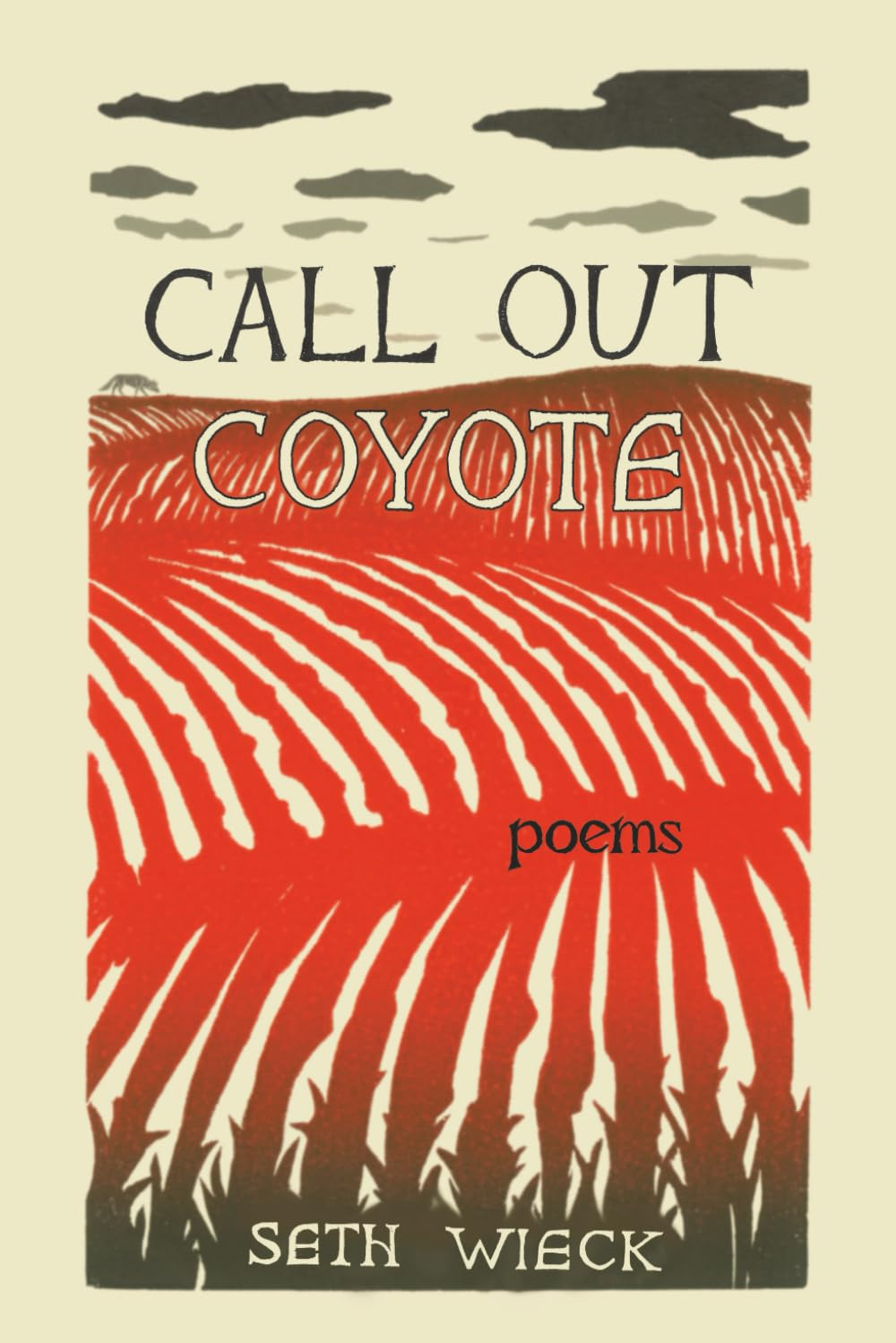
Wieck’s debut poetry collection, Call Out Coyote, was published by Wiseblood Books in 2026. He lives in Amarillo, Texas, with his wife and three children. In this conversation we discuss poetry as memory, as rebellion, and as a way to stay grounded in the world—and possibly even hear a coyote when drunkenly reciting lines in the night.
What is poetry for? As a society today, we seem to discount it. What are we missing?
Breaking down any art form into uses feels like shaking hands with a guy who’s missing a finger. What is poetry used for? It can be used for a lot of things. Entertainment. Contemplation. Advertising. Propaganda. Therapy. None of those is a full hand shake.
In ancient Rome, the poet Virgil composed his less famous Georgics as a sort of how-to manual for best agricultural practices. Caesar Augustus had given land to his most loyal military officers as payment for winning his civil war against Marc Antony. This of course displaced farmers—who’d been keeping the land for thousands of years—with politically savvy generals who had no experience in agriculture.
So Virgil composed verses about keeping bees and breeding kine so the old ways wouldn’t be forgotten. There was no Farmer’s Almanac. There was no printing press. This book couldn’t be sold at the feed store. He composed it as a song so the practices could be sung in the fields, and the farms wouldn’t be totally lost. But I’d like to believe that it was also composed so beautifully that it actually made absentee landowners desire to live on those farms, to see and hear the beauty in those places far away from the eternal city’s political ladders.
In Virgil’s words: “the honors of the crowd, royal purple, won’t move him. . . .” Rather, “he gathers the yields of his trees and fields . . . he sees the farm but not the Forum’s madness.”
I tend to think poetry functions first as a tool for memory—maybe early humans’ first tool for sharing a memory with another person and thereby creating a communal memory. Linguists have theorized that language developed as song with rhythm and eventually rhyme. Before we had the tool of an alphabet which allowed us to write things down, we sang songs. How do we knap an arrowhead? Sing the knapping song, which has a built-in percussion section as we strike the flint.
If society today discounts poetry, it’s probably because we have a thousand other tools for memory. Each is effective in its own way. If I needed to learn how to knap an arrowhead now, I’d watch a video on YouTube. But I would miss the point of sitting in a circle with the community whose survival depends on singing the songs, on making the arrows, on embarking on a hunt, on celebrating the animal which was divinely provided, on preparing the animal for the meal and clothes and tools and sacrifice, on the continuation of the community. The YouTube video can teach you a skill. The song will teach you the skill’s purpose and embed it into a communal rite. We tend to think the extracted skill is enough.
This can all sound a bit gloomy, a longing for ye olde days of Tennyson and tweed. I tend to think the general man-on-the-street would imagine poetry as being “useless” while at the same time carrying in his mind for the rest of his life a bawdy limerick he read on a bathroom stall. Or song lyrics that remind him of his high-school girlfriend. Or a chorus that allowed him to openly weep while dancing with his daughter at her wedding. The “useless” form of poetry he has in mind is probably more akin to the extracted skill of the YouTube video, hidden in an esoteric niche of academia and publishing.
Where did your love for the art form begin?
Language was important in our household. My dad kept an unabridged dictionary in the kitchen. My parents held no literary aspirations, but the meaning of words was important.
My first moral memory is of bald-faced lying to my parents about defacing my sister’s doll with markers. They let me tell the lie and stew in my guilt for a few days as my sister cried over her vandalized doll. Eventually, with some coaxing, I admitted my crime and the lie and was met with swift justice and restoration back into the family. Not that I had been exiled in fact, but guilt is isolating—especially when everyone knows you’re guilty. The lie had pronounced my isolation.
I mean this to say: Death and life are in the power of the tongue, and they that love it shall eat the fruit thereof. Plus language is fun. The life-giving fruit of the tongue is beautiful and fragrant. You can just walk around saying things like:
Whatever is fickle, freckled (Who knows how?)
With swift, slow; sweet, sour; adazzle, dim.
He fathers-forth whose beauty is past change:
Praise Him.
What would be different about your life if you weren’t writing and reading poetry?
Most of my life is not spent writing poetry. By necessity of a mortgage and mouths to feed, poetry is an avocation more than a vocation. But poetry is a kind of fruit that grows from attentiveness. Poetry isn’t attention’s only fruit though.
My father-in-law, who probably hasn’t used the word beauty to describe anything except his four daughters, will lay tile in a rental house. Sometimes he’ll lay it in a diagonal pattern, which in terms of planning and waste of material is more difficult and less efficient, but he’ll say, “That looks better.” I hope that if I weren’t writing poetry, I’d find some way of practicing that attentiveness and extravagance.
Poetry provides me an immediate, material way to capture those moments when light glimmers through the cracks in creation, but a similar impulse might be satisfied laying tile.
In terms of reading poetry, I’m not sure. I’d be reading something. The back of the cereal box. Tweets. On our honeymoon, my wife was surprised to learn that I read every street sign. It’s how I familiarize myself with the world. We’re constantly being compelled to memorize the latest talking points and spin. Reading poetry provides me with a beautiful, enduring narration to counter the noise; to displace the static. What would I replace that with? God help me if it’s the news.
Your poems are rooted in Texas scrubland. I think of embodiment, observation, memory, and reflection. How does landscape inspire and inform your work?
Some landscapes immediately inspire works of art. My native landscape doesn’t have many landmarks. We do have two minor rivers (Red and Canadian) and the second largest canyon in the United States. But to the newcomer, our main feature is an endless horizon which can make a person feel adrift on a sea of short grass.
If you grow up in the environment and see the landscape under its different lights and weathers, you see the slope and watershed because in the winter of ’98 it rained so much that the main road to your best friend’s house was blocked for six months. You see the near fifteen-year growth of the locust trees the city planted in the park because the drought of 2011 killed the elm trees which had survived the Dust Bowl.
Outside of town are the mesquite trees who know when to throw leaves because they can discern what no weather machines seem to know: when the last freeze has taken place. You know when to get inside as the light goes green and an odd blast of cold air arrives before the hail storm, and you stand by the window next to your dad and wordlessly watch a pretty good stand of wheat get leveled in five minutes.
When you have stakes in the place, the acuity of your observation is more keen, what Christian Wiman calls a
distant killing
vigilanceit would take a native
to know was love.
The oldest poem in Call Out Coyote dates to Christmas Day 2004. The book came out more than twenty-one years later. How did you, as a poet, evolve over those two decades?
I’ll admit, when I began assembling the poems I kept thinking about the Johnny Cash song “One Piece at a Time” about the factory worker who steals Cadillac parts for twenty years before he assembles the ugliest Cadillac ever seen.
I guess the short answer is I grew up. I developed a taste for what I like and don’t like. In God’s providence, I was born in a time when tuberculosis is largely licked. I’m not a precocious genius like Keats or Crane. I did have an early proclivity for language which was enough to keep me at the desk.
I apprenticed slowly, far from competitive crowds and fashions. I met and married my wife. We had three kids. We formed the little economy of our household. I read a lot and tinkered with forms. I had enough of an education in college to read poetry well and grasp the lay of tradition, so I could read Robert Penn Warren and his friend Cleanth Brooks and find the threads back to Eliot, back to Donne, back to Dante.
I’m not much of a scholar, but delight will drive you on. I did the same thing in high school, reading guitar magazines in my friend Eran’s basement.
I’ve followed you on X for some time—since probably back when it was Twitter, but my memory is faulty. Yours is not. One of the things I’ve enjoyed most about following you was seeing videos of you in the car reciting poetry from memory as you drove. When did you start internalizing poetry?
As a kid, listening to Casey Kasem’s Top 40 every Sunday afternoon. I know pop songs aren’t poetry proper, but you get a sense of form and rhyme and meter. Riding the bus home, my friend Chris and I would trade off reading Shel Silverstein poems. One time he brought an illustrated version of Sir Gawain and the Green Knight that showed up in my nightmares.
Mrs. Kuhlman had us memorize “Casey at the Bat.” Mrs. Petruccione had us memorize Shylock’s monologue from The Merchant of Venice. I heard George Clooney recite “And Death Shall Have No Dominion” in Solaris and immediately went to the university library and fell into a long walk with Dylan Thomas. I don’t know that I initially set out to memorize the poems on my own, but lines would stick.
Later, I was talking to my friend, the singer-songwriter Ryan Culwell, and he’d begun a lifelong project of making a family songbook; fifty songs that he and his daughters could sing, fifty songs that he wanted his daughters to carry around with them when he’s gone.
When I heard that, I began reciting Ben Myer’s “The Reverend on Natural Theology” while I was taking my kids to school. My oldest had it memorized before I did. Now I do it to pass the time while I drive. I drive a lot.
What does memorization do for your relationship to poetry: what you’re reciting and what you’re writing?
First, I don’t need a mediocre poem taking up space. It needs to offer wisdom because I want the lines to rise in my mind when they’re needed. Second, saying a poem fifty or sixty times will let you know if it’s actually any good. You will get extremely bored with a mediocre poem long before it sticks.
Some poems have a few good lines that will last longer than the whole poem. A couple of years ago, I memorized Wendell Berry’s “Do Not Be Ashamed” for a friend. I’ve lost most of the poem now, but a few lines spring to mind often:
And you will know
that they have been there all along,
their eyes on your letters and books,
their hands in your pockets,
their ears wired to your bed.
Most of the poem is kind of boring though, even if I heartily endorse the poem’s message. Maybe that’s why it’s boring. It’s heavy on the commentary and light on the song.
Which leads me to this: It needs to be fun to say out loud. Rhythm, rhyme, alliteration, assonance. All of those poetic techniques exist for a reason. I can quote Christian Wiman’s “Native” at the drop of a hat as I did earlier. I think most of my poems offer that.
There’s a perception—I don’t know if anyone says it out loud, but you can tease it out of the atmosphere—that poetry tends toward the feminine, that there’s something soft or gentle in poetry that renders it less masculine. And yet Call Out Coyote is quite masculine. I feel as if I’m getting ready to step in something just raising the issue, but do with that what you will.
What minefield did you just invite me into? You’re not the first person who has made this observation. There are other sectors of culture that could probably be mapped onto some imaginary masculine-feminine spectrum. I think blue-collar jobs are typically imagined as masculine while white-collar jobs would be imagined as feminine, even though there is no conclusive demographic data to support that.
In my mind, it’s more about class than gender. Growing up, the town next to ours had a small university (which eventually became my alma mater). I remember my grandad stopping to help a professor change a flat tire. He got a lot of laughs out of the highly educated man being unable to do a basic, mechanical task like changing a tire. As a courtesy, men were expected to change flat tires for women—you know, chivalry. Of what use to society was this white-collared man if he couldn’t change his own tire, let alone the tire of a stranded woman? And what did this professor do for a living? He taught literature.
Of course this is anecdotal, but I think this is how poetry becomes unspokenly perceived as feminine. It does seem like the wrong category, and that categorization seems to use feminine pejoratively. But if my poems seem masculine, well, I’m a dude. Hath not a dude hands, organs, dimensions, senses, affections, passions . . .
Let’s talk about your concrete imagery; your work is crammed full of it: a peachstone, an arrowhead, the ticktocking of a clock, “the loose teeth/of an ass’s jawbone.” Some of these are core to the whole piece, others anchor just a stanza or line. How do you conjure the imagery?
The nice thing about using concrete images is that I don’t have to conjure anything. The images are just lying there in the things that have been made. If we look at them with gratitude, then we perceive the “dearest freshness deep down things,” “the invisible things.” Contemplations and metaphors are tethered to concrete.
When I was teaching, I’d marvel in front of the kids how miraculous it is that we can see a series of ink squiggles on a page, or hear soundwaves on the air, and have a physiological reaction. Read the passage in A Christmas Carol when Scrooge hears the ghost of Marley approaching and feel the hairs on your neck stand up. Feel your heart beat a little faster as Updike describes the girls walking down the grocery aisle in “A&P.” Feel your stomach turn when I say “the coffee machine splattered and dripped like a punctured sphincter in a bed pan.”
None of these things are actually happening, but our imaginations are great furnaces if you stoke them correctly, and the best fuel is a concrete image. Abstract concepts are not moving; they are smoke produced in the fire. Say a girl is beautiful, nothing happens. Say “a fly-away strand of her red hair fluttered on the air-conditioned breeze breathing from the snow cone stand. She reached up with rainbow-stained fingertips and swept it behind her ear, a bead of sweat gathering under her jaw.” Which is what I saw the first time I saw the girl who would become my wife. That image still moves me.
Now the sources for your inspiration more broadly. You’ve got poems that are familial, some that are historical, agricultural, some that are biblical. In how many wells have you plunged your buckets?
I guess this is a benefit of writing for twenty years. There is so much life and life is so rich, and you can live the life without feeling the need to mine it for a poem, yet some images sprout their way into a poem the way an acorn will eventually heave a slab of sidewalk.
I rarely am inspired by anything topical in the news, unless it’s an event that can be told timelessly. I think the most common inspiration is coming across something ironic. One definition of irony is the upsetting of expectations. We live expecting certain things to happen, but when the expectations are upset, it becomes a splinter that needs to be worried, a paint chip that needs peeling, a scab that wants to be picked. It’s a message on a staticky radio and you keep twisting the dials trying to tune it.
One of my poems grew from driving down a long stretch of highway and seeing a giant metal sculpture a farmer had made and placed in the middle of nowhere. Who did he make it for? It required great skill and effort. Who was his patron? I couldn’t stop thinking about it. It could have been just as easy to keep driving, eyes blurring with the landscape I could see no end of.
Give me the background on your jail poems (that is, “Corrections Officer,” the “Inmate Reads” pieces).
When I graduated from high school, my dad became a part-time farmer and a full-time prison guard. It was hard on him. In the popular imagination, prison guards are rarely the good guys. It’s a thankless job which is often scapegoated by both politicians and journalists.
There’s a lot of debate about the purpose of a prison—reform or retribution—but for that moment in history in our region, a lot of farmers became prison guards. I don’t know the extent of the economic, cultural, and political forces at work—it may be better to call them powers and principalities—which constitute the need for such a large prisoner population, while at the same time allowing a prison guard to earn more than a man who grows our food (but less than an elementary school teacher). It occupies my imagination.
I have a couple of poems with the conceit of inmates reading the King James Psalms from a donated Gideon’s Bible. I tried to imagine someone who’d committed a heinous crime being confronted with psalms of praise. Which is probably not a mode of thought for someone deep in depravity. Their brains don’t have that wrinkle.
Texas has a database of prisoners and you can look up their prisoner ID numbers, their crime, their sentence, so I did and found some awful stories. People we don’t want in our neighborhoods. When you’re exposed to that stuff on a daily basis, it can be easy to despair. After my dad retired, he ran into a former warden, and together they supposed it took at least two years to shed the heavy darkness they’d carried. I wondered if the beauty of the psalm would awaken something in such a person. I wondered if redemption is available there. I hope there is.
Epigraphs: I’ve heard Scott Cairns say an epigraph can launch the poet and the reader into the poem; it gives the poet something to react to. You use epigraphs all through your book, and I found your usage particularly effective. How did you decide which voices to perch atop your own lines? Did they come before or after the drafting?
The unacquainted reader may need a little background to hit Line One at running speed. Like in my long, and admittedly difficult poem “He Will Speak for Himself” which is a meditation on the man born blind in John 9. I provided a piece of that passage to set up the drama of the poem: a blind man recounting his life in sounds.
The poems are in conversation, sometimes arguments, with other poems, and those poems are part of a larger conversation. As I had those conversations in my head, lines would arrive. There may be a little librarian impulse. “If you like this poem, you should really check out these others. Have you read Frost? Let’s read his ‘Out, Out.’ That’s an allusion to Macbeth, by the way. Have you read Shakespeare?”
The all-wise Internet tells me you’ve worked as a farmer, butcher, dishwasher, construction worker, real estate appraiser, teacher, and copywriter. How has making a living with your hands shaped your poetry?
I’m not very good at making a living with my hands. I’m too slow. I think too much. I measure twelve times and still cut twice. That’s probably why I write poetry.
The nitty gritty of the process. How do you actually sit down to write? Where do you write? Caffeinated, noncaffeinated? Smoking, nonsmoking? What does a typical session look like—drafts by hand or on a computer, how many iterations before a poem feels finished?
I write in the margins. I try to get something down either early in the morning or late at night when everyone in the house is asleep. I’m most productive at the dining room table.
I have a Google Doc open on my home computer and my work computer. I need to be at my day job office by eight and usually get home around six. It’s not unusual for me to drive three or four hours during the work day. If I have a poem going, I can usually tinker out loud while I drive.
At the desk, if the subconscious starts nudging me, I’ll switch from spreadsheets and tax records to the poem, but the clock is always ticking on appraisals. To break into verse feels like a small rebellion against the machine.
If I need more momentum, I’ll ask to be spared from Saturday kids’ activities and try to stay submerged in the language of the poem all day. Some of the longer poems were written during a different stage of life. I don’t think I could manage a poem as long as “Ulysses Arrives in Amarillo” right now.
Tell me about “Ulysses Arrives in Amarillo.” You have Homer’s Odysseus and the prophet Amos sitting down together. They were near-contemporaries historically but represent radically different visions of the world. What happens when you put them at the same table?
Violence is the short answer. That’s not giving anything away. The poem says so in the opening stanza. Amos was a shepherd from a provincial region of Israel. His book essentially continues the argument that the prophet Samuel made when the Israelites asked for a king. He warns against allying with other nations.
It’s worth noting that Homer’s Odysseus was a hero, an exemplar of the Greek virtue of hospitality. However, Virgil, the Roman poet, turns him into Ulysses, a duplicitous villain who lied, burgled, and mocked the gods. He’s a complicated figure.
In the Odyssey, the shade of the blind prophet Tiresias tells Odysseus that upon returning home, he must carry an oar inland until he meets someone who mistakes the oar—a seafaring tool—for a winnowing fan—a grain harvesting tool. There he must build an altar to the ocean god Poseidon, to spread his glory into regions where he isn’t yet worshipped. I figured Amarillo was far enough inland.
The ancients had local hearth gods called penates, but they were displaced by empire gods; famous Olympic deities vying for man’s worship and tempting them into wars. Setting Ulysses and Amos’s conversation on the borders of Amarillo helped me make sense of these large outside political and economic forces, demanding mine and my neighbors’ devotions. We call them politics and economics, but our pagan ancestors knew what they really were: deities. They want to be worshipped.
When someone finishes reading Call Out Coyote, what do you hope they carry away from it?
I hope there are some lines that rise to mind when they’re needed.
Final question, and the Odysseus and Amos poem naturally lead into this one. You can invite any three poets—living or dead—for a long meal. Neither time nor language is an obstacle. Who do you invite, and how does the conversation go?
I’ve had some wonderful conversations with some very good living poets. It would do me no good to start listing. Dana Gioia may be the most generous poet I’ve talked to. He has a poem called “Three Drunk Poets” which tells the story of old friends, drunk, meandering through town reciting poems from memory.
They decide not to stop until they run out of poems. Eventually, they wander out of town, reciting older and older poems, until they find themselves in the country in the dark, away from civilization where they hear a coyote and decide to turn back home. I don’t know who the other two poets were, but I’d like to have been one of them.
Thanks for reading! If you enjoyed this post, please hit the ❤️ below, restack, and share it with your friends (especially if they love poetry).
Not a subscriber? Take a moment and sign up. It’s free for now, and I’ll send you my top-fifteen quotes about books and reading. Thanks again!
While you’re here, check out 👇

The point about Virgil's Georgics preserving the ways of farming reminded me of Cicero's essay 'On Old Age', which contends that one of the pleasures of old age is that of farming.
I had to laugh at the idea of poetry being 'feminine'. The male prophets of ancient Israel spoke in poetry, and in the traditional patriarchal cultures of the Middle East and Central Asia, to speak one's thoughts in poetic imagery was deeply respected. If one were to tally up a list of the most famous poets in Greek, Latin, and English, the majority would turn out to be male: Homer, Virgil, Shakespeare, Donne, Pope, Tennyson, Whitman, etc. - all too often women lacked education and the time from donestic duties to pursue literary excellence. Only in the industrialized modern world could poetry be mistaken as a primarily feminine pursuit.
This changed the way I see poetry forever. Ok I know that sounds dramatic, but something really clicked for me reading this interview.
The connection of poetry to memory, I think, is what flipped the light switch on. I’d only ever thought of that connection in a purely pragmatic “mnemonic device to help you pass a college exam” sort of way. I never thought of it as a time-tested defense in our dumpster fire attention economy/warzone. A way of replacing the deluge of manipulations with a beautiful and hard-won sanctuary of words.