

There are 8 billion of us humans, give or take, ambling across the surface of this marvelous ball of dirt, and every one of us has a mind of our own and the power to verbalize whatever we imagine. Given all that diversity, we’re certain to bump into ideas we dislike.
Odds are equally good others will frown, spit, and snarl at some of our own cherished notions, and it’s doubly fraught for those whose jobs and favored pastimes fill the world with words. As novelist Margaret Atwood said, “You can’t exist as a writer for very long without learning that something you write is going to upset someone, sometime, somewhere.”
So, here’s the question: Should we be free to express all those objectionable ideas? A few recent books wrestle with aspects of the question.
The Future of Free Speech
For some of us the answer to that question is an obvious yes. But—if you’re keeping tabs—that’s just another idea that some find objectionable. In fact, it’s safe to say that in most times and climes advocates for free expression have found themselves in the radical minority. How many countries have speech protections and press freedoms as vigorous as the U.S. First Amendment? It ain’t many.
And yet, as Jacob Mchangama and Jeff Kosseff argue in their book The Future of Free Speech: Reversing the Global Decline of Democracy’s Most Essential Freedom, things don’t look as rosy as they once did, even in the U.S. In his prior book Free Speech: A History from Socrates to Social Media (see our discussion about the book here), Mchangama tells the story of free expression, going back to the beginning of Western civilization. The Future of Free Speech (also the name of the think tank Mchangama founded at Vanderbilt University) is more concerned with the recent past and where current trends are pointing.
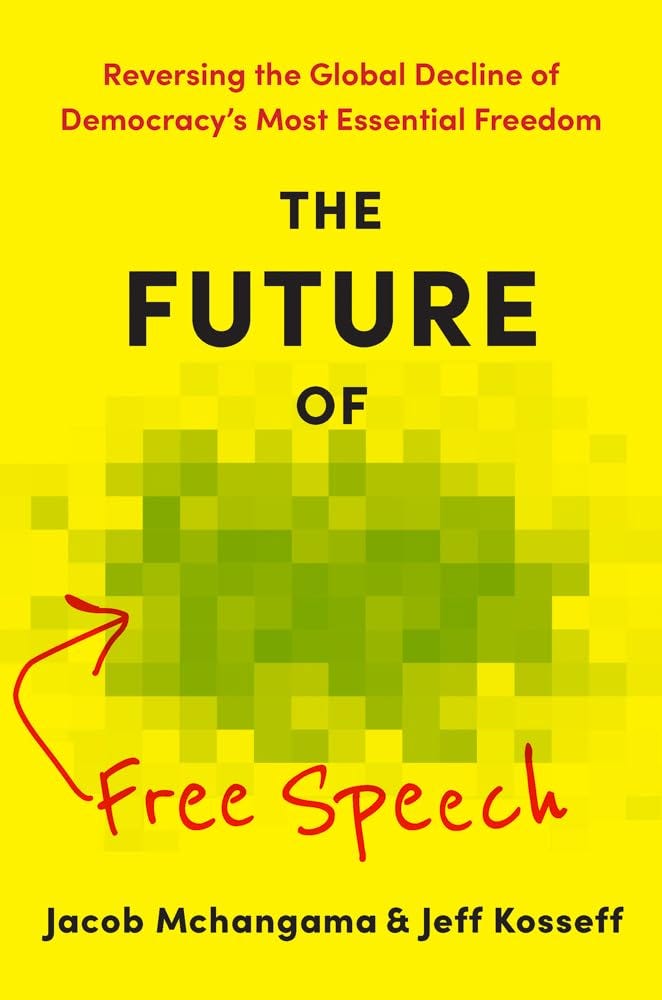
In part one, Mchangama and Kosseff trace the expansion of free speech through the twentieth century, “The Global Golden Age,” in which protections and exemptions in the U.S. provided an exemplar for other nations to follow, especially in the global square-off against communism and its restrictive stance on speech. This Golden Age peaked in the late 1990s with the rise of the internet and its free-for-all ethos of exchange, bolstered by Section 230 of the Communications Decency Act of 1996, and supported by favorable court rulings.
“As free speech expanded globally in the final decades of the twentieth century,” write Mchangama and Kosseff, “the United States emerged as both champion and exemplar of robust speech protections as the U.S. Supreme Court developed the world’s most speech-protective jurisprudence.” And then everything got weird.
Part two catalogs a litany of recent efforts to undermine the free-speech regime, including hate-speech laws, government jawboning (such as pushing Twitter to stifle COVID dissenters), child-protection measures, campaign-finance reform, and AI regulation, leading to what the authors call a “free-speech recession.”
Any one of these initiatives—and gobs more—has plenty of defenders who either don’t consider the First Amendment ramifications or have few figs to give for them. I appreciate the rationales behind such initiatives. Who wouldn’t? But the erosion of free speech, however distasteful the content of that speech, is worse than any social or political ills we might attempt to solve by stifling expression. To quote philosopher Randy Jackson, “That’s a no from me, dawg.”
Part three explores the ways in which individuals and institutions can combat speech restrictions: transparency, decentralization, and more speech. “Freedom of expression and access to information remain core strategic advantages for democracies,” write Mchangama and Kosseff. “To preserve this advantage, democracies must resist the siren song of censorship and instead empower their citizens to harness the creative potential of digital tools. From counterspeakers to developers of digital libraries and modern-day samizdat platforms, the growing number of people and civil society organizations using the power of speech and information demonstrates that fostering a resilient culture of free speech is possible in the digital age.”
Like what you’re reading? Subscribe, and new posts will ride an electron rollercoaster directly to your inbox twice a week. Free subscribers get two-week open access to every post; paid subscribers get the run of the archive, plus bonus content.
Just Plain Filthy
I care about free speech broadly considered but for obvious reasons pay special attention to the impact on publishing. That takes me to Anthony Aycock’s Just Plain Filthy: The Story Behind Book Banning’s Trial of the Century. The trial in question? Island Trees School District v. Pico (1976), in which students sued their school district for pulling books, such as Kurt Vonnegut’s Slaughterhouse-Five, from library shelves.
Led by Steven Pico, editor of his high school newspaper, the students argued that denying them access to information undermined their First Amendment rights. The U.S. Supreme Court ultimately agreed, but the journey to the verdict was—as you might imagine—complicated and contentious, and the ramifications of the court’s weak decision highly indeterminate, leading to the situation we find ourselves in today, where books are regularly challenged and pulled from school libraries for arbitrary and politically motivated reasons.
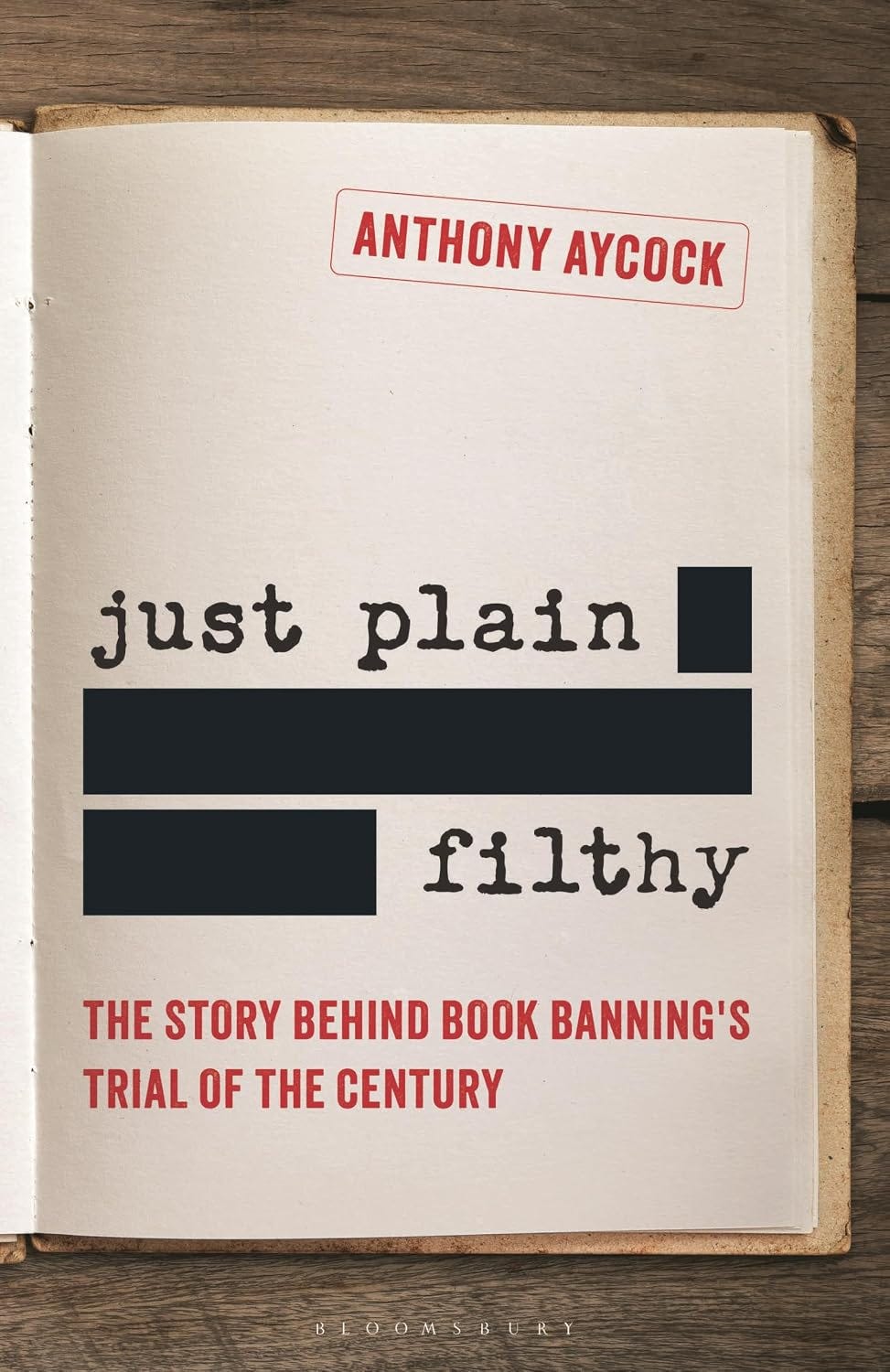
Aycock presents the Island Trees story from beginning to end, marshaling the principals, their arguments, the public debate, the legal wrangling, and the court’s opinion into a fascinating narrative. Interspersed with the main story is a history of book banning in the U.S. Those who support yanking books from school libraries for whatever reason (maybe even defensible ones), often point out those books aren’t genuinely banned; a student can always pick up a copy at a bookstore. But that wasn’t always the case in the U.S., where First Amendment protections were weaker in times past and cities could prohibit the sale of books within their jurisdiction, leading to, for instance, the designation “Banned in Boston.”
Librarians and booksellers could be fined and jailed for distributing verboten books, such as Theodore Dreiser’s 1916 novel Sister Carrie, which was banned in New York City and Cincinnati.
Then, as now, efforts to squelch a book often led to the sort of publicity that boosts the profile of the offending title and leads to greater sales (a lesson book banners never learn but which booksellers have). When Walt Whitman’s Leaves of Grass was classified “obscene literature” by the district attorney, his Boston publisher caved and withdrew the book. Whitman found a Philadelphia publisher to pick it up, and the controversy stoked brisk sales. The publisher joked that he wanted Philadelphia to ban the book, too, because “the Boston fools have already made me more than $2,000.” As Aycock notes, Whitman bought a house from his share of the increased proceeds. Previous editions of the book had largely flopped. “When you are banned in Boston,” said Upton Sinclair, “you are read everywhere else.”
Huckleberry Finn was banned by the Concord, Massachusetts, public library the same year it came out, 1885. Mark Twain was amused and thanked the library. Banning the book, he said, “will cause the purchasers of the book to read it, out of curiosity, instead of merely intending to do so.”
Thanks for reading! If you’re finding this post worthwhile, please restack it, hit the ❤️ below, and share.
Legal contests over these very bans, in which the censors lost, form the basis for publishers’ widespread freedom today. But the soft censorship of librarians and school boards exiling books persists, and Huck Finn—perennially controversial—represents a fascinating case in that every generation finds some new offense in its pages, something egregious from which to protect young, impressionable readers.
That Book Is Dangerous!
Given the legal protections now in place, the censorious have turned to a form of literary cannibalism, documented in Adam Szetela’s fascinating study, That Book Is Dangerous! How Moral Panic, Social Media, and the Culture Wars Are Remaking Publishing. School bans represent one place the culture wars exhaust readers’ patience, but Szetela’s focus is the publishing industry itself and the wider social media ecosystem the industry relies on for promotion.
“Welcome,” he says in the introduction, “to the sensitivity era.” In an effort to protect and extend diversity in published voices, the industry increasingly employs sensitivity readers to vet projects, while self-appointed influencers police the trade from their smartphones and bully authors and publishers into whatever they deem as compliance.
Szetela opens the book by unpacking the distinctive ideological basis for the movement:
diversity (increased representation of marginalized voices),
sensitivity (attention to the concerns of marginalized communities),
essentialism (a commitment to identitarian ideals, e.g., gay Latino characters require gay Latino authors),
presentism (today’s moral enlightenment—exclusively defined by those with the above-listed commitments—trumps all prior moral conceptions), and
expertise (principally in the form of sensitivity readers but extended to social media critics who can claim some form of “lived experience”).
A middle-of-the-road liberal worldview can easily absorb and even champion the first two, but it gets trickier the further you tumble down the list. Mix it all in a cocktail shaker and out pours something like the controversy surrounding Jeanine Cummins’s 2020 novel American Dirt. Cummins’s tale of a Mexican bookseller caught in the crosshairs of a vengeful drug lord sent some progressives into paroxysms of moral panic during which the outraged denounced—of all people—Oprah Winfrey for promoting the book.
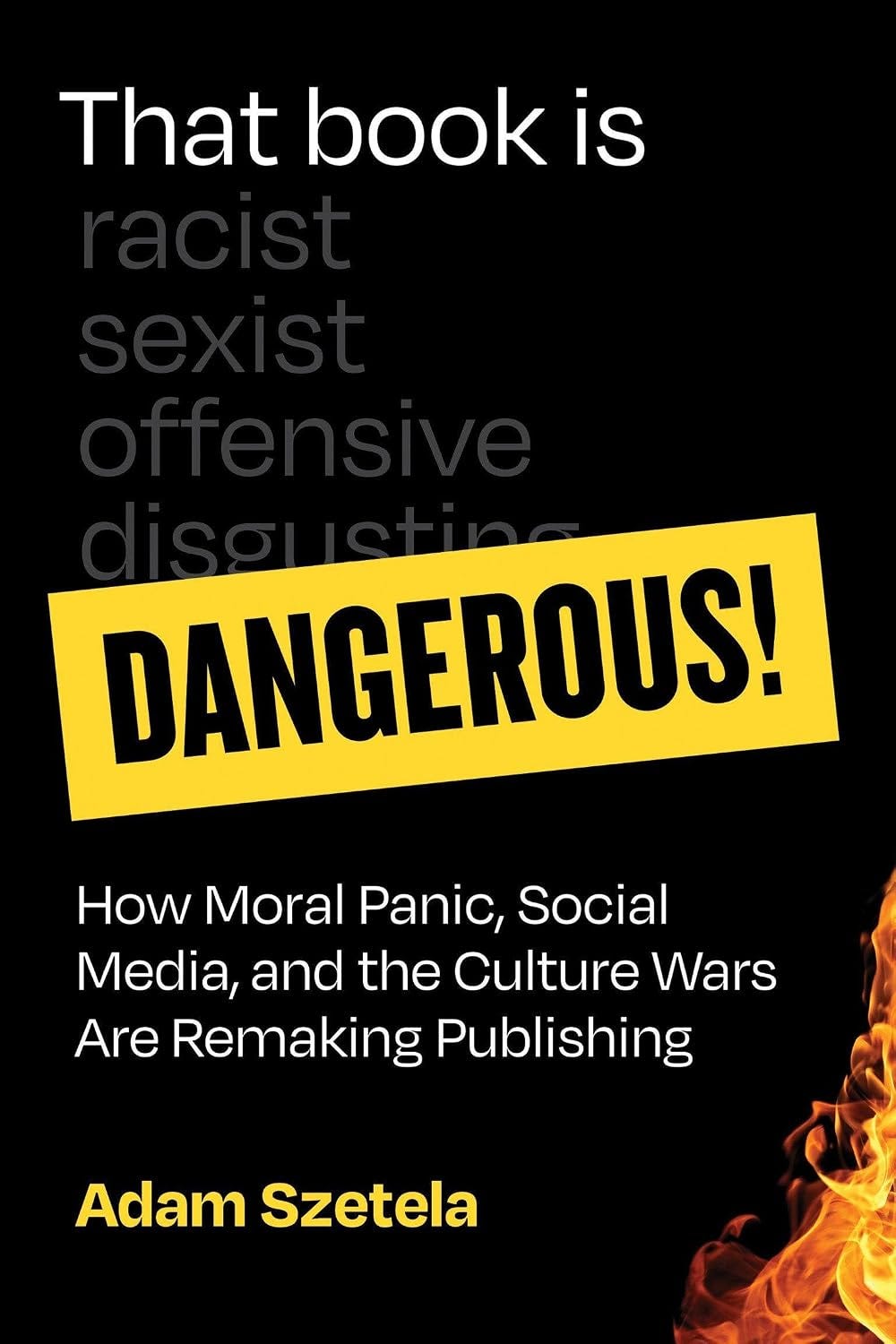
If Cummins’s experience were isolated, we could regard it as an odd tic or spasm, but the impulse behind punishing her for violating several tenets of the sensitivity era’s moral code has affected the entire industry, transforming—and in some cases distorting and even destroying—the work of authors, agents, editors, publicists, marketers, teachers, librarians, the whole gamut. YA fiction represents one area particularly affected by the current climate, as Szetela shows. But it extends well beyond. In the name of diversity, crusaders enforce conformity.
Given his criticisms of the movement, one might expect the author of a book like That Book Is Dangerous! to be a conservative with a chip on his regressive, troglodytic shoulder; that wouldn’t be the case. Instead, Szetela arrives at this project by way of Cornell and Harvard, having written for the Washington Post, the Guardian, and Newsweek—not to mention being a successful professional ghostwriter.
Szetela recognizes the good intentions behind many of the players in this movement—for instance, authors who hire sensitivity readers to ensure they’ve done justice to their minority characters and social situations. But the overall effect is, as Szetela’s study shows, a dampening of expression and a vigilante atmosphere in which false moves lead to denunciation campaigns and cancellation by moral crusaders.
The most bizarre feature of this movement is that many of the denounced, the pilloried, the exiled, share many of the same basic beliefs as their denouncers. Szetela approvingly quotes Stuart Hall, founding editor of the New Left Review. “Our enemies are bad enough,” he said; “God save us from our friends.”
As if that weren’t ugly enough, all of this leads to a direct conflict with school-board book banners and into the hands of the conservative culture warriors. The net effect is a literary and cultural landscape flooded with nonsense from both sides, where people trapped in between feel less free to think and express what comes to mind, less free to write and share what they believe. These are regrettable cultural manifestations of what Mchangama and Kosseff call the free-speech recession. But the remedy here, as in the political and legal cases, is the same: more speech, not less.

I’ll be adding these books to my TBR. As an English professor and a former school librarian, I am so deeply troubled by the recent onslaught against libraries and librarians, as well as the move to ban books.
The censorship excuses used in book publishing in the past would eventually filter down to film, television and the Internet, setting the boundaries of creative freedoms and limitations there.