
There Were Two Civil Wars, and We Weren’t Always Sure Which We Were Fighting
Damon Root’s ‘Emancipation War: The Fall of Slavery and the Coming of the Thirteenth Amendment’

You’re a general in the American Civil War. You have charge of Fortress Monroe, a heavily guarded outpost of the Union Army in rebel Virginia on the Chesapeake. Your name is Benjamin F. Butler, and you have guests.
Three runaway slaves have arrived at the fort, seeking protection. What do you do? It’s May of 1861, and the war is barely a month old. There aren’t any plans for this sort of thing and, thanks to the Fugitive Slave Act, the precedent would actually suggest returning them.
It’s safe enough to start with the basics: You feed them and give them some work. Yet how to respond when an officer arrives from the Confederate Army demanding their return? You refuse. But on what grounds?
The Confederate officer cites the Fugitive Slave Act, which would have compelled you to hand the men over, as a decade’s worth of precedent dictated. “Ah,” you say, “but the Fugitive Slave Act doesn’t apply to foreign nations, which Virginia now claims to be, and it’s just your luck I’m taking you at your word.”
Sorry, sucker; no dice.
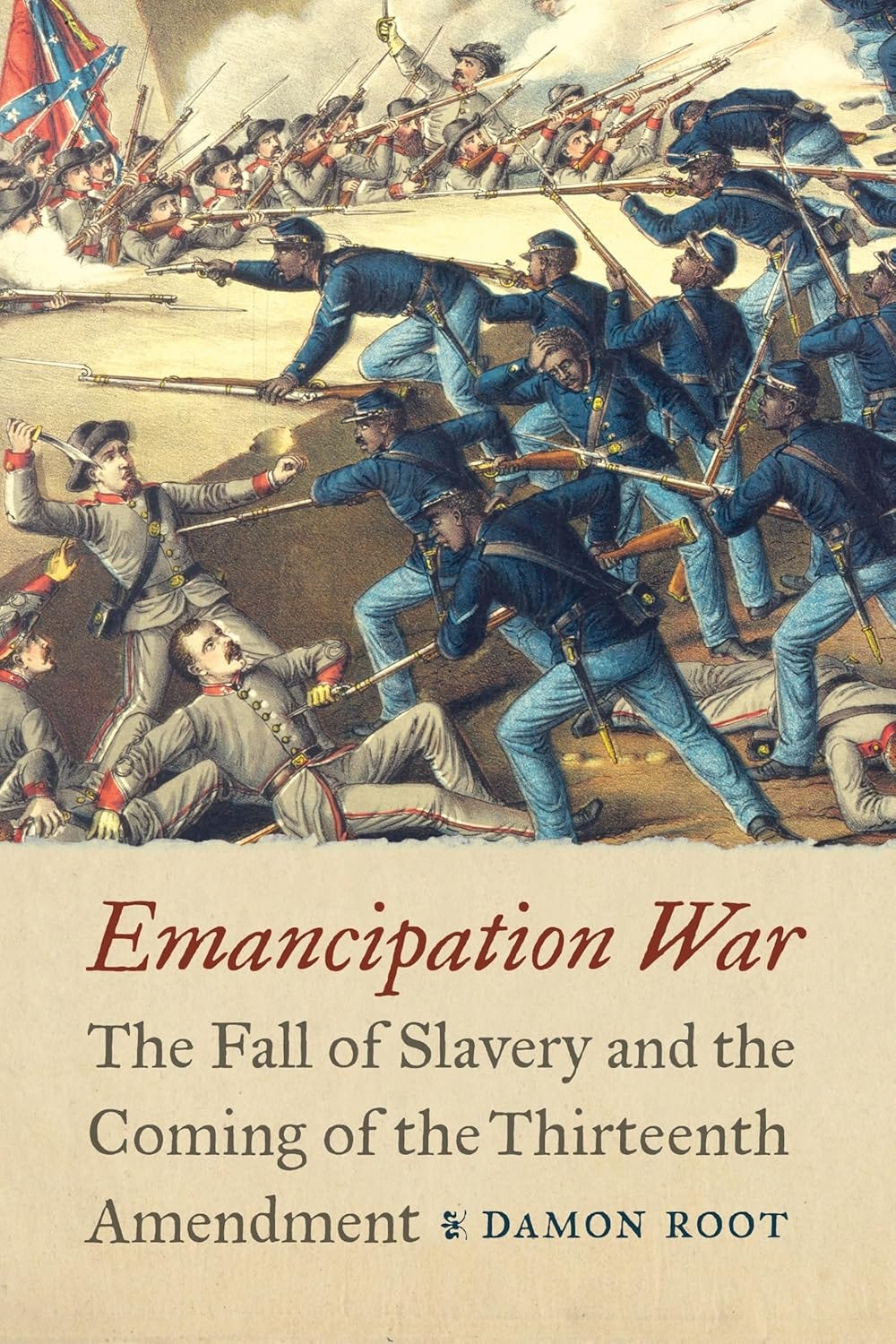
The real Gen. Butler found himself in exactly this position and reported saying almost those very same words, as Damon Root recounts in his riveting new history Emancipation War: The Fall of Slavery and the Coming of the Thirteenth Amendment.
But then what? The runaways kept coming. By the end of July, 900 more such folks were clustered around Fortress Monroe, bestowing it their own name, the Freedom Fort. As Root argues, the presence of these people and how they were treated helped define the nature of the war.
Two Civil Wars
In the beginning, there were two Civil Wars running simultaneously and bumping into each other in awkward, problematic ways:
the official war, in which one side sought to preserve the Union and the other to defend states’ rights
the unofficial war in which one side fought to abolish slavery and the other to protect their “peculiar” institution
The South was unified on both the official and unofficial war because the two were linked. Without the conflict over slavery, there would have been no secession. Meanwhile, the North was a mess. You can chart the situation like so:
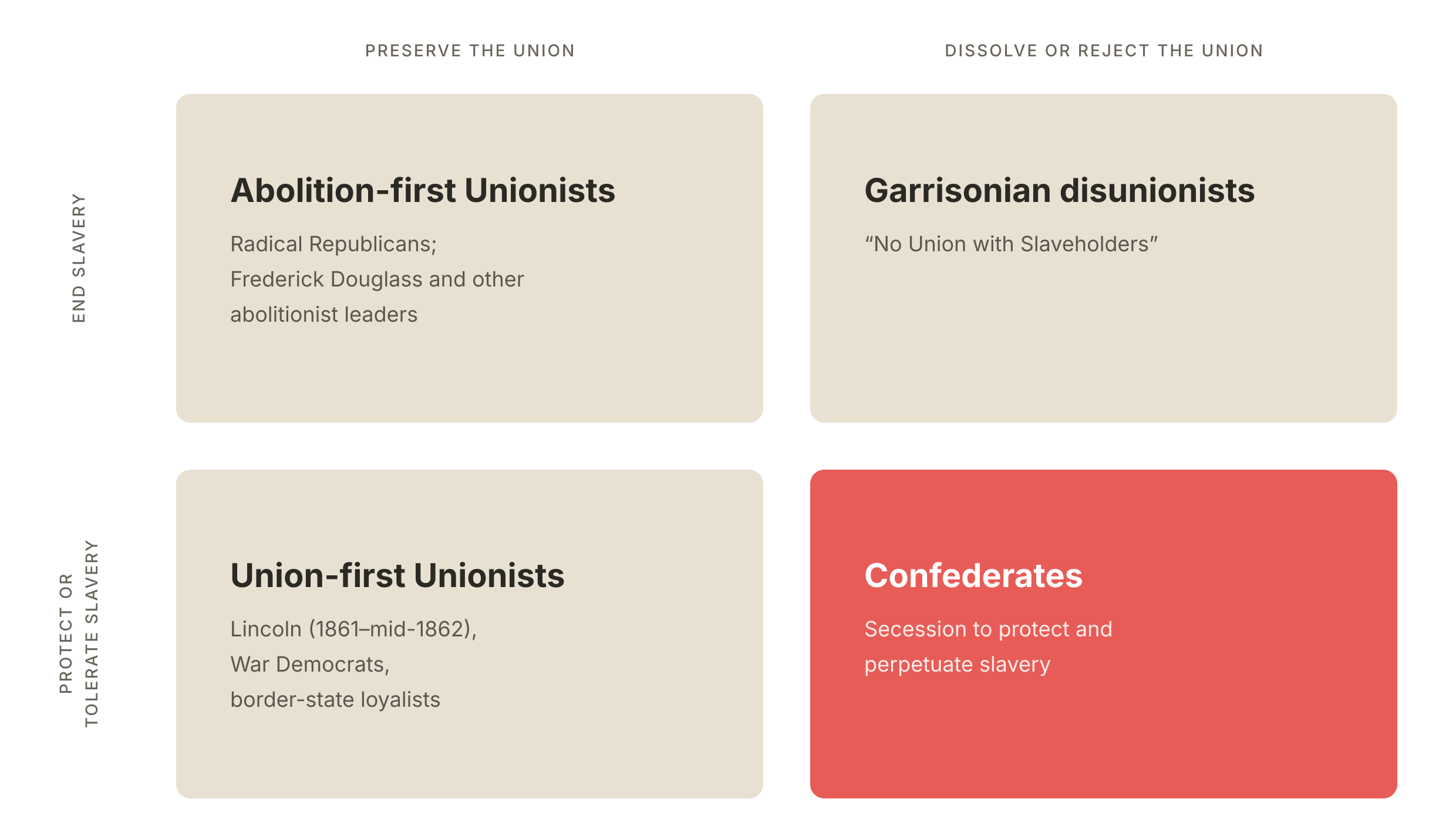
The South maintained a unified position, but the North was divided. Root shows how that confusion played out on the ground, especially early in the conflict. Twice, for instance, Union generals in the field freed the slaves in their territory. President Lincoln overruled them both times.
Lincoln personally disapproved of slavery, but his foremost concern involved preserving the Union, and he maintained a precarious political coalition to do it. Going all-in on abolition risked rupture within his camp.
Root documents this drama in his book, starting with the proposed thirteenth amendment to the Constitution. We’re all more or less familiar with the text:
(1) Neither slavery nor involuntary servitude, except as a punishment for crime whereof the party shall have been duly convicted, shall exist within the United States, or any place subject to their jurisdiction. (2) Congress shall have power to enforce this article by appropriate legislation.
But when Lincoln was first elected, the proposed thirteenth amendment, which had already passed Congress, read a little differently; in fact, quite the opposite:
“No amendment shall be made to the Constitution,” the proposed amendment said, “which will authorize or give to Congress the power to abolish or interfere, within any State, with the domestic institutions thereof, including that of persons held to labor or service by the laws of said State.” In other words, slavery forever. And, as a sop to the South, Lincoln backed this language.
War came anyway, and the pressures of the conflict not only galvanized Lincoln against slavery, but enslaved Americans like those showing up at Fortress Monroe—the Freedom Fort—forced the issue and paved the way for their own emancipation.
The Problem with Property
Barbaric as all wars might be, modern conflicts are governed by laws, waged among politicians as much as soldiers on battlefields. This was all the more so during the Civil War, in which the part of the contested ground included the Constitution and the legal tradition of the nation itself.
In war, the property of opponents can be seized as contraband and put to use waging the conflict. If you take a fort, you keep the fort. If you take a prisoner, you keep the prisoner. Gen. Butler was free to do this when the former slaves showed up at his doorstep; he fed those initial three and gave them a job. But what about when the rest began mobbing the fort? “The children, certainly, cannot be treated” as contraband, said Butler when describing the situation.
And then there were those enslaved persons who were abandoned as enslavers took flight. Abandoned property becomes the possession of those who salvage it. “If property, do they not become the property of salvors?” asked Butler. “But we, their salvors, do not need and will not hold such property and will not assume such ownership: has not, therefore, all propriety relation ceased?”
Once they came into Union hands, Butler reasoned, the slaves had functionally freed themselves. “My own mind is compelled by this reasoning to look upon them as men and women. If not free born, yet free, manumitted, sent forth from the hand that held them, never to be reclaimed.”
That sort of logic seems obvious today. Not so in the nineteenth century, especially once you toss in the various legal—and thus political—ramifications of taking action on it.
The Dueling Wars
As an example, Maj. Gen. George McClellan, a key figure in the Union Army, almost quit when Lincoln—moving toward abolition but not fully there yet—issued his preliminary Emancipation Proclamation in September 1862. The president’s actions, McClellan told his wife, “render it almost impossible for me to retain my commission and my self respect at the same time.”
Root mentions a more astounding example in the case of Benjamin R. Curtis, a former Supreme Court justice who previously dissented in the infamous Dred Scott case. Curtis was pro-Union and disdained slavery but opposed Lincoln’s move toward emancipation. State law regarding slavery was the states’ business, not the federal government’s, and Lincoln was overplaying his hand.
“The war in which we are engaged is a just and necessary war,” said Curtis. “It must be prosecuted by the whole force of this government till the military power of the South is broken.” But if we violate the Constitution doing it, what’s the point? “With what sense of right can we subdue them by arms to obey the Constitution as the supreme law of their part of the land,” Curtis asked, “if we have ceased to obey it, or failed to preserve it, as the supreme law of our part of the land?”
Jefferson Davis would have loved that. Contrary voices in the North did not and argued their side of the case. Eventually, they prevailed, but it was, as the tension in Root’s narrative makes clear, not a foregone conclusion. And it would take significant legal action as well as military force to settle the issue.
Black Americans Free Themselves
Into this mix of white politicians and military leaders wrestling over the terms of the conflict, black Americans joined the fight. In one of Root’s most effective chapters, he documents the role black Union soldiers played in not only changing the war, but the nation as well.
The first efforts to marshal black soldiers failed. In April 1862, Gen. David Hunter requested “50,000 muskets,” along with “50,000 pairs of scarlet pantaloons,” to arm and dress former slaves. He got nowhere with the request.
Arming former slaves to fight the war proved controversial, even in the North. Still raw from the threat of slave rebellions, especially that of Nat Turner, the New York Times warned on May 22, 1862, that arming blacks would lead to the “exterminat[ion of] the white population in those States.”
But pressures persisted the other direction. First off, black Americans wanted to join the fight. Frederick Douglass championed the move, and the military value of black troops became apparent. But how would they serve? Technically speaking, the property of an enemy could be seized and put to use in opposing the enemy. But the North had no interest in owning troops; nor would such troops have any incentive to serve.
No, the reward for service would be freedom. The Militia Act passed July 17, 1862, granted emancipation to all black soldiers and their families—several months before the preliminary Emancipation Proclamation. They would be, as Secretary of War Edwin Stanton said regarding the new law, “forever free.”
Lincoln was initially ambivalent but got on board. A year after the passage of the Militia Act, he urged the recruitment of black soldiers, and when he caught wind of Confederate soldiers violating the rules of war regarding those troops, he came down hard. “For every soldier of the United States killed in violation of the laws of war, a Rebel soldier shall be executed,” Lincoln ordered, “and for every one enslaved by the enemy or sold into slavery, a Rebel solider shall be placed at hard labor on the public works. . . .”
“This was not,” as Root says, “the Lincoln of 1861.” The two Civil Wars were converging, and abolition and preserving the Union were finally moving toward a single goal. But, as far as the ultimate fate of slavery was concerned, uncertainty persisted.
Resolving the Conflict
Grade school narratives of the Civil War and whatever the popular imagination might recall tends to forget that slavery existed in the Union—in the border states such as Kentucky and Delaware. Lincoln’s final Emancipation Proclamation only freed slaves within the Confederacy. He had no legal grounds to free slaves in Union states, and was on shaky constitutional ground even in the South; the Emancipation Proclamation could have been overturned in court.
Slavery thus persisted after the war and might have been later reestablished in the South if something were not done to address the issue.
The only solution? A constitutional amendment, but like everything in the conflict the road to the passage and ratification of the thirteenth amendment was fraught. First, there was that that original version already passed that had to be discarded. Then there was the new language to be considered. Competing versions proliferated, and political egos and machinations got predictably involved.
The safest and surest course was to ground the amendment in the text of the Northwest Ordinance, already enshrined in U.S. law, in fact predating the U.S. Constitution: “There shall be neither slavery nor involuntary servitude in the said territory, otherwise than in punishment of crimes whereof the party shall have been duly convicted.”
Even here the North was divided. And the risk of the amendment’s defeat was potential all the way until it crossed the line. Former slave states participated in the ratification process, meaning that the requisite number of votes was imperiled from the beginning of the process. But on December 6, St. Nicholas’s Day, 1865 Georgia lodged its vote and ratified forever freedom for all Americans, regardless of color or previous condition, including the servility enforced by the state on its own inhabitants.
A Personal Note
None of this is abstract or impersonal to me. I read Damon Root’s book with rapt attention. I grew up in California, seemingly half a world away from this conflict. In my twenties I bought the states’ right argument. In my thirties I would have agreed with those who found Lincoln’s actions toward emancipation unconstitutional, even technically tyrannical. I enjoyed being contrary, and I could make all the arguments.
But I also contradicted myself in all sorts of ways. As a libertarian, I loathed—then and now—police violation of civil rights, especially those directed at black Americans by racist motives. What changed my mind on the war? For one thing, I moved to Tennessee; these are not theoretical conversations here, and you’ll meet plenty of folks who maintain Lincoln was in the wrong, even if they’d never countenance slavery. Humans are complicated; so are our hearts.
I now live adjacent to a Civil War battlefield. Three of my kids are black. They now possess property on land where they once would have been possessions, where they once would have been property.
I can’t imagine that America, and I’m glad—profoundly, endlessly, existentially grateful—for the sacrifice required to change it, including the impossible negotiations of existing law and political and military exigencies necessary to secure freedom for my children. Root’s Emancipation War tells the dramatic story of how it happened.
Thanks for reading! If you enjoyed this post, please hit the ❤️ below, restack, and share it with your friends (especially if they’re interested in the Civil War).
Not a subscriber? Take a moment and sign up. Free subscribers get two-week access to all new posts. Paid subscribers get access to the full archive, going back to 2022, plus an exclusive member chat and monthly member calls.
Somehow, much of contemporary American politics can trace its origins back to the "two" Civil Wars and what they were "both" fought over.
Fascinating review. I've got to read this book.