

“You cannot hope to understand the potential impacts of AI if you don’t read science fiction,” says historian Niall Ferguson, nodding toward William Gibson’s Neuromancer, Ted Chiang’s “The Lifecycle of Software Objects,” and Neal Stephenson’s The Diamond Age. Of course, not everyone enjoys sci-fi, whatever value it might confer. And given some of the eccentricities of the form, who can blame them?
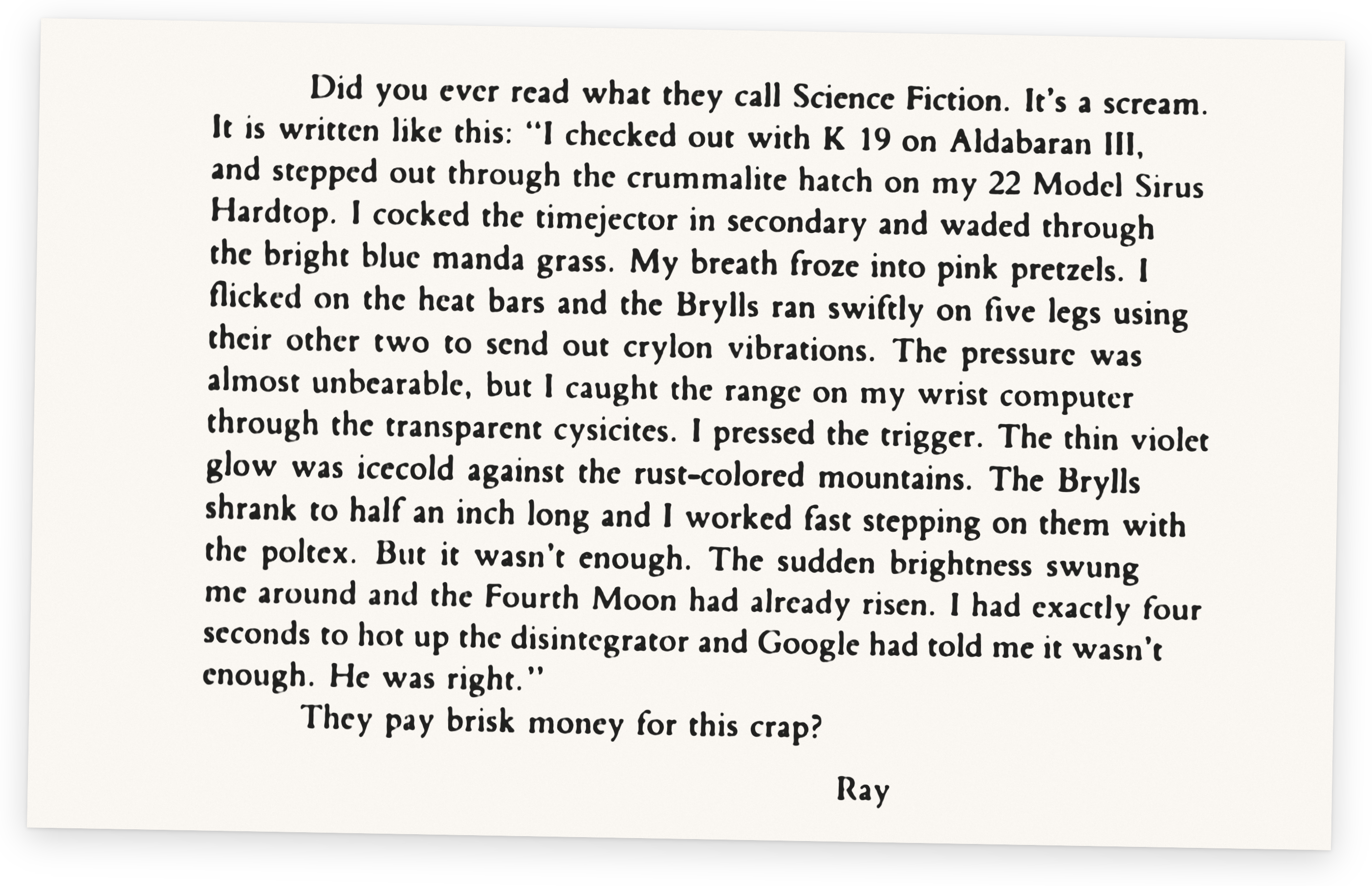
In 1953, hardboiled detective writer Raymond Chandler took a swipe at the genre in a letter to his agent.
‘Ways the World Could Be’
One of serious sci-fi’s virtues lies in proposing a range of thought experiments, stretching certain variables to extremes while still being grounded in enough recognizable reality to present useful comparisons and contrasts to our daily concerns. “Sci-fi opens the mind to other ways the world could be,” says economics writer Peter Coy. The genre allows readers to imaginatively explore scenarios beyond our present circumstances but which nonetheless relate, facilitating something like an A/B test on our world.
Kurt Vonnegut’s Player Piano, for instance, envisions a future in which a centralized computer runs the entire economy with machines handling most of what needs doing, except grunt work; ill-positioned humans take that. There are people at the helm, those jockeying to get close, and scads of people displaced. It’s all told in Vonnegut’s satirical and comical style, but it raises the sorts of issues that concern readers—especially now, in the age of AI.
Philip K. Dick’s The Penultimate Truth, like a lot of Dick’s novels, concerns the difficulty of knowing what’s real and what isn’t. It includes a subplot about a propagandist who uses rudimentary AI to generate propaganda. Not surprisingly, he struggles to maintain his integrity—not only because . . . well, propaganda, but because he’s a writer who no longer does any real writing; he just prompts his machine. Sound familiar?
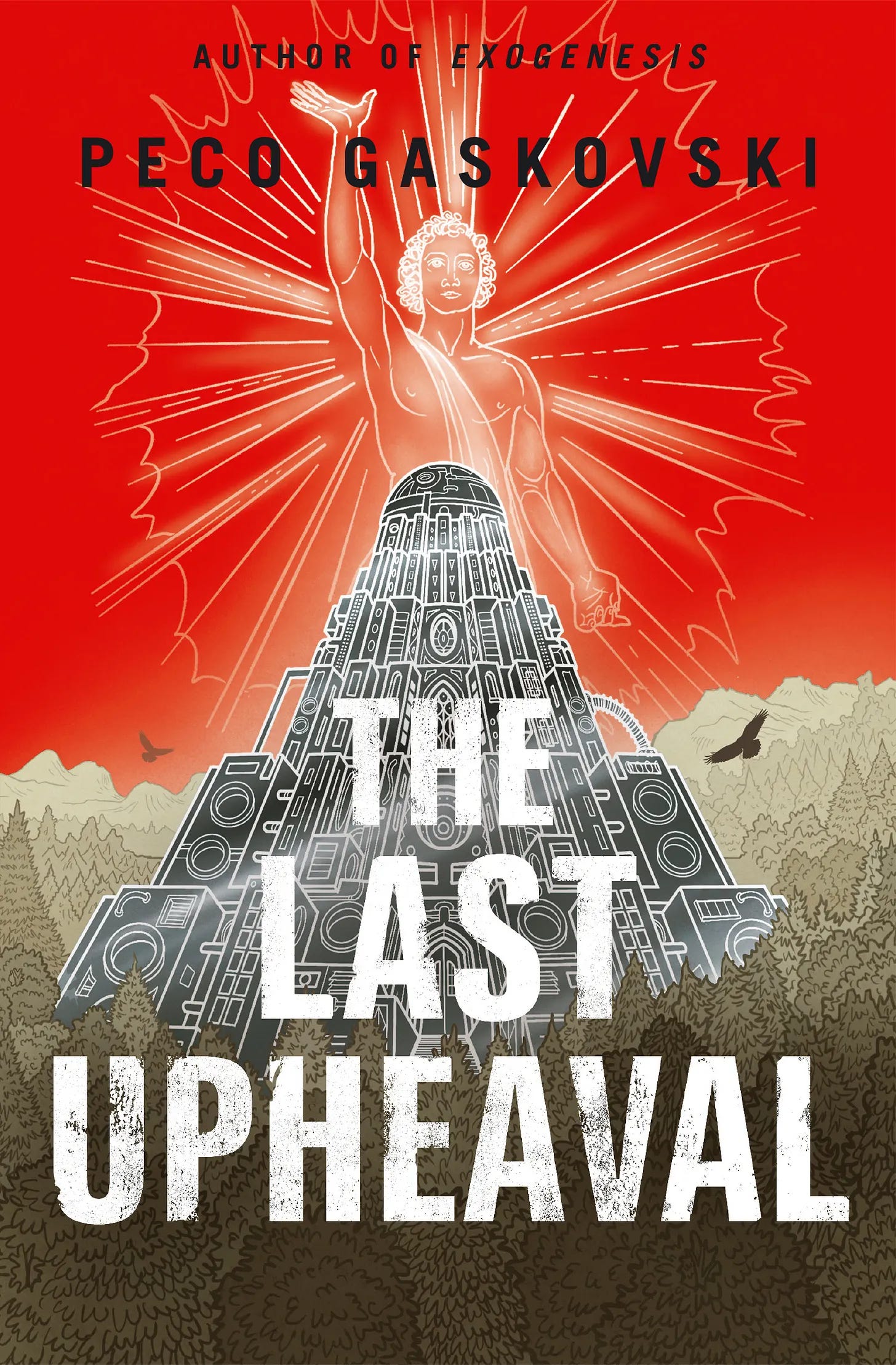
Most caricature sci-fi is escapist nonsense, and Chandler was right to mock it. But then, that’s not what Ferguson is talking about. Nor is it what people like Vonnegut or Dick were doing. Nor is it what Peco Gaskovski is doing in his latest novel, The Last Upheaval.
A Novel and Its Prequel
A few years ago Peco’s industrious, Substacking wife, Ruth Gaskovski, reached out and said her husband had written a great sci-fi novel she thought I would enjoy.1
Would I? I come from the publishing world, and there’s almost nothing scarier than somebody telling you their nearest and dearest has written a book you should read. Most people are terrible critics of what happens when their loved ones range across a keyboard. As a result, editors and others in the publishing industry have an allergy to such suggestions. For some, it’s anaphylactic. But I’m a good sport and have an EpiPen. I decided to pick up a copy.
I can’t say what my hopes were when my copy of Exogenesis arrived, but the timing was perfect. I was reading John Wyndham’s sci-fi classic The Day of the Triffids and was jonesing for more. The minute I turned the final page, I opened Exogenesis. Was I pleasantly surprised? Far beyond. Gaskovski had penned a riveting novel: well written, compelling characters, an engrossing storyline, an inventive plot—especially the twist. Ruth knew exactly what she was talking about. (You can, by the way, read my review here.)
Now, fast-forward a few years, when I began hearing rumors of a prequel. Set more than three centuries in the future, Exogenesis imagines a time after some great convulsion had rattled North America to the foundation and people had restructured society along lines you can picture forming today—those whose use of advanced technologies takes a domineering role in their lives and the descendants of opt-outers and refusniks who live at the margins.
Gaskovski’s prequel, The Last Upheaval, happens in a time much nearer our own, say, twenty years down the road—Gen-Xers like me are olds—and that great convulsion is just getting started. The story begins days into a string of mysterious cyberattacks. The power grid (“glorious electricity. The lightning blood of civilization”) buckles, blackouts sweep the nation, and the supply chain collapses. Nobody knows where the attacks are coming from—but some suspect nefarious origins.
Life in the Machine
The narrator, Sol Mereman, works at the Polygon, a research facility resembling a Silicon Valley tech company, with ambitions involving human biometrics, AI, robotics, and loads more, including organic, biological machines. The corporate offices resemble a massive glass pyramid, not wholly impervious to the outside world. “There were,” says Sol, “many leaks in the building, whose vast architecture expanded and contracted in a thousand complicated ways between the temperature extremes of summer and winter.” The people at the Polygon are rebuilding the Tower of Babel, but their ziggurat leaks.
For Sol, it’s a minor inconvenience. He uses a bucket to catch the water and feeds it to his office plants. For his family, however, particularly Sol’s wife Isbeth and college-age daughter Dessa, the Polygon represents something far less innocuous. For them, the Polygon increasingly represents the Machine—shorthand for a technocratic dystopia that trades promises of material progress for increments of our humanity.
There are, I should say, ideological (if ideology is the right word) reasons I might find such a story less than compelling. One way to read The Last Upheaval is as fictionalization of Paul Kingsnorth’s Against the Machine, a book with which I have serious disagreements. The overlaps are there, but that sells Gaskovski’s story short.
Such a novel would run the risk of devolving into a staged sermon or harangue in costume. Instead, Gaskovski offers a rich character study in which the drama primarily turns on marital and family tension.
Sol’s wife suffers from a mysterious condition that leaves her fatigued to the point of incapacity. The family attends—though Sol quits shortly after the action begins—a local nondenominational church run by a charismatic preacher, Greysen, obsessed with the end times who wants to gather his flock and flee to a remote tract of land where they can dig in for whatever’s coming. Parishioners believe the government is behind the cyberattacks, concocting the emergency to solidify control over the populace.
“It was planned ahead of time,” says Greysen. “Chaos by design.”
Was it? Sol is sympathetic to some of the argument. In principle, he accepts the Machine and its dangers. But he finds the conspiracy claims outlandish. Meanwhile, his wife swallows the message whole, grows increasingly adamant about joining the church’s exodus, and sees Sol’s job—the only source of family income following her illness—as capitulating to the enemy.
“What do you think I am . . . an institutional stooge?” he says in one testy exchange.
“That’s a good question,” she responds. “They’ll make you one, if you aren’t.”
Sol’s daughter Dessa complicates matters further by joining a ballooning protest movement against the Polygon and picketing her father’s workplace after the Polygon begins an expansion project. The company plans to extend its campus into a neighboring woodland. “What’s more wrong, me protesting against the Machine, or you working for the Machine?” she asks him, convinced of her righteousness.
A staff writer for the company magazine, The Review, Sol possesses plenty of concerns of his own about the technology the Polygon is building—an android, for instance, that raises ethical alarms for its behavior during a demonstration. Sol has nominal freedom to explore and express those alarms, moderated into concerns, in his articles (“I try to be critical”) but, even then, his editor, Manda Luren, mostly shuts him down, convinced he’s obsessing on the wrong angles.
So, Sol finds himself caught between a church community teetering on the edge of paranoia (if not well over the line), a wife siding with the paranoiacs, a family that hates his company, his growing issues with the organization, and his own sense that none of them is being remotely reasonable.
How does he hold it all together while all these planets threaten to spin out of orbit? While all these pressures mount, a string of unsettling encounters begins to undermine Sol’s own sense of sanity. As the story progresses, the tensions ratchet upward until Sol’s situation becomes roughly impossible, which stinks for him but makes for a good read.
A Lens on Turmoil
I finished The Last Upheaval in just a few days, pencil in hand, scribbling and dog-earing as I went. Gaskovski has a way with character and narrative, and one device is particularly humorous and effective. (Someone tell Raymond Chandler to settle down; he’s in good hands.) While narrating the story, Sol characterizes people and situations by referring to their own “books of the Bible.” Late in the novel, he reveals what he’s been doing all along.
While his editor, Manda, confronts him about his conduct in a staff meeting, and while his roofleak drips to the side, Sol asks, “What are the rules in the Book of Manda?” She doesn’t get it, so he clarifies: “If you were your own Bible, what would your rules be? Do you have any Thou shalts or Thou shalt nots in your life?”
“This sounds like a party game,” she responds. “Let’s see . . . Thou shalt not let people step on you. Thou shalt fake it till you make it.”
Sol shorthands and summarizes with the technique throughout the novel, often to comic effect—for instance, “The Book of Advice for Husbands: Thou shalt never tell thy wife to relax, calm down, or to otherwise restrain her emotions.” These quips tell us what Sol thinks about the people around him and, sometimes, how, he assumes, those people see themselves.
There are many lenses through which to read The Last Upheaval, but the plainest reading, to my mind, is that it’s about relationships under the strain of social, technological, economic, and political turmoil—the sorts of turmoil we currently and inconveniently find ourselves in, or are heading toward, depending on how you look at it.
The Last Upheaval ultimately provides a resolution to these tensions. But we, living here and now, have no escape hatch—an eschatological moment that sorts out the options and narrows our possibilities to the few we can take—at least I hope not. Troublesome as it might be, we have to navigate these tensions in the present. And we can feel Sol’s difficulty in moments like this because they’re our moments too: “I watched the news, scrolled through endless opinions and analysis, until everything was even murkier than before.”
Sol reminds me of Mark Studdock in C.S. Lewis’s That Hideous Strength. But I don’t take Sol as duped by the powers that be, so much as cautiously trying to navigate a fraught landscape in which the wobbly balance of his life might falter at any moment. It’s the kind of existential challenge we’re all dealing with to one degree or another. The Last Upheaval, as Peter Coy said, “opens the mind to other ways the world could be”—but, even more so, to the ways the world is.
I had the pleasure of reading The Last Upheaval a little earlier than most. It’s not out yet! But it will be soon. While Gaskovski published Exogenesis the traditional route, he decided to self-publish The Last Upheaval with a small Kickstarter to get it over the finish line. He’s already well past his goal, but if you want to jump on the offer, back the book, and get your copy when it releases later this month, I recommend you do! Here’s how.
If you found this post interesting or helpful, please restack it 🔄, hit the ❤️ below, discuss, and share.
And consider subscribing: Free subscribers get two-week access to all new posts. Paid subscribers get the run of the complete archive, plus bonus content.
If you don’t subscribe to School of the Unconformed, you should!
My experience using AI is it reinforces "official" propaganda. Think viruses are real and vaccines are safe and effective. If you believe that it is only because you have been brainwashed.
Joel, what a wonderful, thoughtful, fascinating review! BTW the book is slated for release the week of Oct 12, and the kickstarter is another way of ordering -- not necessarily ahead of time, but just another option with some perks included (including one-on-one conversations with readers).
I should also mention that the publishing world is changing fast, and in putting out this book we took the route of collaborating with another small publisher (WBW Press). So, while School of the Unconformed Press is listed as the publisher, there was a team effort in the background!