
Never Quite Home: 2 Incomplete Answers for a World in Flux
Dueling Dystopias: Reviewing Yoko Tawada’s ‘Scattered All Over the Earth’ Trilogy and ‘The Emissary’

Aboard a mail boat sailing the Baltic Sea, the multinational travelers sit down for dinner. The Indian’s place is set with the Indian flag, the German’s with the German flag, the Greenlander’s with the Greenlandic flag, and the Dane’s with the Danish flag. But the two Japanese aboard? There is no flag for them. “The land of sushi,” as Japan is called in Yoko Tawada’s Scattered All Over the Earth trilogy, has vanished without a trace.
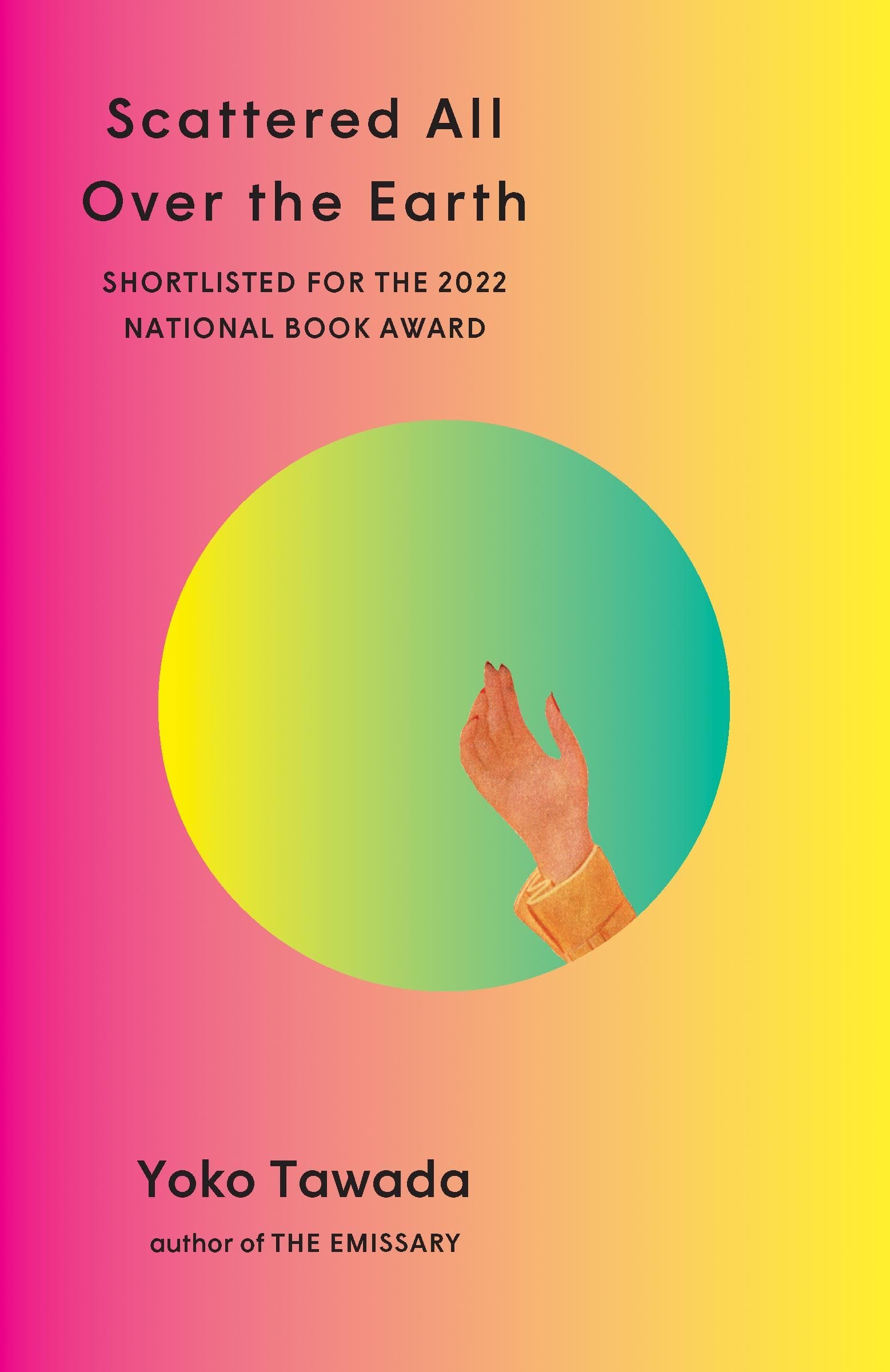
The whole story begins with the Dane’s realization of this catastrophe. As Knut mindlessly watches local TV, he sees an interview show where each panelist hails from a vanished nation—Yugoslavia, East Germany, the Soviet Union, and so on. Unlike the rest of the panelists, however, Hiruko’s country didn’t vanish because of political realignment; the land of sushi apparently slipped under the waves.
Knut, a budding linguist, is obsessed because Hiruko speaks a “homemade language,” something she calls Panska (Pan-Scandinavian). As a permanent migrant, Hiruko raids the pantries of Danish, Swedish, and Norwegian to assemble a new microtongue mutually intelligible to its parents but distinctly its own. As presented in Margaret Mitsutani’s translation of Tawada’s original, it reads like broken English. Knut compares it to a Monet painting. “The homemade language Hiruko spoke was like Monet’s water lilies,” he says. “The colors, shattered into pieces, were beautiful but painful.”
Hiruko longs for home but has no sense of how to return to her vanished land. The closest she can get? Finding a Japanese speaker in Europe. Knut helps her locate one, and off they go to Trier, Germany, to meet a man named Tenzo—who turns out to be a fraud. He’s an Eskimo from Greenland, whose real name is Nanook! The only thing Japanese about him is that he works as a sushi chef and has learned a little of the language.
The German Nora finds Tenzo/Nanook injured in Trier’s Roman ruins and appoints herself his nurse, protectress, and lover. He spends the rest of the trilogy trying to escape her. Try as he might, he can’t. All four of these people are pulled along on a common quest, one that weirdly and comically creeps and grows as the story progresses. Soon these four have acquired a fifth quester (Akash, an Indian man transitioning genders) and then a sixth (Susanoo, an actual Japanese speaker, also a sushi chef, who mostly refuses to speak despite Hiruko bombarding him with questions and provocations).
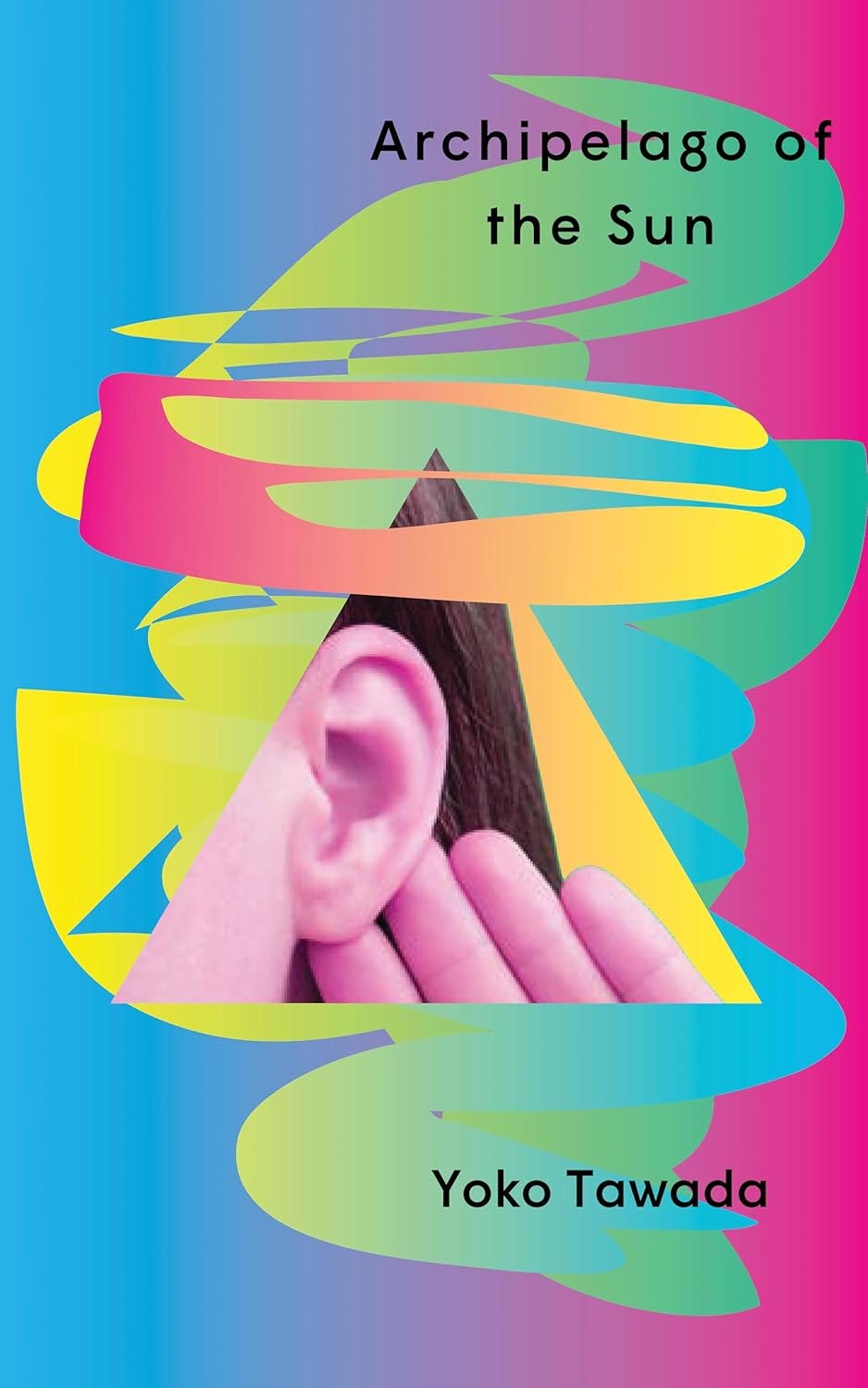
Bringing this oddball crew together in the first book, Scattered All Over the Earth, Tawada’s trilogy, completed by Suggested in the Stars and Archipelago of the Sun, then follows their antics as they bounce around Europe—from Oslo, Norway, to Arles, France, then to Stockholm, Sweden, plus a trip around the Baltic for reasons even the travelers cannot fathom—on their elusive quest for the vanished land of sushi.

Nations Don’t Last, Humans Do
At one point Nanook is jailed in Oslo for participating in a sushi competition that intends to serve whale. One has washed up on the beach, and authorities arrest him on the presumption he had something to do with the animal’s death.
Throughout all the adventures and misadventures, a handful of themes recur: the slippery nature of language and the equally slippery nature of nationality. Tawada foregrounds these themes in the case of Hiruko and her multinational escorts and lets them bubble in the background as well—the Roman Empire is gone, for instance, and characters walk among the ruins; humanity outlives its various political arrangements, including those that seem most permanent of all.
Each of the primary characters and some of the secondary characters take turns narrating the unfolding tale, sharing their individual perspectives and filling out various backstories, many of which include comical and tragic revelations. It turns out, for instance, that Knut’s mother knows Nanook. But how? Why? And she also knows the egotistical speech pathologist who tries to help Susanoo speak. Again, how? Why? The mysteries emerge as the travelers and others recount their stories.
All the while Tawada scrambles our assumptions about the way the world works. Hiruko and Susanoo are, for instance, compatriots but have little else in common. “Because Susanoo and I come from the same country,” says Hiruko in Archipelago, “people assume that I understand him better than they do, when actually, he’s more foreign to me than to anyone.” Linguistically, they’re even rivals, each speaking a different version of the same language: “This is a battle between dialects—Fukui vs. Niigata,” she says of one of their sparring matches.
Meanwhile, Nanook notes the diversity and curious unity of their ragtag group. “We came from all over, lived in different cities, had different jobs. And yet there were things that tied us together.”
And what is a country, anyway? Aboard the mail boat, Akash meets the Polish writer Witold Gombrowicz—quite a feat since the man would be long dead in a timeline that mapped to our world. Perhaps it doesn’t. Perhaps he’s a ghost. Tawada brings him into the story to answer the question. “When I was born,” he says,
my hometown wasn’t in Poland, but in Russian territory. It’s not all that unusual for Poland to disappear from the map. So, we Poles believe in our towns more than our country. Towns are made from stone and brick, so they don’t vanish so easily. Countries, on the other hand, are only promises, recorded on documents—in other words, they’re made of paper.
Even when people do belong they don’t always feel it. When some in the group visit Kaliningrad, a Russian enclave jammed up against the Baltic and separated from the rest of the country, they encounter Sergei, who seems to fit nowhere. “I need to vent my frustration with both the West and the East at least once a day, to keep my stress level down,” Sergei admits.
But there are always people who value their roots above all else. While touring the Weichselmunde Fortress in Gdańsk, Poland, a taxi driver informs Hiruko and Knut that the coastal redoubt serves as a symbol of their homeland. “Not all our enemies attacked from the sea,” says the driver. “Some came from inland, pretending to be peaceful citizens, and gradually increased their numbers until they finally took over.”
“Are all foreigners enemies?” asks Hiruko, wondering if the driver views her as a threat.
“Protecting the homeland is a difficult task. Nevertheless, it must be done,” says the driver. “What’s wrong with loving your homeland?”
“Keep thinking your homeland is always right,” says Hiruko, “and that everyone around you is an enemy, and someday it will dissolve and disappear.” Is that what happened to the land of sushi? To answer that question, we turn to Tawada’s earlier, standalone novel, The Emissary.
Keeping Out the World
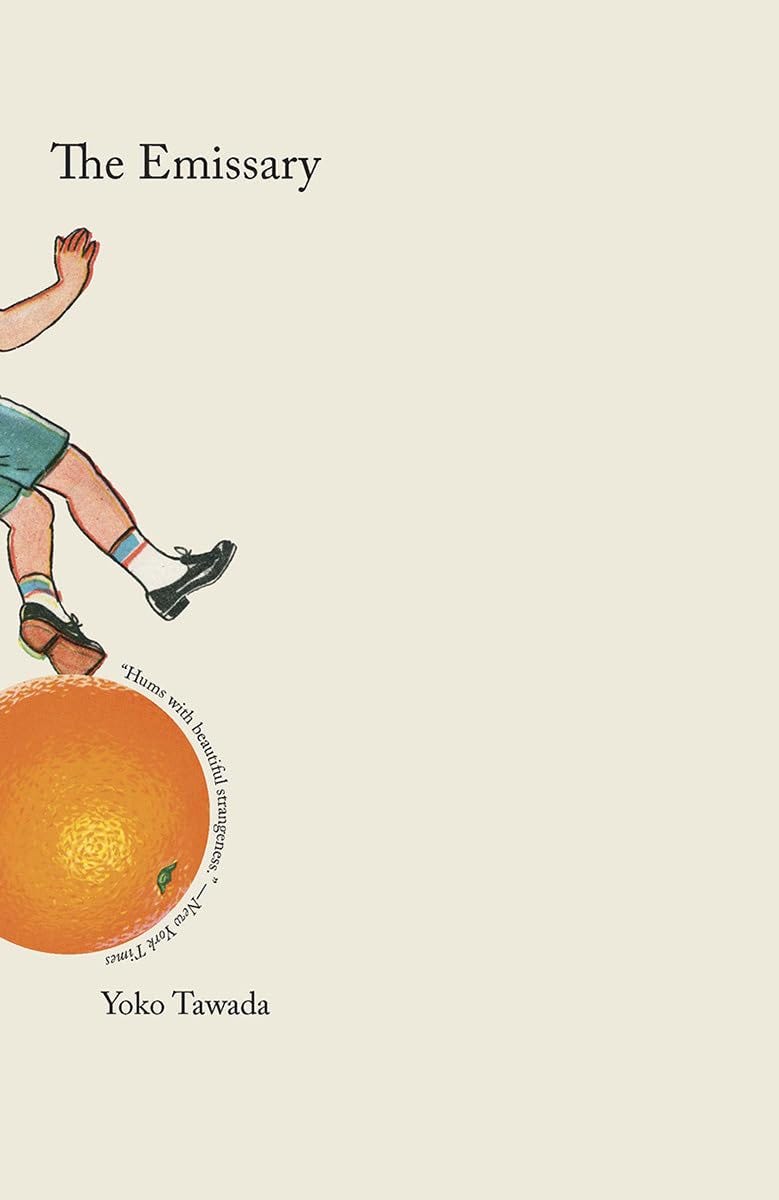
In a dystopian future, Japan closes its doors to the world after an unspecified catastrophe. Mutations abound, and fallout is a verboten word, so all clues point to a nuclear catastrophe. Tawada doesn’t dwell on it; she’s interested in the aftermath. The government bans foreign travel, foreign languages, even mentioning foreign words. There is no looking outward any longer, only inward.
The story centers on Yoshiro, a 108-year-old writer, who cares for his great-grandson Mumei. Here in this inward Japan, in a bizarre reversal, the old tend to age into vitality and vigor while children are born infirm—constantly feverish, struggling to walk as they grow, unable to properly chew and digest their food. “The adjective healthy didn’t really fit any child,” says Tawada’s narrator.
Yoshiro’s present differs starkly from his past, and he muses on the loss. But he’s more interested in coping with the world than fighting its deterioration. So when he mentions a foreign country to his baker, for instance, he doesn’t complain about the suppression of speech; he just drops his voice and looks around to see no one is listening. And when he realizes a historical novel he’d been writing, Emissary to China, is riddled with references to foreign countries, he abandons the project and buries it in a cemetery: “He’d had to get rid of the manuscript for his own protection.”
For people like Yoshiro and his wife Marika, the repressive isolationism seemed to come out of nowhere: “When the public was informed that the isolation policy had already gone into effect, Yoshiro and Marika weren’t the only ones too shocked to do anything but gasp and moan.” Newspapers ran articles appealing to the isolationism of the Edo period. “Isolation is not necessarily a bad policy,” they said.
The pundits and intellectuals who penned these defenses—though actually opposed to isolation—insisted they had supported isolation all along. But capitulation leaves no ground to stand on. Everything erodes from there. Since the laws and expectations changed constantly in the reactionary regime, people like Yoshiro find themselves permanently on alert. “Afraid of getting burned by laws they hadn’t heard of,” says the narrator, “everyone kept their intuition honed sharp as a knife, practicing restraint and self-censorship on a daily basis.”
Still, there’s a kind of consolation in the restriction. Isolationism offers clarity: we are here, they are there, and the boundary protects us. What does it cost? Only the future. Repeating Hiruko’s statement from Archipelago, “Keep thinking your homeland is always right, and that everyone around you is an enemy, and someday it will dissolve and disappear.” Japan has traded openness for purity, and the cost is dissolution.
What’s the way out of this horrible situation? There is none, except the thinnest of hopes entrusted to a few of those fragile children. A clandestine network emerges to smuggle gifted youth off the island, hopefully to scientists abroad who can study them and see what’s gone wrong. Yoshiro’s wife and Mumei’s teacher belong to this network, and Mumei is chosen as an emissary—Yoshiro’s buried book unearthed in the fragile person of his great-grandson.
The Argument We Inhabit
When the world is uncertain and dangerous, what’s the best path forward? Tawada’s dueling dystopias offer competing visions, neither of which are fully satisfactory. The Emissary considers isolationism as a survival strategy; the Scattered All Over the Earth trilogy offers cosmopolitanism as another. Neither works perfectly, but one works better.
Isolationism provides certainty at the cost of decadence and decay. Cultures obey their own version of physics, and entropy wins in a closed system. Instead, cosmopolitanism provides Hiruko resilience. Unlike Yoshiro’s sealed Japan, Hiruko’s Europe is radically porous. When her country vanishes, she survives because she can move, adapt, and connect. But she bears a cost, too: Hiruko is never quite home.
Read together, these four books stage a debate. Isolationism says, “Draw the boundaries tight, protect what’s ours, and maybe we’ll ride out the apocalypse.” Cosmopolitanism says, “The boundary is an illusion, and we’ll suffocate if we close ranks. It’s better to learn how to live with strangers than to die alone.”
Isolationism confers rootedness at the price of resilience. You can try preserving your language, your customs, your sense of who we are and who they are. But when the disaster comes—as it always does—you will have no tools for adaptation. Meanwhile, cosmopolitanism confers resilience at the price of rootedness. You can survive almost anything if you’re willing to keep moving, keep adapting, keep concocting ways to communicate. But you can’t go home.
One solution is fatal; the other, if sometimes grievous, is survivable. Perhaps more than survivable: Hiruko has lost her homeland, but she builds a new home of the friendships she’s cultivated along the way. “‘The People’ is an abstract concept I can’t believe in,” she tells the taxi driver in Gdańsk. “What I really feel in my heart is my homeland.” I’d wager that’s truer for most of us than we might recognize.
Thanks for reading! If you enjoyed this post, please hit the ❤️ below and share it with your friends—or the strangers in your midst.
Not a subscriber? Take a moment and sign up. I’ll send you my top-fifteen quotes about books and reading. Thanks again!
And check these out👇


The second option, the cosmopolitan of never quite being at home, is the one that seems closer to the oft-forgotten/ignored Christian calling of being a "stranger and pilgrim" (Hebrews 11:13, I Peter 2:11). I have had the privilege, in my journeys, of being part of an even more diverse group of nations than Yawada envisioned, with only one thing in common between us, a calling to serve others, and never felt more at home.
Sounds like a commentary on Acts 17:26-28.