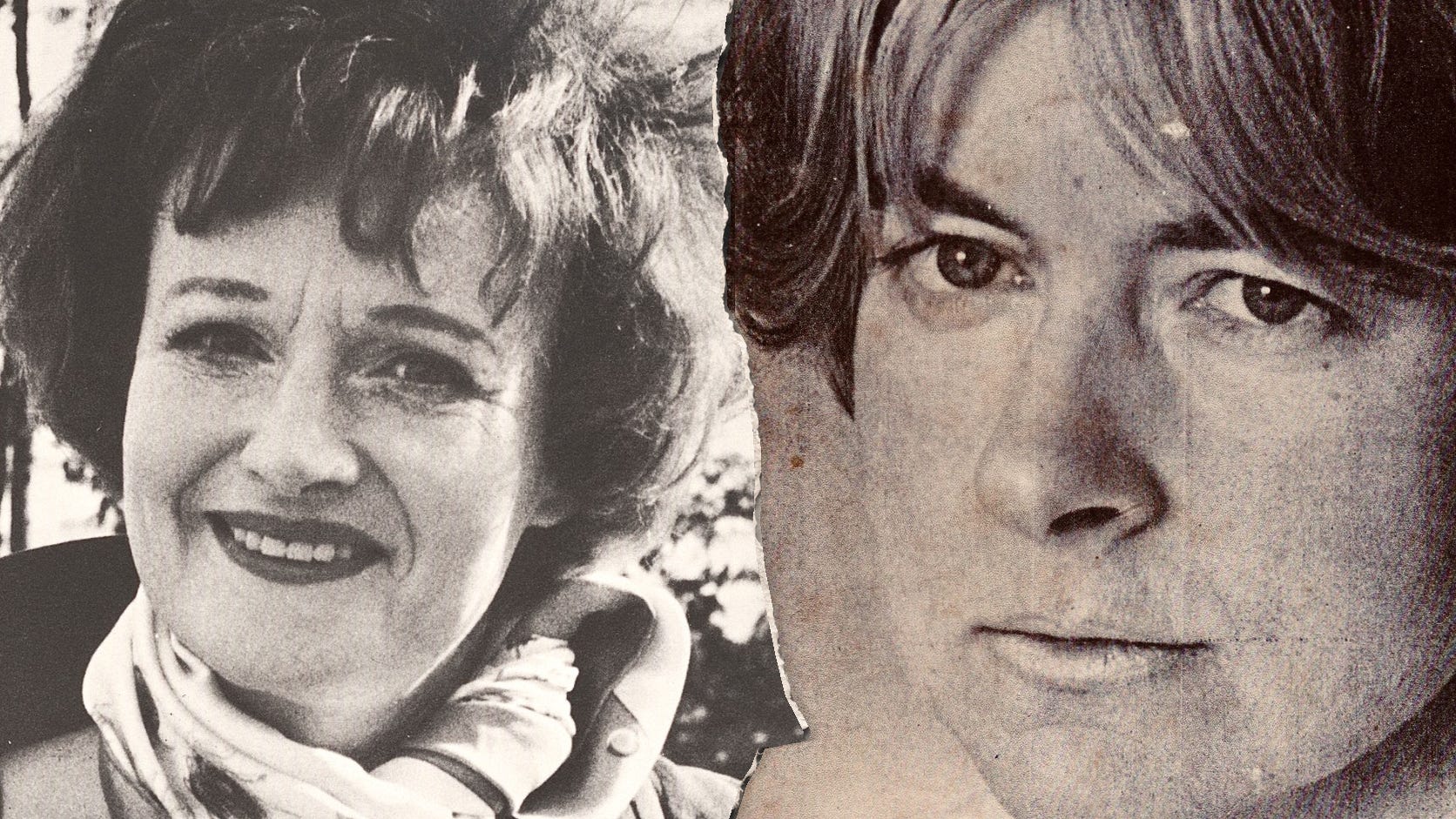
Both Converted, One Wrote 22 Novels, the Other Burned Her Books
Muriel Spark, Rosemary Tonks, and Two Radically Different Encounters with Faith

Hopped up on speed to lose weight and getting nowhere near enough calories to sustain a grown woman, in the early 1950s Muriel Spark was on a path to become several things other than an acclaimed novelist. The poet T.S. Eliot, so she believed, was not only sending her romantic cryptograms to decode but was also, if we believe the testimony of an old lover, sneaking into her house to steal her food.
In her autobiography, Spark described her own state as an “illness,” in an earlier interview (one she later disavowed) as a “breakdown.” Yet she somehow stumbled through that mess in 1954 and tripped over the threshold of the Catholic Church. Following her conversion, she wrote twenty-two celebrated novels, marked for their outlandish comedy and, as Judith Shulevitz said, “screwball storylines that recapitulate our hapless drift toward final judgment.”
As the Sparks Fly Upward
Faith seems to have given Spark a principle on which to hang her world. “I was able to organize my work better after I’d got my spiritual life organized,” she once said in an interview. Indeed, still dripping from the Tiber, she wrote her first novel, The Comforters. It was an odd novel; many of hers were.
“These may be religious works, but they are not works of consolation,” said Ian Penman. “They are waspish, clear-eyed, and astringent. Far from her faith being a sop, Spark’s characteristic tone is bleakly comic.” John Updike compared her novels to “shards of glass.” It all worked. Spark developed a significant following—and a significant lore—enough of both, in fact, to warrant two biographies in as many years, two decades after her death in 2006.
Intriguingly, however, some critics have complained that both of these new books fail to treat her Catholicism with anything passing for serious attention or care. Faith is challenging to live, as Spark discovered, and difficult to discuss, as her recent biographers have apparently discovered as well.
Reviewer Nic Rowan complains that the more recent of the two, James Bailey’s Like a Cat Loves a Bird (2026), says almost nothing about it, and the prior, Electric Spark by Frances Wilson (2025), seems to misconstrue. Reviewer Lydia Sherwood points to several faults in the portrayal (“Wilson . . . is at her worst when writing about Spark and religion. This is true every time the subject comes up”), and Spark’s semi-authorized biographer Martin Stannard cocked an eyebrow as well:
“Despite devoting a chapter to Muriel’s ‘Conversion,’” he said,
Wilson’s otherwise scintillating account engages only distantly with the religious passion that drove Muriel to Catholicism . . . Wilson gives us the facts of this conversion: how Muriel moved from agnosticism to Anglo-Catholicism to her reception into the Catholic Church; how she seriously considered becoming a nun. We have a reliable account of what happened and when. But the why seems missing . . . The passion, in both senses of the word, has evaporated.
Based on these readings, Wilson makes it sound as if Spark were an unwilling convert to a church she couldn’t support. Whatever her own ambivalence about her faith, which seems apparent enough, Spark deserves better; her conversion can be seen, should be seen, as a pivotal moment in her life as an artist; she said as much.
The same could also be said for her near contemporary, Rosemary Tonks, though the outcome couldn’t be different. I regularly stalk the website of New Directions, looking for possible additions to my TBR (plenty of Muriel Spark there, incidentally). But a couple of years ago I spied Tonks’s The Halt During the Chase, her final novel, rereleased after decades of being out of print, and bought it. It’s something of a miracle it ever appeared because, whereas religion helped Spark organize her mind, it seems to have fractured Tonks’s.
Consigned to the Fire
Tonks achieved some fame for her poetry (two collections) and novels (six published in all) during the sixties, bleeding into the seventies, in a nine year sprint between the ages of thirty-five and forty-five. Then things got weird, beginning with a parade of terrible events, described here by Mark Ford: “The death of her mother, the breakdown of her marriage, the development of neuritis in her left arm, a costly lawsuit, a devastating burglary. . . .”
She turned to various eastern spiritual beliefs and practices for support amid the turmoil, including Sufism, Taoism, and yoga. None, as Ford notes, delivered. Instead, things got worse; she even lost her eyesight for a time.
The timeline’s fuzzy, but around 1980 she converted to a strident stripe of Pentecostalism, a galaxy away from Spark’s worldly Catholicism. The distance can be measured by the severity of her response. “It became imperative that she personally destroy a significant hoard of Asian artworks that had been bequeathed to her by another aunt,” said Ford.
These included Tang horses with riders, statues of Sung priests, Chinese jades and bronzes, and a Korean dancing figure. “The burning of some idols,” as she called it, took place in August 1981. Items that survived the incinerator she hammered to pieces . . . Two months later she visited Jerusalem to have herself baptized in the Jordan River. Her new life—which lasted more than three decades—had begun.
Tonks didn’t stop with the idols; she torched her own books, too. As Audrey Wollen detailed in the New Yorker,
Tonks, after her great renunciation, took a firmer line: destroying the manuscript of her final novel, despite characterizing it as “the best thing I had ever written,” was easy, as was pulling out of a contract with the Phoenix Press, which wanted to issue a selection of her poetry. But further action was needed: Tonks wrote to publishers instructing them to remove her work from the anthologies in which it had appeared, and she would even—or so the rumor goes—withdraw her own books from public libraries so she could burn them.
Tonks was fairly successful, as later book hunters could attest. When Michael Hofmann profiled her work for Poetry in 2015, a year after her death, he could scare up only three of her novels. Luckily for readers, Tonks’s family was more sympathetic to their plight and authorized reprints with New Directions (three so far). But before reissues recently began appearing, said Wollen, “getting hold of any of her work was prohibitively expensive; one novel could cost thousands of dollars.” And it wasn’t just her own work she came to despise.
Religion and the Literary Imagination
Outside the Bible, which she avidly read and shared with evangelical fervor, Tonks swore off all literature. “What are books?” she asked in her journal in 1999, offering the following answer: “They are minds, Satan’s minds . . . Devils gain access through the mind: printed books carry, each one, an evil mind: which enters your mind.”
Throw that against Spark. It is hard to imagine two more divergent conversions, though both were Christian. Spark entered the Catholic Church and penned twenty-two novels; Tonks emerged from the Jordan determined to destroy the six she’d already written. By her own accounting, faith gave Spark a way to order her imagination. Meanwhile, it persuaded Tonks to obliterate hers.
What made the difference? We need better biographies to tell.
Thank you for reading! If you enjoyed this post, please hit the ❤️ below, 💬 discuss, and share it with your friends—or anyone you know who loves Spark and Tonks.
Not a subscriber? Take a moment and sign up. Free subscribers get two-week access to all new posts. Paid subscribers get access to the full archive, going back to 2022, plus an exclusive member chat and monthly member calls.
Before you go, check this out👇


I imagine the Inklings discussing these things philosophically like this.
Jack: It's all in Plato.
Tollers: Let's step out of this cave and take a walk to look at the clouds.
Williams: This also is Thou; Neither is this Thou.