
Don’t Know Jack About the Other C.S. Lewis?
Lewis Had 3 Careers: Novelist, Lay Theologian, and Scholar. Here’s a Look at His Most Ambitious Academic Project

I grew up in a book desert. My parents were serious readers, and our home was full of literature. But Roseville, California, had few bookstores in those days—and there were none in Lincoln, the exurb to which we moved a few days before my seventeenth birthday. So I relished visiting my aunt and uncle in San Jose; they had a Barnes & Noble! For whatever grievances people level at Jeff Bezos these days, we fail to appreciate how hard it was to find books before Amazon, before the Internet.
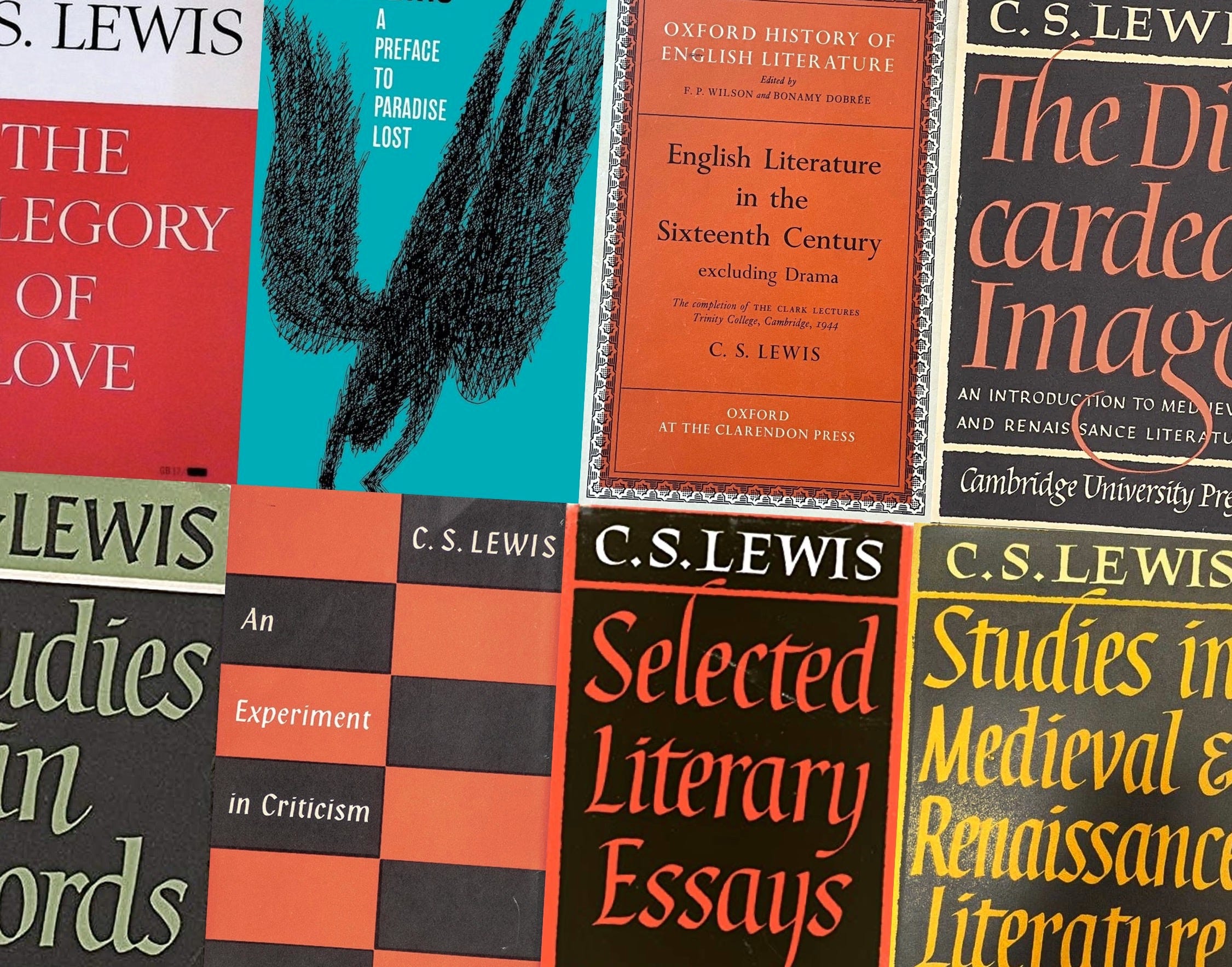
On one fateful trek to that grand emporium of words in San Jose, while hunting for God knows what, I ran across a reissue of C.S. Lewis’s Studies in Words, originally published in 1960. Of course, I bought it.
But what was it?
The Other C.S. Lewis
Lewis had at least three careers: novelist, lay theologian, and academic. How often is he tagged as an Oxford don? For a certain kind of reader, his academic credentials helped validate his other work, even if it had little to do with, say, his religious writing. But the focus was never on his academic work—only the legitimacy it supposedly conferred.
I guess I was pretty much in this camp. My awareness of Lewis’s scholarship was limited to whatever George Sayer mentioned in his biography (the only biography of Lewis I’d read to that point). Otherwise, I knew Lewis mostly from the Space Trilogy and books like Mere Christianity. I was an adult before I ever read The Chronicles of Narnia.
But Studies in Words was something else, an artifact of a career almost totally obscured by Lewis’s broader reputation. And there was more. Many years later, while visiting one of my authors in Colorado Springs, Colorado, as an editor, I stopped into Poor Richard’s and found another token of this other Lewis: a used copy of The Discarded Image, Lewis’s survey of medieval literature. Based on a series of lectures, Lewis prepared it for publication in 1962, but it wasn’t released until a year following his death in 1963.
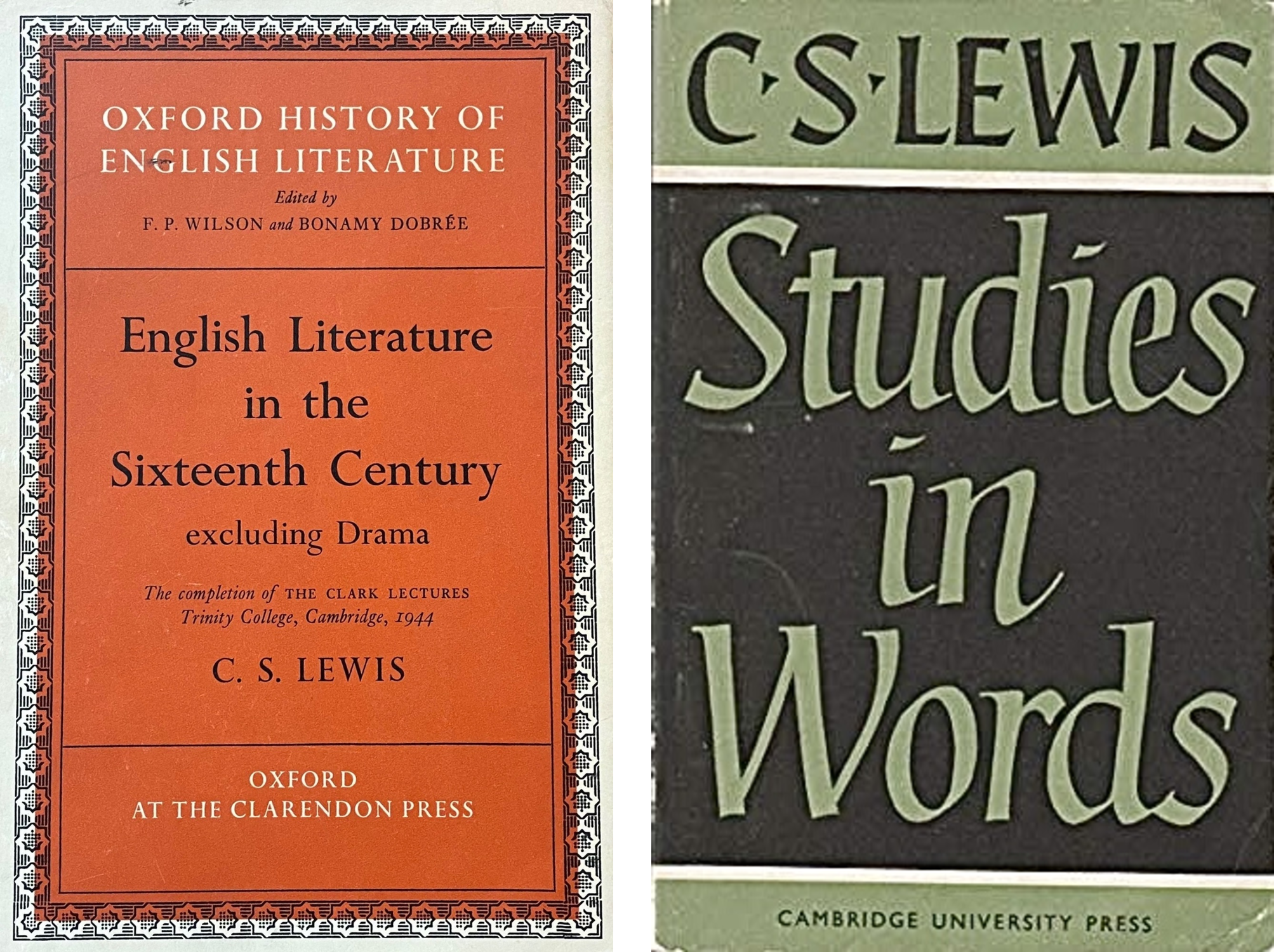
By 1960 his celebrity as a popular writer and novelist had crested and he was publishing more academic work again. Throughout the 1940s and ’50s, he published only one scholarly work, though it was a beast—maybe his best—took eighteen years to finish, and nearly killed him: English Literature in the Sixteenth Century, Excluding Drama.
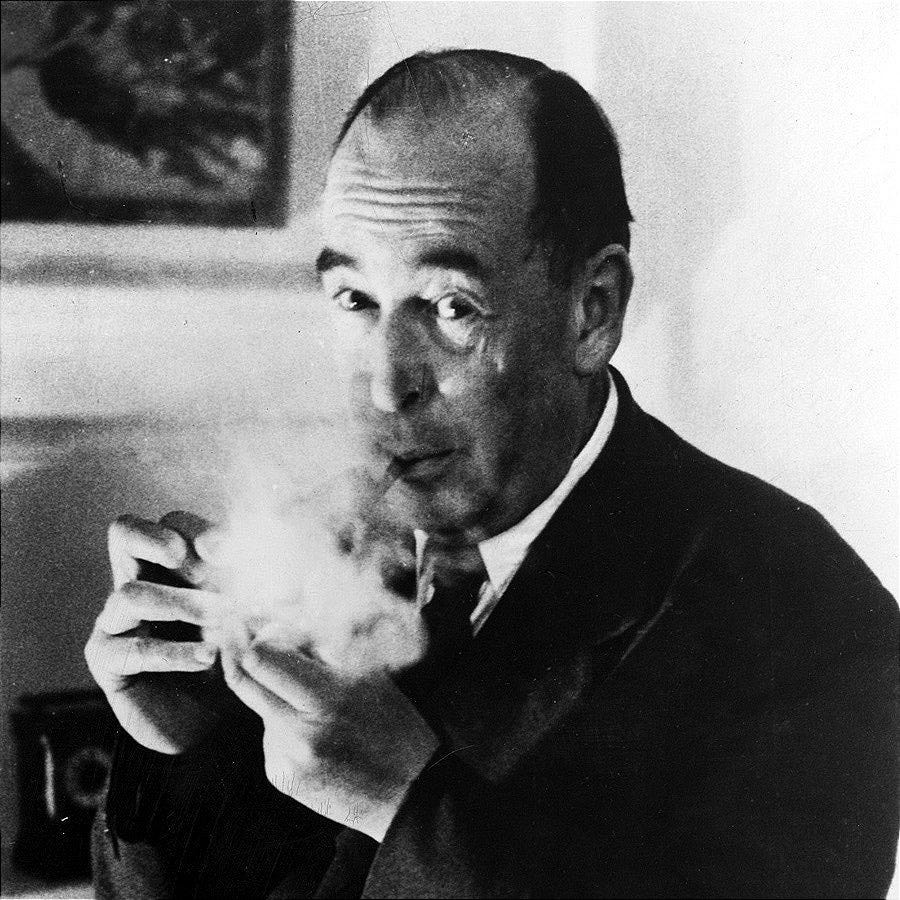

Understandably, none of this academic output rose to the level of fame garnered by books like The Screwtape Letters, Mere Christianity, or his memoir Surprised by Joy. But it’s all worthwhile—especially for readers with an interest in the Middle Ages and Renaissance and literary criticism more broadly.
I’ve since acquired more of Lewis’s scholarship and think, taken together, the eight volumes presented below tell a fascinating story. Read in order of publication, they reveal Lewis working for nearly three decades on a unified critical vision—one that begins with a straightforward but controversial conviction about how we should read, especially old books, and widens into a complete approach for reading literature of any sort.
The Allegory of Love (1936)
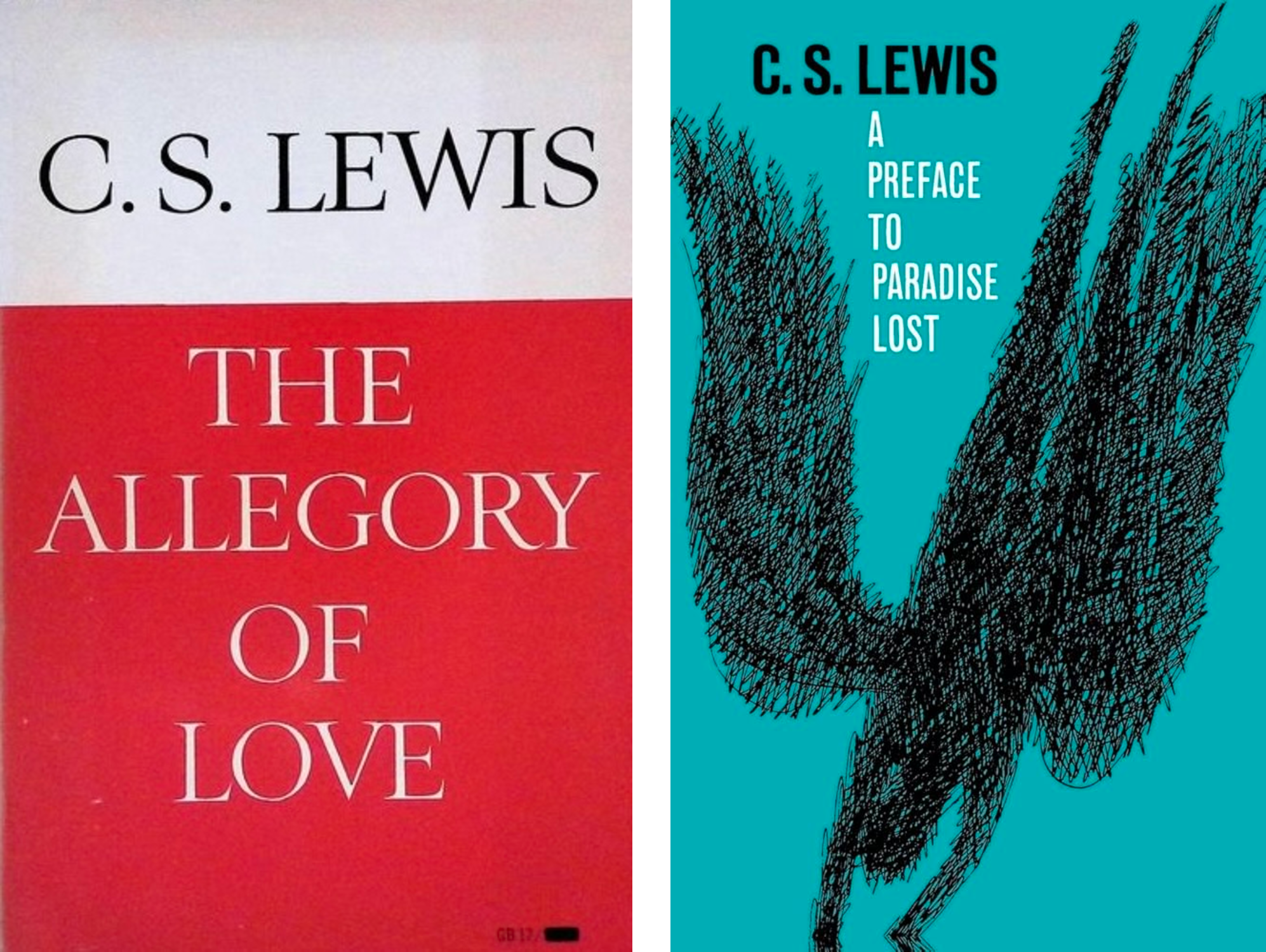
Every famous author has a book that first makes their name. For Lewis it was an academic work on the rise of the courtly love tradition in medieval poetry, The Allegory of Love, published in 1936—several years before his later fame as an apologist and children’s author.
The book opens with a trenchant observation, which modern people (me among them) often forget: We are not so different from our forebears as we suppose. “Humanity,” says Lewis, “does not pass through phases as a train passes through stations: being alive, it has the privilege of always moving yet never leaving anything behind. Whatever we have been, in some sort we are still.” The older forms, he says, have left “indelible traces on our minds.”
Those indelible traces have had an effect, however oblivious we are to it. Lewis argues the courtly love tradition did more than produce stirring poetry; by filtering throughout the later Western literary tradition it shaped how we moderns experience romantic love. The idea that love is the supreme human experience was invented, not inevitable, and the allegorical love poets of the Middle Ages were its creators.
Thus, says Lewis, “We shall understand our present, and perhaps even our future, the better if we can succeed by an effort of the historical imagination, in reconstructing that long-lost state of mind for which the allegorical love poem was a natural mode of expression.” His method? To help modern readers recapture the feeling of reading such poetry as if we lived in the time of its composition.
A Preface to Paradise Lost (1942)
Six years later, Lewis put that method to the test. A Preface to Paradise Lost is an attempt to salvage the reputation of John Milton’s masterwork, which Lewis’s predecessors (such as the Romantics) had misunderstood and his contemporaries (such as T.S. Eliot and F.R. Leavis) had not only misunderstood but devalued out of their ignorance. The sort of immersive inhabiting of past worlds he had championed in The Allegory of Love would have prevented the misreadings and denigration.
The problem was that later readers had lost touch with Milton’s world and—unable or unwilling to find their way back into the technique of epic poetry and seventeenth-century theology—failed to appreciate what Milton was doing. As a literary critic, Lewis’s lifelong mission was to take the work as the work, whatever it was, whenever it was written. To do that requires delving into the world of the author deep enough to recognize what he was actually trying to do.
Not that the author was always successful in that attempt. Lewis doesn’t hold back on fault-finding. Paradise Lost, he says, reflects “curiously bad” writing in places. But his contention is that we only get to judge a work if we judge it on its own terms and within the world of its creation. To assist that project, Lewis carefully reconstructs the web of assumptions and convictions that formed Milton’s world.
And, as always, Lewis marbles his argument with delightful observations, such as this:
What the Satanic predicament consists in is made clear, as Mr Williams points out, by Satan himself. On his own showing he is suffering from a “sense of injur’d merit” (I, 98). This is a well known state of mind which we can all study in domestic animals, children, film-stars, politicians, or minor poets; and perhaps nearer home. Many critics have a curious partiality for it in literature, but I do not know that any one admires it in life.
English Literature in the Sixteenth Century, Excluding Drama (1954)
With The Allegory of Love and A Preface, Lewis had demonstrated his method on individual traditions and single works. In English Literature in the Sixteenth Century, Excluding Drama he attempts something far more ambitious: applying it to an entire century of literary production.
Written as a volume in a larger series, the Oxford History of English Literature, the final product proved massive—nearly 700 pages. It was a torture to write but thankfully a pleasure to read, or even just read in, not to mention fascinating. Lewis opens with an argument that’s far more common today but novel in his own time: That Renaissance humanists slandered their medieval forebears by characterizing them as perpetuating the so-called Dark Ages. And modern readers are forced into the humanists’ scheme because our educational system and its concepts are inherited from them—evidenced by the simple fact that we refer to the “medieval” at all. It’s a Renaissance coinage.
Beyond the praiseworthy effort of preserving ancient texts, the humanists actually did more harm than we recognize, principally by codifying their prejudice as good taste and intellectual rigor. Constraining their vision with this set of arbitrary blinders, they proceeded to narrow the options available to writers, leading to what Lewis polemically refers to as the “Drab Age” of prose and verse. “Perhaps every new learning makes room for itself by creating a new ignorance,” he says. “Man’s power of attention seems to be limited; one nail drives out another.”
These Drab Age writers followed the humanists’ conventions about proper style, but mostly produced—as the name suggests—flatfooted, lifeless poetry. And philosophy? Lewis regards humanist philosophy as “a Philistine movement.” It’s not until poets and other writers began to shake off the humanists’ strictures that we get the Golden Age writing of Sidney, Spenser, and Shakespeare (whose sonnets “are the very heart of the Golden Age, the highest and purest achievement of the Golden way of writing”).
Lewis argues that the Golden Age poets succeeded where the Drab Age writers failed precisely because they dropped the blinders and drew upon the full tradition of the classical and medieval past. As a non-scholar and mere dabbler, I can’t judge Lewis’s argument. But it resonates precisely because his overall project resonates: When we judge a period by modern standards—in this case the humanists concocting a novel set of criteria by which they denigrated the medievals—we tend to misunderstand and mischaracterize more than we realize.
Studies in Words (1960)
If recovering a lost world is the goal, language is the first obstacle. To inhabit medieval and Renaissance literature requires understanding the words its authors used. And we don’t. What linguists call false friends (words whose meaning we think we grasp but don’t) abound. “If we read an old poem with insufficient regard for change in the overtones, and even the dictionary meanings, of words since its date . . . then of course we do not read the poem the old writer intended,” says Lewis.
Linguist John McWhorter has made most of a career off his observation that words are always on the move. Studies in Words is Lewis’s attempt to wrangle such commonplace terms as nature, sad, wit, free, sense, and simple, plus several others, along with their foreign counterparts, by delving into each word’s etymological and literary backstory, showing how their meaning and valence have wandered around over the centuries.
“When a word has several meanings historical circumstances often make one of them dominant during a particular period,” says Lewis, and that dominant sense comes most readily to mind when we read it—regardless of the meaning intended by an author and some distant remove. “Whenever we meet the word, our natural impulse will be to give it that sense. When this operation results in nonsense, of course, we see our mistake and try over again. But if it makes tolerable sense our tendency is to go merrily on. We are often deceived.” For words that regularly trip us up, he supplies the term “the dangerous sense.”
This is exactly what’s behind McWhorter’s controversial recommendation that we “update” Shakespeare so the Bard’s intended meaning can be communicated in words that map closer to our dominant sense today. Failing that suggestion, one could always read Lewis’s Studies in Words instead.
An Experiment in Criticism (1961)
Partway through this decades-long project, Lewis paused to ask the questions his work had been assuming an answer to all along: Why does any of this matter? What makes one way of reading better than another? What is good reading in the first place?
The standard answer points not to reading but to supposedly good books—and their counterpart, the bad ones, which are to be avoided. That’s what the humanists did with the medievals; that’s what T.S. Eliot did with Milton. But Lewis’s An Experiment in Criticism flips the typical approach to literary evaluation on its head. Rather than starting with some Platonic ideal of the “right books,” and then sorting readers by their allegiance to this canon—sheep on one hand, goats on the other—Lewis says we should start working from the other direction, with how people actually engage with the books they read. After all, so his argument runs, it’s easier to define a good reader than a good book.
Consider the latter. Lewis points out that books—even prized examples—slip in and out of fashion. Milton didn’t change; the culture did. Suddenly it signals bad taste to say you enjoy him, esteem him, whatever. Even if we assume there’s a real, transcendent canon to which we might appeal (there isn’t), taste and popularity sway back and forth across the line like an inebriated driver during a 2 a.m. sobriety check.
But what if we’re focused on the wrong element in the equation? Lewis draws a distinction between the unliterary and the literary. The unliterary “use” a book; the literary “receive” it. You can already see how this ties into the argument he’s been making in his prior books.
For unliterary readers, books are a last resort—something to pick up when there’s nothing better to do, a source of information, or escapist wish-fulfillment, consumed once and never revisited. The unliterary reader imposes his subjectivity on the book and stays in control of the experience.
For literary readers, on the other hand, books are essential. They return to them, surrender to the author’s vision, and often find themselves transformed by the encounter. The literary reader surrenders their subjectivity and hands the steering wheel to the author, usually coming back from the experience enlarged. That’s primarily why the literary read at all, says Lewis. We’re not killing time. We’re not mining for takeaways. “My own eyes are not enough for me,” he says, “I will see through those of others.”
Based on this distinction, Lewis defines a “good” book as one that rewards and sustains the kind of immersive experience literary readers want. By that definition anything might be fair game, provided it’s artfully constructed and masterfully executed—even, as Lewis suggests, science fiction. And a bad book? It’s one that unliterary people might well love, but literary people can’t stand. (Dan Brown, you still writing?)
This approach reframes the whole Milton controversy. Eliot’s problem wasn’t with Paradise Lost in itself. He was measuring the poem against the modern literary fashion he advocated, not receiving it for what it is. I could say more about this book, and hopefully will someday; Eliot was, for instance, far from unliterary. But Lewis says that the literary are the most susceptible to—no big surprise—literary fads, which leads them to confidently misjudge work they don’t actually understand.
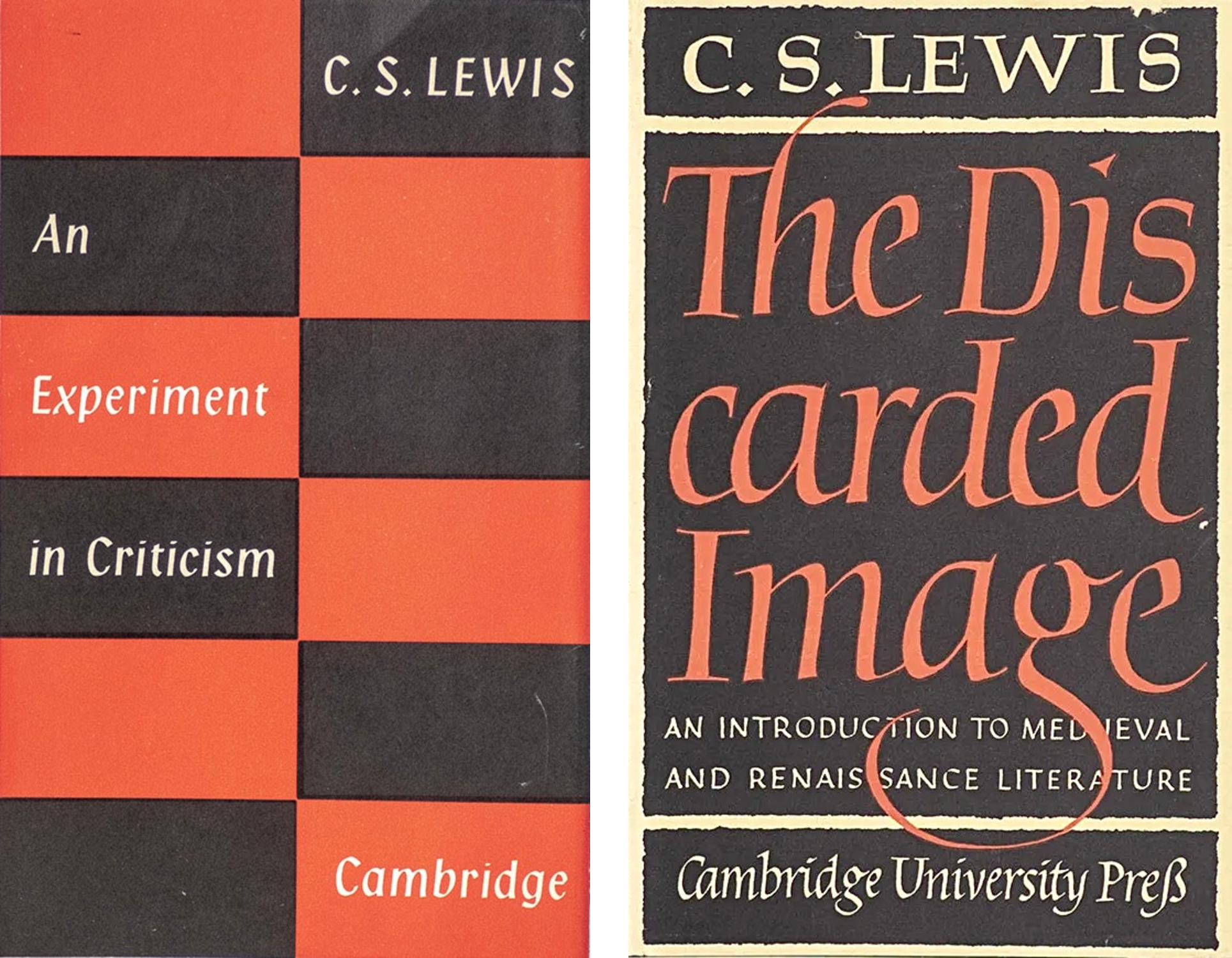
The Discarded Image (1964)
Seeing through the eyes of others requires more than literary willingness to surrender to an author’s vision. As the prior books demonstrate, it requires entering into the world of the author with enough knowledge to navigate the terrain without stubbing our toes and twisting our ankles—at least no more than necessary. In The Discarded Image, Lewis hands us a compass.
Lewis positions it as a survey of medieval and Renaissance literature, but in many ways it is an introduction to the medieval mind, which he conceives as a complete worldview (or what philosopher Charles Taylor would call a “social imaginary”) that harmonized the diverse philosophies, poetry, histories, homilies, and satires inherited from Christian, Jewish, Greek, Roman, and barbarian sources.
Lewis rummages through the classical and early medieval sources—for instance, Lucan, Cicero, and Apuleius for the former and Boethius, Pseudo-Dionysius, and Macrobius for the latter. From there he launches into a wide-ranging exploration of medieval literature focused on its authors’ unique understanding of the natural world, the celestial world, history, the soul, human physiology, and education.
As with all of Lewis’s work, he’s delightfully opinionated; he calls Isidore’s Etymologies “a work of very mediocre intelligence.” But he’s also willing to take the medieval world on its own terms. Sometimes there’s little good to say about it. Plenty of medieval literature, says Lewis, suffers from “sheer, unabashed, prolonged dullness.” But it also serves up Dante, Malory, and Chaucer.
Returning to the primary theme of English Literature in the Sixteenth Century, Excluding Drama, Lewis says the medievals could produce Dante, Malory, and Chaucer—and many, many others—in part because they were free of the “pseudo-classical” burdens later imposed by the humanists.
Studies in Medieval and Renaissance Literature (1966)
With the medieval worldview reconstructed, Lewis turns to particular authors and works. This posthumous collection, edited by Lewis’s secretary Walter Hooper, picks up the thread of The Discarded Image and invites readers to dive into the past and its presuppositions. At the outset, Lewis compares reading old literature to traveling to a foreign country. You can do it as a mere visitor—or you can go deeper.
You can eat the local food and drink the local wines, you can share the foreign life, you can begin to see the foreign country as it looks, not to the tourist but to its inhabitants. You can come home modified, thinking and feeling as you did not think and feel before. So with the old literature you can go beyond the first impression that a poem makes on your modern sensibility. By study of things outside the poem, by comparing it with other poems, by steeping yourself in the vanished period, you can then re-enter the poem with eyes more like those of the natives; now perhaps seeing that the associations you gave to the old words were false, but the real implications were different from what you supposed, that what you thought strange was then ordinary and that what seemed to you ordinary was then strange.
Unlike The Discarded Image, which mostly focuses on the features of the medieval worldview, Studies in Medieval and Renaissance Literature emphasizes particular authors and their works: Dante’s Comedy, Malory’s Le Morte d’Arthur, Tasso’s Gerusalemme and Furioso, Spenser’s Faerie Queene, and Layamon’s Brut, a 16,000-line epic tracing British mythic history from its founding through King Arthur.
And what does the native perspective reveal about these writers? These medieval writers didn’t work as moderns do. They both slavishly followed the original material they worked with and cavalierly altered it to suit their needs. What’s more, they were working with the hodgepodge leftovers of Rome’s slow demise, the persistence and development of local traditions, and other literary odds and ends. They tried reworking this heterogeneous, self-contradictory pile into a harmonious whole.
It was apparently difficult to believe that anything in the books—so costly, fetched from so far, so old, often so lovely to the eye and hand, was just plumb wrong. No; if Seneca and St Paul disagreed with one another, and both with Cicero, and all these with Boethius, there must be some explanation which would harmonize them. . . . It is out of this that the medieval picture of the universe is evolved: a chance collection of materials, an inability to say ‘Bosh’, a temper systematic to the point of morbidity, great mental powers, unwearied patience, and a robust delight in their work. All these factors led them to produce the greatest, most complex, specimen of syncretism or harmonization which, perhaps, the world has ever known. They tidied up the universe.
And so the originality and inventiveness of Dante, Malory, and the rest is in part an attempt to use the familiar in unfamiliar ways. But we miss what they were doing if we’re unfamiliar with what to them was commonplace. That’s the cost of being a tourist rather than a native. And it’s what Lewis spent his academic career trying to remedy—work that carried on even after his death.
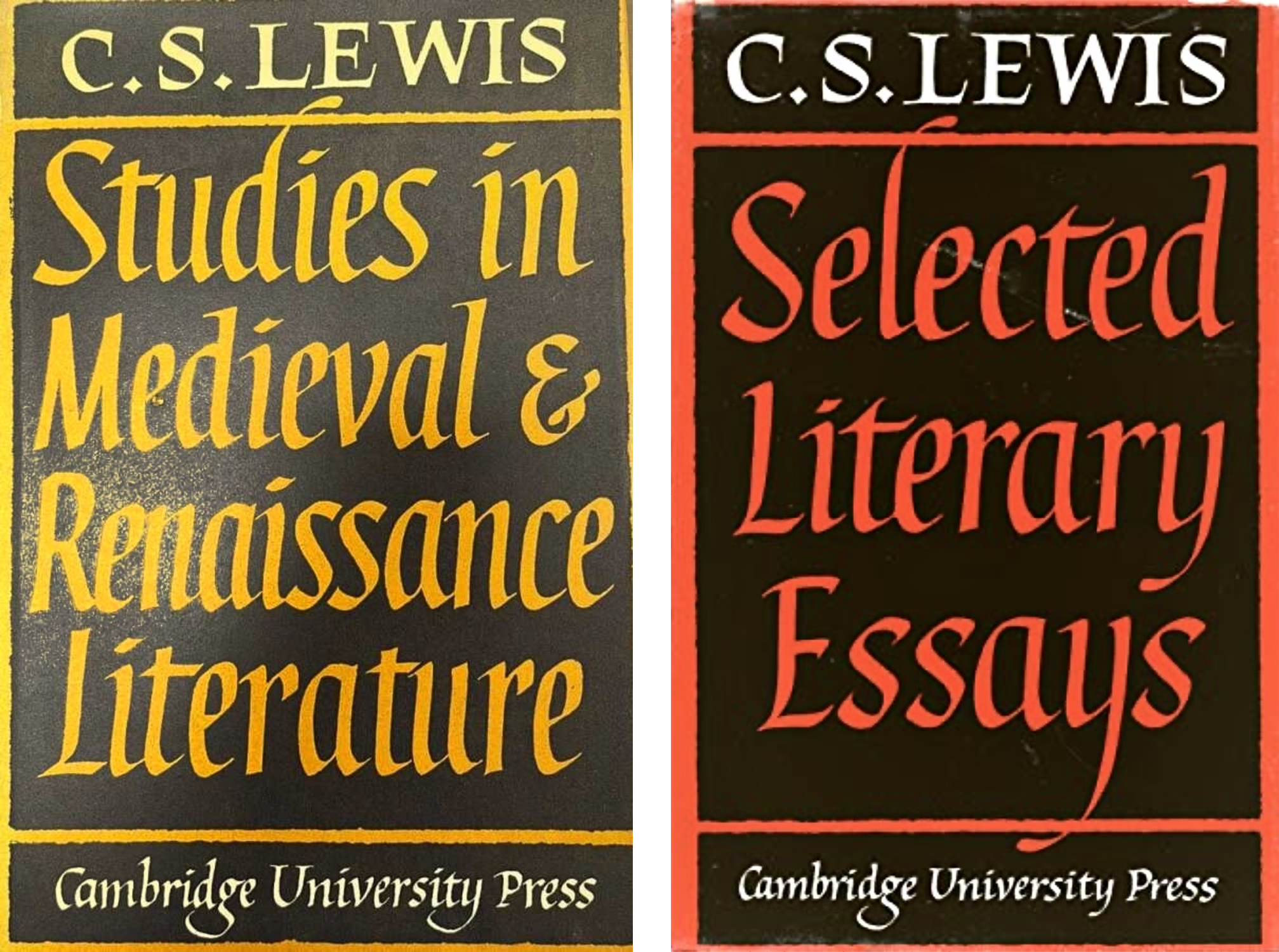
Selected Literary Essays (1969)
The final book I’ll mention? Another posthumous collection, again chosen by Hooper, gathering essays spanning Lewis’s entire career, from the 1930s through the early 1960s. Where most of the books I’ve covered so far emphasize the period Lewis knew best as a scholar, Selected Literary Essays ranges all over—covering such authors as Shakespeare, Bunyan, Austen, Kipling, Scott, Shelley, not to mention four-letter words, Freudian literary criticism, and high- and low-brow culture.
His treatment of John Bunyan’s Pilgrim’s Progress—a book I do not enjoy in the slightest—is an example of his critical method in action. Lewis admits to finding Bunyan’s theology “somewhat repellent” and says a couple of passages “will not prevent drowsiness.” But by and large it is, in Lewis’s estimation, a ripping good read. Stylistically, the book is rich. Bunyan displays “a perfect, natural ear, a great sensibility for the idiom and cadence of popular speech. . . .” But many people stumble over its pages because, he says, they no longer understand how allegory works. In keeping with everything we’ve seen thus far, he suggests readers “mov[e] always into the book, not out of it. . . .”
I don’t know if Hooper intended it this way, but the collection serves as a coda to a long and productive career, showcasing Lewis’s critical method across periods and genres with a consistency that confirms the unity of his scholarly project. Whether writing about a medieval allegory or a modern novel, the underlying commitment is the same one he demonstrated in The Allegory of Love at the beginning: venture into the work, inhabit its world, and only then presume to judge.
For Lewis, the point was never antiquarian. He wasn’t trying to turn modern readers into medievalists. He was trying to free us from the tyranny of our own moment—the assumption that how we see things now is how things have always been. When we do that, we fail to understand how things really were, and we also fail to understand how we came to be how we are. Reading old books and reading them well is the cure for what he dubbed “chronological snobbery.”
And that’s the eventual answer to the question about Studies in Words. What was it? A window not so much into the past but into understanding itself. To read well is to escape the prison of the present, even our own mind, and inhabit another consciousness. The unliterary? They probably regard it as an eccentric, unproductive way to pass the day. But the literary? They recognize it as one of the most important—and rewarding—things a human being can do.
Postscript. If Miller’s Book Review 📚 has a patron saint, it might as well be Lewis. I’ve written a fair bit about him and his work: his career-long tiff with T.S. Eliot and how they became friends near the end of Lewis’s life; Eliot’s kindness after the death of Lewis’s wife, Joy Davidman; the arduous process of writing English Lit in the 16th Century; Lewis’s friendship with Tolkien; Lewis’s fame before the Narnia phenomenon; his reliance on eastern sources in the Narnian universe; a review of Lewis’s greatest novel—greatest book!—Till We Have Faces; accounting for Lewis’s ongoing fame and the afterlife of one book in particular, The Abolition of Man; and more. Hit the site search for Lewis and range at will.
Thanks for reading! If you enjoyed this post, please hit the ❤️ below and share it with your friends (or anyone else who enjoys Lewis).
Not a subscriber? Take a moment and sign up. I’ll send you my top-fifteen quotes about books and reading. Thanks again!
Thanks so much for this fabulous intro to Lewis' literary scholarship.
My phone keeps autocorrecting C.S. Lewis to C.S. Luis so I had AI make it official.
He writes magical realism, drinks café de olla, and meets his best friend J.R.R. Tolquién at the pub every Tuesday.
Here’s the picture: https://substack.com/@whitenoise/note/c-223703428