Bookish Diversions: Anything Better than a Bookshop?
Just a Great Big Post About the Wonderful World of Bookstores: Big Ones, Little Ones, Running One, and Why They Matter. Plus, I Introduce You to the Fantastic Mr. Barton
Mothership. I was in Portland, Oregon, for a wedding. But my hotel stood just a couple blocks away from the mothership. Could I resist? Why would I try? Just hours before the ceremony, my eldest boy and I, along with the groom, tramped off to Powell’s to see what magic might be conjured in ninety minutes of browsing. It turns out, quite a lot.
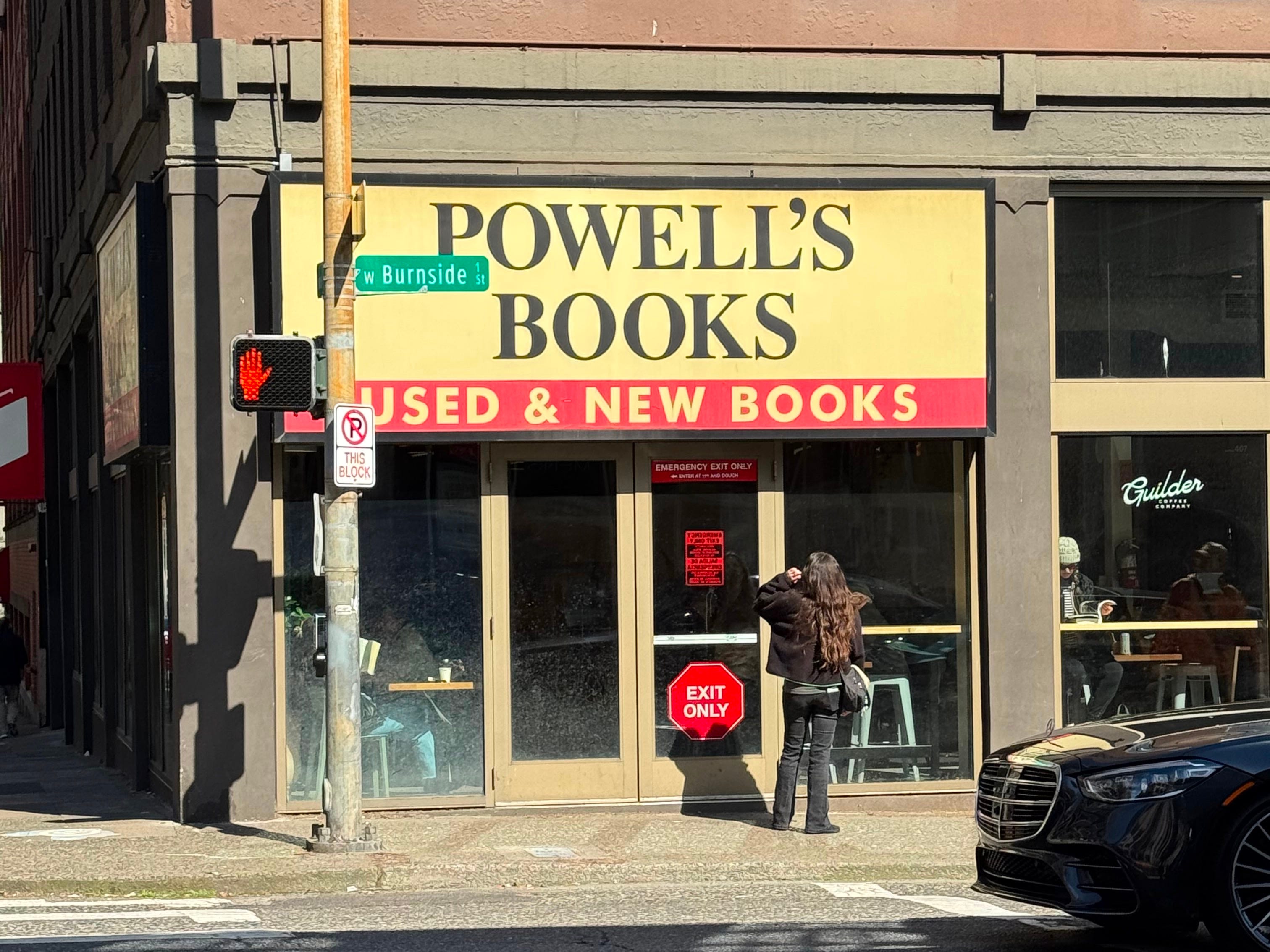
¶ First stop. ”The first thing I do in any town I come to,” said Robert Frost, “is ask if it has a bookstore.”
¶ World’s best narcotic, psychedelic, and stimulant. Some people do drugs. I prefer bookstores. The canny among you will say why not both?
Tempting, but I’ll stick with books.
¶ Natural habitat. A while back The New York Times followed actors around in the wild. Where do these strange creatures go? What do they do? Paul Giamatti’s favorite haunt? A used bookstore. “I like used bookstores more than new ones,” he told the Times. Why?
Because there’s just something about all the old books that feels more comforting and peaceful to me. I do have a big collection of books at home, and I actually had to get help from somebody a few years ago to organize it. I got rid of hundreds if not thousands of books about three or four years ago. And in the space of time since, I’ve almost reacquired everything I got rid of.
Naturally.
¶ The Fantastic Mr. Barton. I once worked at a used bookstore in Roseville, California, called the Almost Perfect Bookstore—a misnomer because it was, in fact, perfect. We had a loyal customer base including the fantastic Mr. Barton.
Mr. Barton was blind. Shabbily dressed in blue pants and short-sleeved checkered shirt with too many items crammed inside the breast pocket, he could actually read if he held the book up against the lenses of his quarter-inch thick glasses. And I mean up against. His nose would graze the crease of the book.
He loved fantasy and science fiction. Sometimes when I would shelve that section, he would stand there with his nose pressed into something by Philip K. Dick, David Eddings, or Stanisław Lem. He could always find his way to something interesting.
When not browsing the shelves, Mr. Barton would position himself in the middle of the passageway between a shoulder-high shelf of books and the cash counter near the front of the store. He stood there to talk with the staff with whom he possessed an incredible rapport. He could yammer on about anything and regularly conversed with the shop owner Kelley and other employees for two, three, four hours at a time.
Every now and then customers would queue up to the counter, a little unsure if he was in line. “Step aside, Mr. Barton,” Kelley or Amanda would say (he was always “Mr. Barton”), or “Make way, Mr. Barton.”
That was his cue, words he’d heard a thousand times before and would hear a thousand times after. He’d politely excuse himself (“Oh, I’m sorry”) and step back or step aside, usually pressed up against that shoulder-high shelf opposite the register, his white cane held vertically to his body, so as not to trip anyone passing by.
For many, he might’ve been an inconvenience, even a nuisance, but Kelley’s heart always held room for the fantastic Mr. Barton, the least likely bookstore patron in town.
¶ More to the story. Powell’s is a full city block. But there are other massive bookstores with legendary renown. To wit, Second Story Books in Rockville, Maryland, which shelves half a million used and rare books. Here’s Richard Morrison, a senior fellow at the Competitive Enterprise Institute, basking in all that glory.

Am I jealous? Of course.
¶ Missing out. And then there’s the Strand in Manhattan. I was recently in New York launching my book, The Idea Machine. Alas, I couldn’t pull away to shop. Story of my life.
When I was an acquiring editor at Thomas Nelson and regularly traveled to New York, I had a hundred opportunities and never made it to Mecca. Hopefully, I’ll paddle my way back up the Hudson in the near future. In the meantime, here’s a delightful video that salves my spirit and stokes my fire.
Just watching economist Tyler Cowen and book reviewer Michael Orthofer (who’s reviewed well over 5,000 books at this point!) shopping the Strand is a joy. And as the video title suggests, there’s good advice here for shopping any bookstore. Did I say “advice”? It’s really more about fanning out and looking for whatever grabs your eye.
¶ Regarding Henry. If you need to entertain Henry Oliver, Jared Henderson figured out the trick. I suspect this recipe might work well on any bookish soul. It’s worth trying on a few of your own out-of-towners and reporting back.
¶ Opinionated bookstores. If you’re going to be a big-ass store, you can shelve a lot of inventory. When I shopped Powell’s, for instance—a full city block!—I checked out several sections but only had about ninety minutes. So I narrowed my browsing to the literature shelves, massive enough by themselves.
Starting in the A’s and going letter by letter, I got as far as maybe the L’s. Where had that ninety minutes gone? Just browsing the Hemingway took me six or seven minutes.
But if you’re going to be a small shop, you have to be more selective with your stock. You have to have an opinion. Erik Rostad manages my local bookshop, Landmark Booksellers, in downtown Franklin, Tennessee. He argues every bookstore has an agenda, and those agendas, whatever they may be, are fine insofar as they go. After all, the owners set the vision; as patrons, we can choose to part with our dollars there or elsewhere. But there’s a business opportunity here worth mentioning.
While massive stores have gobs of inventory—so much choice!—smaller stores have something possibly better: a curated inventory that can more carefully and intentionally serve the local clientele. At Landmark, for instance, they have a massive installation along one wall, the Great Wall of Books. It’s all classics chronologically arranged. Gilgamesh on one side, Kurt Vonnegut on the other, and a world of treasures in between.
In a big-ass store, these books would be shelved all over, one in this section, another in that, all of them swamped amid the flood of titles. What might Plato, Dante, Dickens, and Philip K. Dick share in common? It’s easier to imagine the conversation those books are having at Landmark. And because of the superb merchandizing and selection, it’s almost impossible to walk out without purchasing something from that wall. I’ve tried and failed several times. (I don’t like losing, but I’m bearing up. Courage, friends.)

¶ Sharpening an angle. It helps to have an angle as a small bookshop, something that makes you unique—a destination. Little shops can’t compete on selection, but they can compete on selectivity.
Alabama Booksmith in Birmingham, Alabama, sells only books signed by their authors. The angle is so unique the New Yorker traveled to get a look and write it up. Ted Gioia explains the magic of the shop here as well.
Baldwin & Co. in New Orleans, Louisiana, is one of 306 black-owned bookstores in the U.S. When I was there a couple of years ago I spied Claude Atcho’s wonderful Reading Black Books on display. Black-owned bookshops are an anchor to local communities wherever they’re found and have a long and vital tradition.
Bestselling novelist Ann Patchett opened Parnassus in Nashville. As you might expect, the inventory reflects a heightened literary sensibility. And bestselling self-help author Ryan Holiday opened The Painted Porch in Bastrop, Texas. If you’re a fan of his work, wouldn’t you love to shop in his store?


¶ Buy from your friends. It turns out many Substackers run bookshops.
I mentioned Erik Rostad above and you can’t stop me from doing it again. Erik runs the show at Landmark Booksellers in my adopted hometown of Franklin, Tennessee. Erik also runs the Books of Titans podcast, where he’s reading through classics—incidentally, a great example of how a personal passion can inform a good business decision, vis-a-vis the Great Wall mentioned above. He is, as Spencer Klavan referred to him, “the marathon runner of the canon.”
David Kern runs Goldenberry Books in Concord, North Carolina, with his wife Bethany. He also runs Close Reads here on Substack.
Novelist Shawn Smucker runs Nooks in Lancaster, Pennsylvania, with his wife Maile Silva. Along with writing novels, such as The Weight of Memory, he writes The Courage to Live It here on Substack.
¶ Where we meet. “Wherever I go,” said Gloria Steinem, “bookstores are still the closest thing to a town square.”
¶ Not an easy job. The Almost Perfect Bookstore eventually closed. Happens, sadly, to a lot of shops. “With notoriously low margins, bookselling is a challenging financial proposition at the best of times,” says Chloe Fox. So, she did what any sane person would do; she dared opening a shop of her own, Fox & King: “the best, worst thing I’ve ever done.”
She tells the whole story in a wonderful piece for the Financial Times. It’s an inspiring account, one in which the whole community comes together to help her get it off the ground.
When her inventory arrives—some five thousand volumes worth about £20,000, randomly jammed in their boxes—Fox’s friends help sort, scan, and shelve the whole lot. “Robert McCrum,” she says, “a local acquaintance who happens to be former literary editor of The Observer, goes over my opening stock list with an expert eye and a red pen, simply for the love of books.”
On opening day, people entered with high hopes and fragile hearts. Some cried for the joy of finally having a bookshop in their village. Many told Fox she was brave to venture out. And they’re right. In Penelope Fitzgerald’s sad but wonderful novel, The Bookshop, the heroine fails to keep her little shop afloat. Still, Fox sold 150 books on that first day and she’s still in business.
¶ But actually, indies are doing pretty well. One of the great literary stories of the last fifteen years is the rebound of small, independent booksellers. The story was pretty grim at the turn of the century. With the rise of the mall chains, big box stores like B&N and Borders, and Amazon in 1995, indie numbers fell dramatically, precipitously, catastrophically. Nora Ephron got a movie out of it, but the rest of us watched our little favorites close.
Indies couldn’t be kept down forever. They began a remarkable phoenix-like turnaround in 2009, thanks in part to some of the features of small shops mentioned above: better, smarter merchandizing, catering to specialized interests, and so on. “Over the last five years,” reports Fast Company, “the number of independent bookstores in the U.S. jumped by 70%. In 2025 alone, 422 new bookstores opened, according to the American Booksellers Association.” More on that story here.
¶ Bookmobile. If you’d like to start a bookstore of your own, you could start small with a bookmobile. Here’s what you need to get started.
¶ Still going. “Historically speaking, bookstores are oddly, almost eerily, susceptible to disaster and scandal,” writes Oliver Darkshire. “In short, they go bust, they explode, people steal all the floorboards and make for the hills, and so on. Unlikely catastrophe and financial ruin follow booksellers like a vocational curse.”
Darkshire tells the story of Henry Sotheran Ltd. Sotheran’s, as it’s usually known, has—despite plenty of scandal and disruption—carried on for more than a quarter millennium now. It has a reasonable claim to being the world’s oldest bookstore.
¶ Cultural survival. “On a daily basis, bookshops—whose margins are already tiny—are finding their viability compromised,” says Booksellers Association president Fleur Sinclair. “But the huge cultural, social and commercial value of bookshops cannot be overestimated; it is crucial to the future of our society that they survive.” Overstating things? Only a skosh.
¶ Signs of civilization. “Bookstores are lonely forts, spilling light onto the sidewalk,” said John Updike. “They civilize their neighborhoods.”
We could use more of that.
¶ My little haul. After scouring the shelves at Powell’s I walked out with a few titles: Agustin Fernandez Mallo’s The Things We’ve Seen, Gabriel Garcia Marquez’s Chronicle of a Death Foretold, and Dorothy B. Hugh’s The Expendable Man. But the real win? I got to spend ninety minutes basking amid all those glorious books in a national institution. If you’ve never been, I hope you get to go yourself someday. I certainly hope to go back and see what’s between M and Z.
Thanks for reading! If you enjoyed this post, please hit the ❤️ below and share it with your friends (especially if they love a good bookstore).
Not a subscriber? Take a moment and sign up. It’s free for now, and I’ll send you my top-fifteen quotes about books and reading. Thanks again!


The casual “along with the groom” is everything!
A fitting and fabulous ode to bookstores - well said indeed, Joel!